MANLY MONDAY – “Blacksad” When Ex-Disney goes Film Noir

The Disney Company owns quite a lot of franchises these days: From Star Wars to Marvel, the Big Mouse has accumulated a vast gallery of rights, artists and studios under its white-gloved hands. Many wonder what Disney doesn’t own at this point.

This poses a more important and certainly more intriguing question: What if someone leaves Disney? What do they do after their time at one of the biggest companies in the world? Here is one of them: Juanjo Guarnido.

Juanjo Guarnido, born 1967 in Spain, always had a love for comics. He drew and joined many fanzines, gained the attention of Marvel, and started doing work for them. In 1993, Guarnido became an animator at Disney Animation Studios in Montreuil, France, and I am fairly certain that you have seen some of his animation work: strong and classy “Helga” in Atlantis: The Lost Empire, the expressive and emotional “Hades” in Hercules, and he was the lead animator of villainous leopard “Sabor” in Tarzan.

However, Guarnido decided to leave Disney and to rejoin with one of his older friends from his comic days in Spain: Juan Díaz Canales – they had been discussing producing comics together for a long time. And so, both of them came together as an artist-writer team to produce their own original comic, which was published in 2000: Blacksad.

They surely couldn’t imagine what this comic would later become: Universally loved by critics and the public, a strong, respected and recognisable franchise with 5 comics in total, and several outstanding awards, such as the Eisner Award in 2011 for the whole series. Let us take a look at this wonderful graphic novel:
68d33259fd0a85a9a028db27ad0a9db3

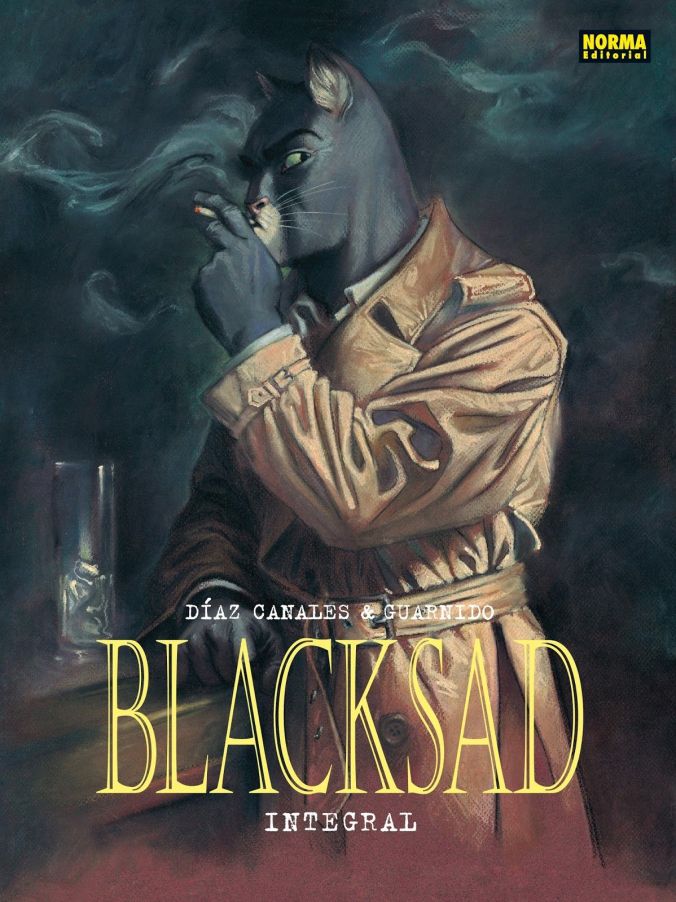
[Spanish Complete Edition Cover.]

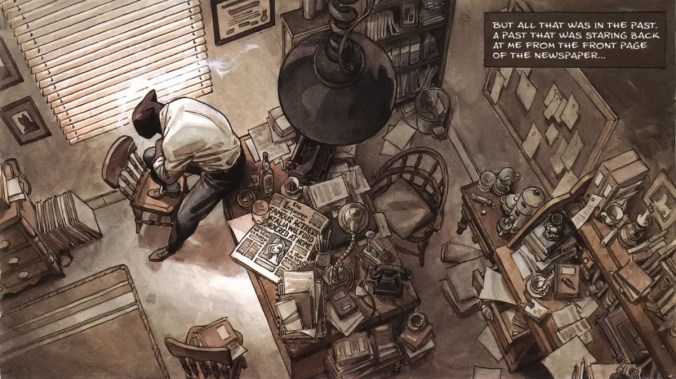
Blacksad is the story of the title-giving John Blacksad, black cat and private detective. His cases range from investigating a murder, to being a bodyguard, to simply fighting for his life which has gone downhill. Blacksad himself is the classic Film Noir protagonist, complete with badass traits and strength, but also emotional vulnerability and other flaws. The first volume, Somewhere Within The Shadows, shows the broken cat man in his messy yet functional office, telling of the character that works here.
blacksad-2

Guarnido’s backgrounds are brimming with detail.

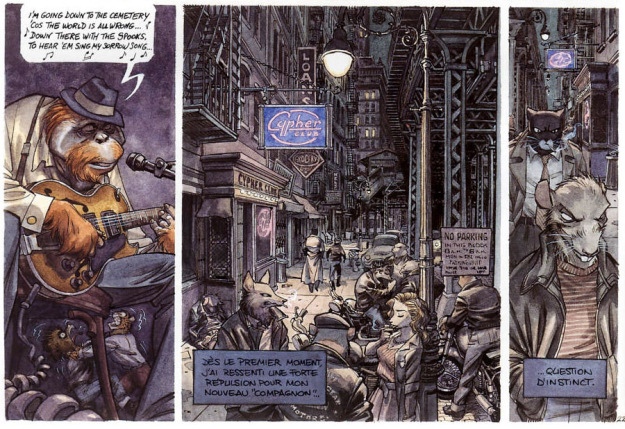
The first volume is a celebration of all that makes the Noir genre, chiseled men who believe in justice, bad guys who must be defeated, shady bars full of questionable characters, and a looming sense of villainy seeping through every rusty crack of the city. The Blacksad series is the distillation of 1950’s America: freedom, style, beatnik, jazz, but also racism, inequality, street violence, and everpresent crime.
blacksad_within-shadows_2000_03.jpg

Every volume plays in a different setting with a different theme, keeping the feeling fresh and interesting, with a reoccuring cast of colourful characters introduced slowly over time. And of course, these adventures will be intense, as the hardboiled genre asks it – action will go down.
blacksad

C54FNQ5

blacksad19

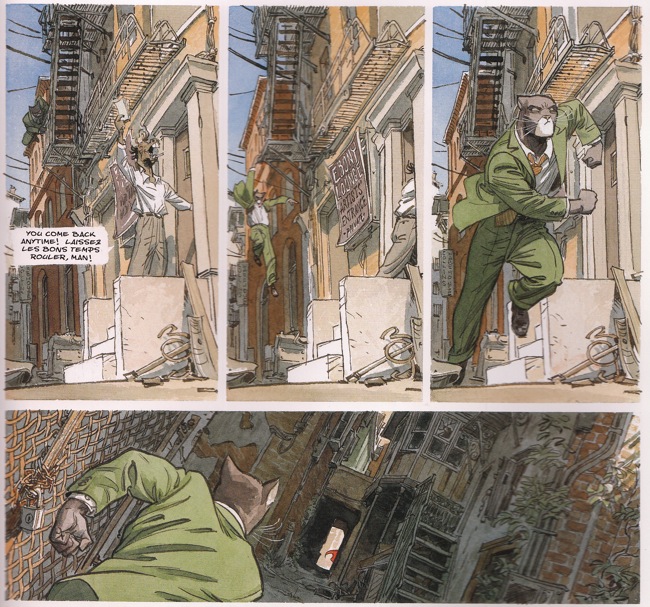
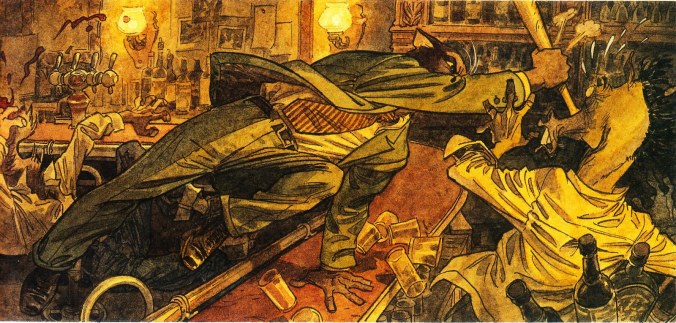
Action inBlacksad” is strong, clear and perfectly framed.

Here is where Guranido’s artwork shows its pure strength: Due to his experience as an animator, of drawing art in motion, he is masterful in his depiction of movement. Shots, punches, beatdowns and explosions all look visceral, right in the execution, as if stopped in a wonderous intense timeframe where one can look at all the details that only a comic book can allow.

If you wish to explore his animation style a bit closer, to also understand his way of framing action, look no further than his animated music video Freak of the Week by Swedish metal band Freak Kitchen. This 5-minute kickstarter-funded marvel is filled with some of the most vivid and expressive character animation in recent years, showing musicians in their fiery strong element, with rough outlines full of camera turns and fluid motion.

Especially that wonderful metal hair animation, fantastic. Sakugabooru.

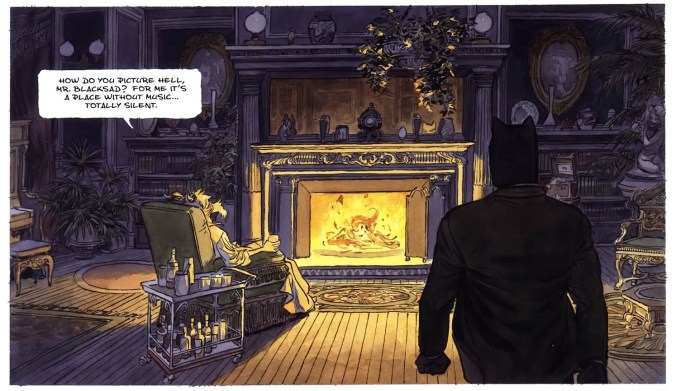
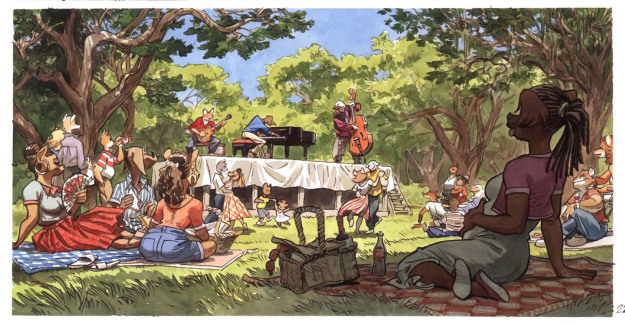
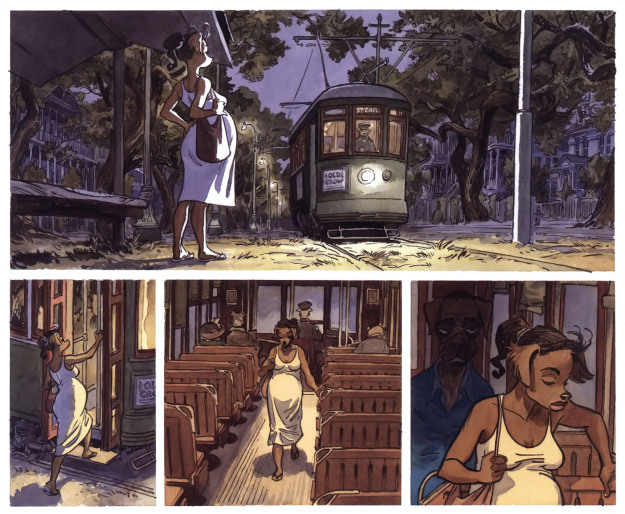
But not only is the action stellar, the colouring and lighting are wonderfully crafted as well. The watercolour settings spring to life, with astonishing detail and such a graspable sense of space that one wishes to simply step into the frame.
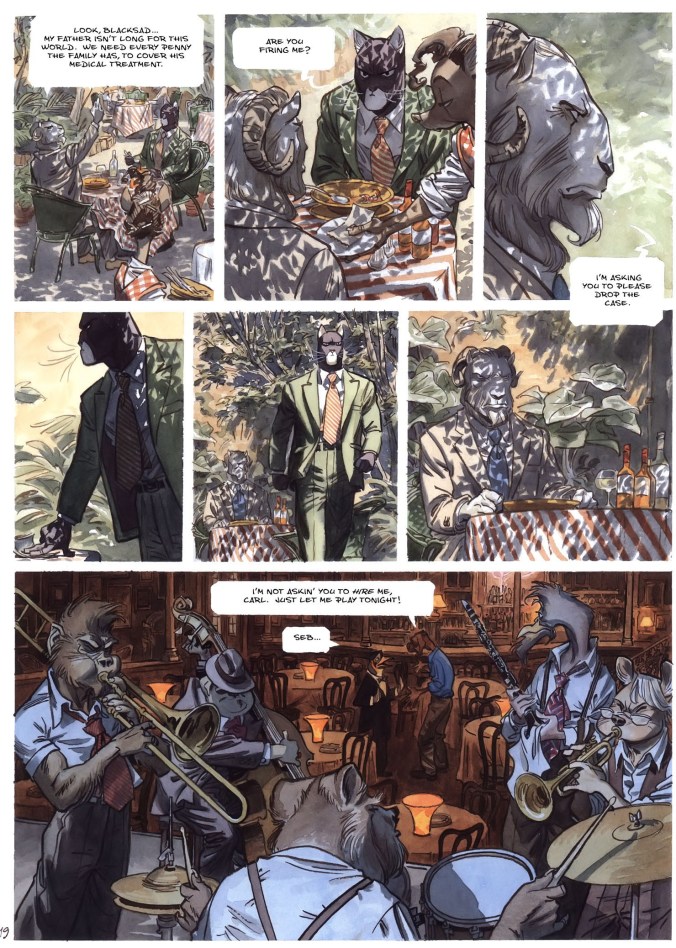
blacksad_a-silent-hell_2012_02blacksad_a-silent-hell_2012_04blacksad_a-silent-hell_2012_03blacksad_a-silent-hell_2012_06

All frames from Vol. 4, “Hell, Silence”, which focuses on the world of jazz.

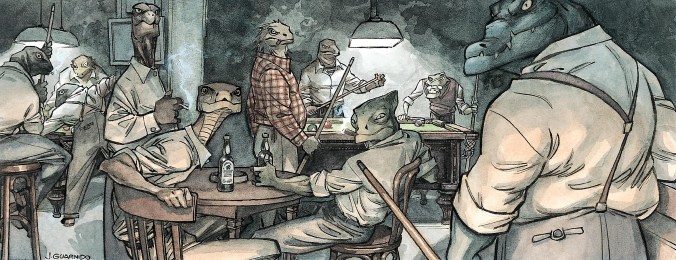
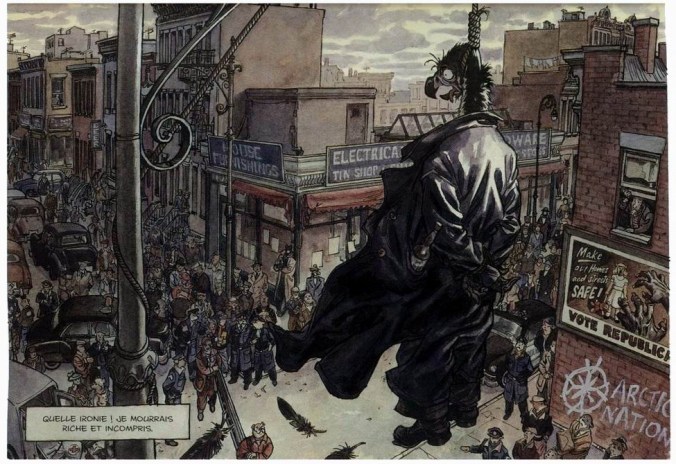
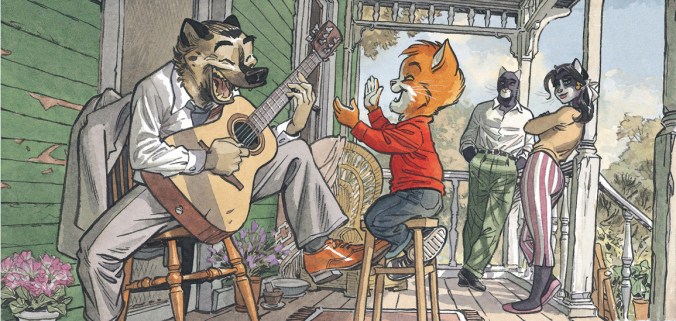
To adress the elephant in the room and the reason many people start this series in the first place: the world is inhabited by anthropomorphised animals. And to see these Disney-esque character designs in dark stories is intriguing as a concept in itself. Together with the brilliant execution and talent of artist Guarnido and writer Díaz Canales, it has an inescapable charm and fascination – and when these bright character designs clash with the harsh reality of society, it is exponentially more shocking.
blacksad-5-750

From happy times with friends…

565587.jpg

…to shady places of the underground…

blacksad_arctic-nation_2003_02

…to the hatecrime against a black-feathered bird in a small town.

This “Disney but not-Disney” feel is one of the main points that draws readers initially in. These themes and topics would never be touched by the family friendly corporation, but with Blacksad, it opens the possibility to a dreamland what-if scenario: What if Disney had never left 2D animation, and had started becoming adult with its content?

However, one should not reduce this graphic novel series to the past of one of the creators. These are expertly crafted comic books with masterful artwork, and I highly recommend that you experience this series yourself. (There was even word around of a Hollywood adaptation with a budget of up to 100 million dollars, however, the project seems to be stuck in development hell since 2009. This is not a problem, as the comics can easily stand on their own.)

An additional note I want to make here: Blacksad was released in France first, and was thus intended for the standard publishing size of that market. Franco-Belgian comic books have a larger format than their international brethren, which is perfect for detailed artwork and has a long tradition in itself. Hence, I would not recommend buying Blacksad digitally, as it can easily lose its impact on a small screen. Treat yourself to the physical release of your choice, Collector’s Edition or single volumes, and enjoy Blacksad as it was intended.

20180525_101112.jpg

From left to right: manga size, American comic size, and the French standard size. Above, you see the full effect of the artwork if the book is flipped open.

Blacksad is a fantastic graphic novel series that I would recommend to anyone who is even remotely interested in comics, artwork and/or colouring. For fans of the Noir genre, this is an absolute must, and even if you are not into the genre – open the pages and let yourself soak in this retro atmosphere of a time long gone, now told with a charismatic cat man by a beloved and insanely talented artist/writer duo.
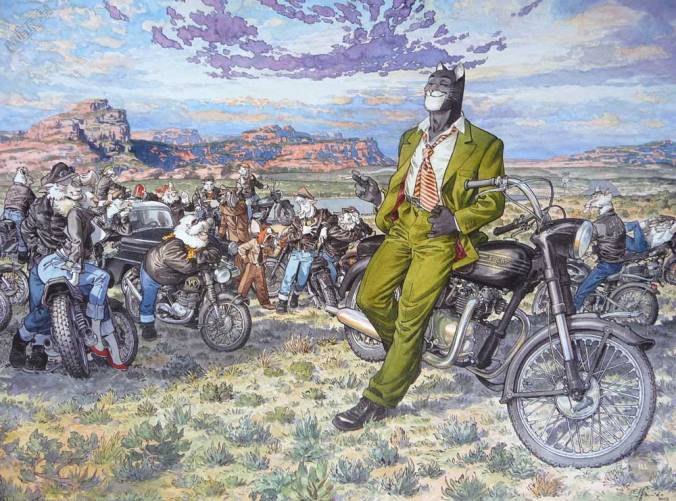
juanjo-guarnido-affiche-art-poster-bd-deco-illustration-blacksad-amarillo-road

The End.

Sources: Wikipedia “Junjo Guarnido” “Blacksad”, Disney Wiki “Juanjo Guarnido”, Sakugabooru.
MANLY MONDAY – “Buraiden Gai”: The Unique Shonen Outlaw

wwwww

It is a good time for Nobuyuki Fukumoto’s works. Gin to Kin and Akagi both have successful TV dramas, the Kaiji manga has started a new arc, Zero is getting a steampunk TV adaptation, and the highly anticipated Tonegawa anime is on the horizon, with a release scheduled for July 2018.

In this big “Fukumotoverse” with its prequels, sequels and spinoffs, lies one smaller work that is on its own. No continuation, no adaptation, there it stands, alone and completed – fitting for its own story, themes and characters.

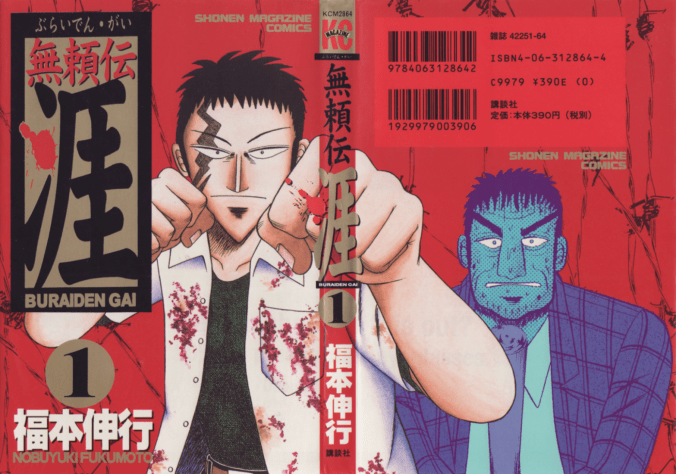
This is the manga Buraiden Gai, or “Legend of Outlaw Gai”. This manga was published from 2000 – 2001 in the Weekly Shonen Magazine, (not related to JUMP) which has more popular and successful series in the past and present than you might think: Devilman, Ashita no Joe, Hajime no Ippo, GTO, and recently, Koe no Katachi, Fairy Tail and AKB49.

In Buraiden Gai, the eponymous Gai, a young 13 year old schoolchild, is running. Running away from the police.

x14

And so, he is cornered in a dead end street.

The city is in chaos, the media is all over the place and the police is unable to cope with all this confusion. Why is everybody on their feet trying to catch this young boy?

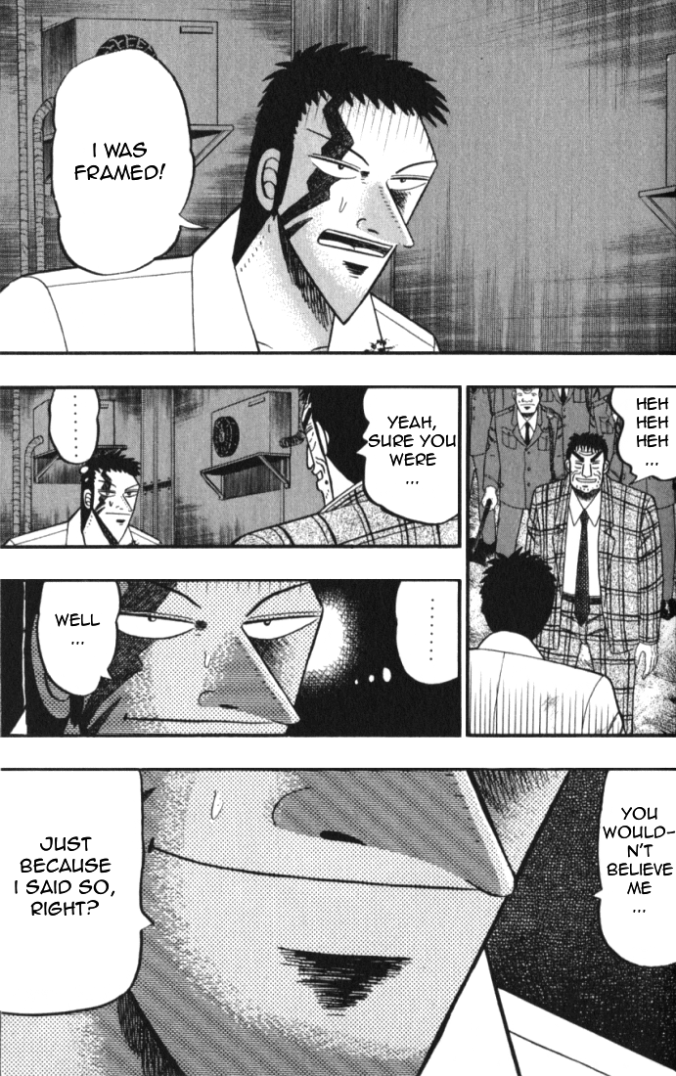
As it turns out, he murdered an older man. Not any man, however, but the patriarch of a big and influential yakuza clan. As Gai faces the overwhelming police force with nothing but his bare fists, he proclaims: “I was framed!”

x28

Of course, no one believes Gai.

The evidence points absolutely against Gai: his fingerprints are on the murder weapon, on the body, at the site and his escape from the crime scene is recorded on a security tape, directly after the point of murder.

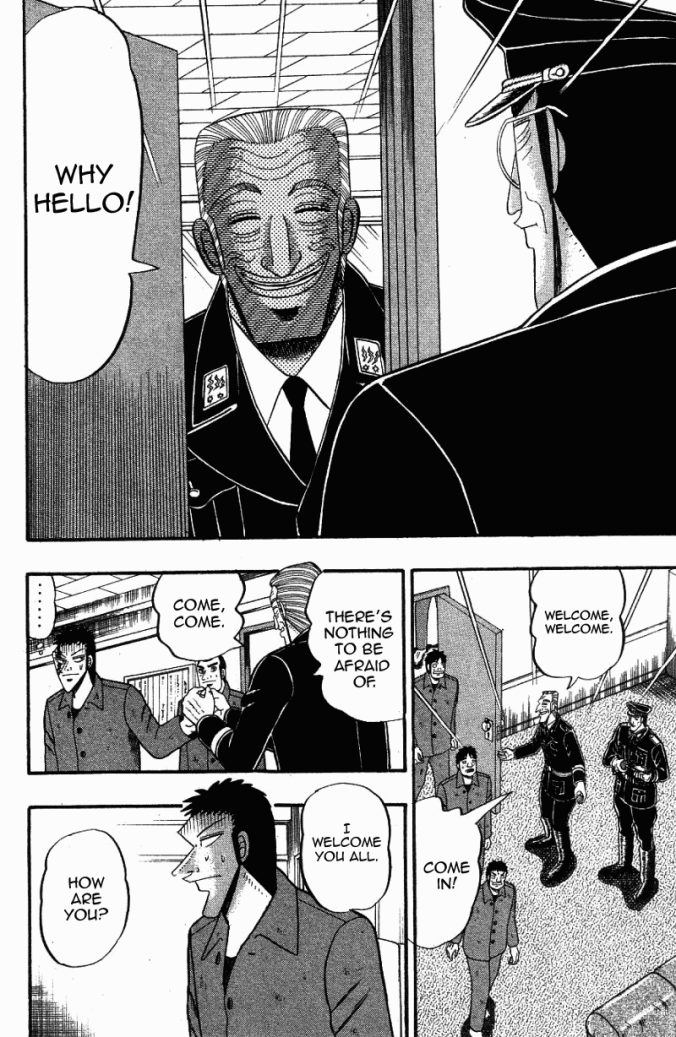
After a long verbal battle and a short physical one with the police inspector, which Gai surprisingly wins despite his age and size, he is arrested. Too young to go to prison, he will be sent to a youth rehabilitation facility before his trial. However, as he arrives, he finds out that this is not better than prison, in fact, it’s worse.

x8 (2)

Something is fishy. Especially the visual historical weight of those uniform designs, if you look at them more closely.

This is more than prison, this an institution of cruelty with one goal only: turning young people into honourable and upright citizens, with any means necessary. It immediately becomes clear to Gai: He has to get out of here, but more importantly, he has to prove his innocence. The police officer believes him, however, there is no proof that the evidence is forged.

And so, the adventure of Outlaw Gai begins: Regain your freedom, fight for justice, crash the abusive system of the adults. “Prison Break Plot” meets “Philosophy Hour”.

Inherently, this sounds like a very Shonen plot, but the seriousness and intensity of Fukumoto’s Seinen spirit shines through, which I will not spoil here. The way the young prisoners are treated is very violent and shocking, and the themes he addresses are important to anyone, not just teenagers who are the target group of this manga. And it is definitely not for the faint of heart. There will be violence and questionable “education” methods, ranging from physical discomfort to psychological terror.

We see several themes in this manga: What is “freedom”? What is “strength”? What does it mean to “grow up”?

x5 (4).png

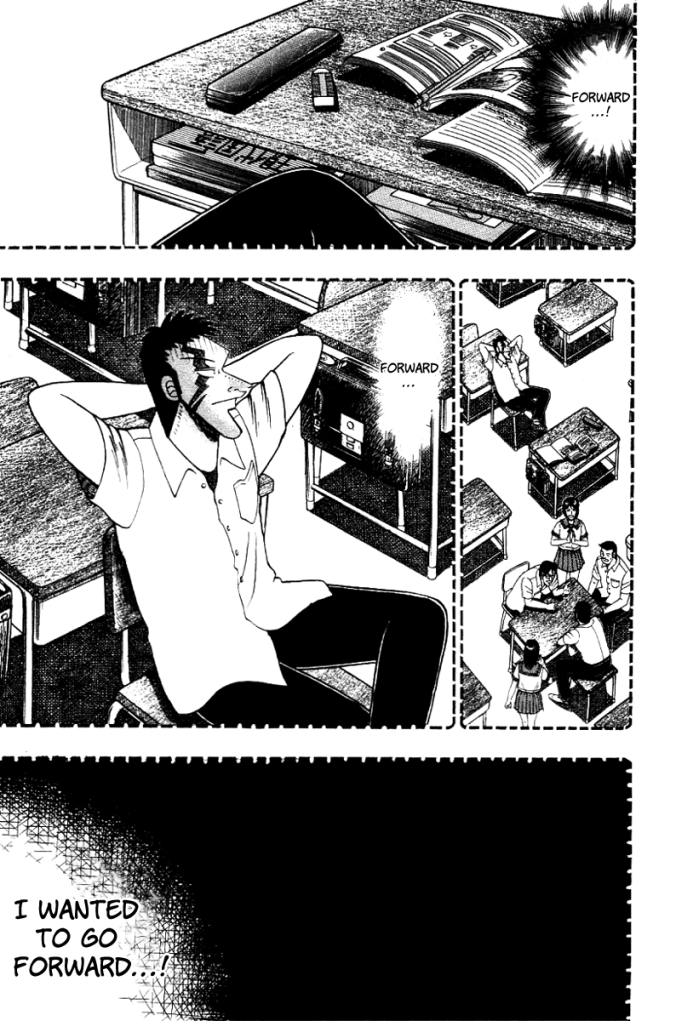
School settings are rare for Fukumoto, and thus very welcome.

Gai is a great protagonist for this story: young, with a clear, straight outlook on life, and he does what he thinks is right. He receives a proper backstory as well, which fleshes out his character even more – a rare thing for Fukumoto, who normally does not give big flashbacks to his protagonists, as they are characterised by their actions in the present, such as Kaiji, Akagi or Kurosawa. For Gai, it fits, as we see him in his middle school days, struggling with the decisions of life before he was thrown into the prison setting.

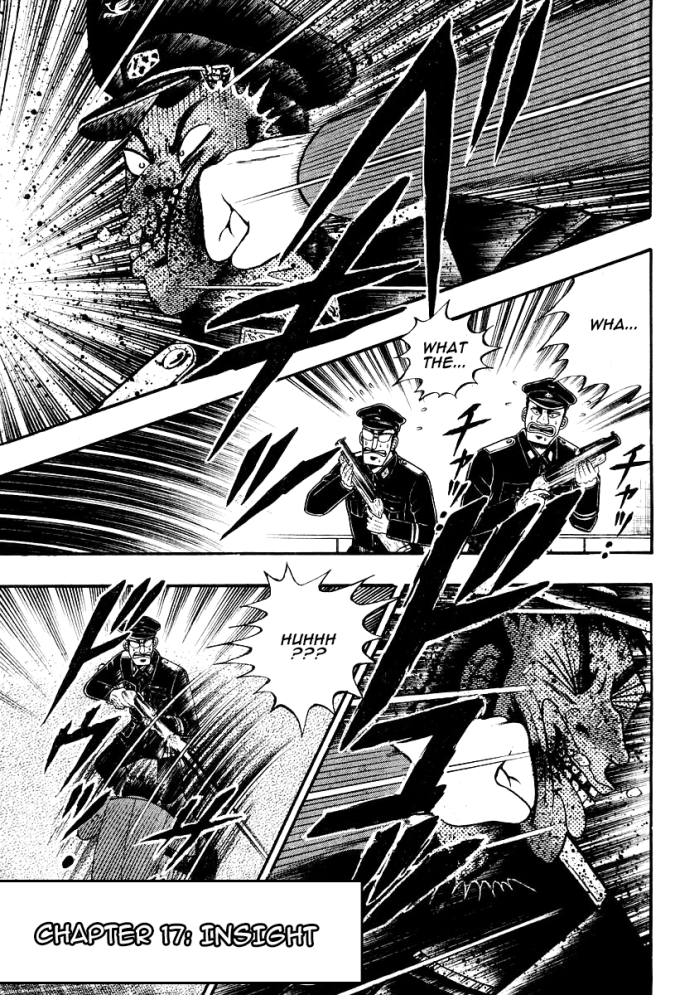
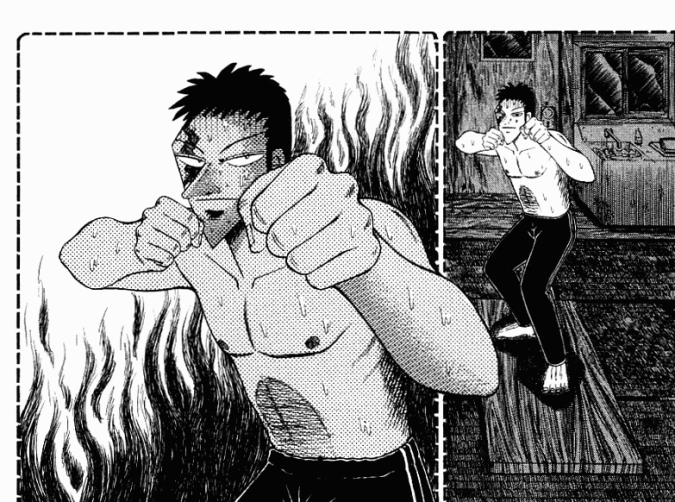
And much like Kurosawa, Gai uses predominantly his fists to solve problems. Fukumoto’s intense, visceral, sharp style lends itself perfectly to these violent outbursts that carry gravitas within the story.

x1 (3).png

Smash the system. Right in the face.

If there is one word I can use for Buraiden Gai, it’s “condensed”. With its 5 volumes and 38 chapters in total, it is one of the shortest series Fukumoto has ever done, some of his series have been going for over 20 years – and yet, it brushes and discusses a lot of topics, through flashbacks, monologues and dialogues, all neatly woven into the story, which is equally busy: a prison break and a yakuza crime story all rolled into one.

From my research, I could only find information that the series was cancelled by the Weekly Shonen magazine, and that Fukumoto was unhappy with the ending he had to re-write, but nothing very concrete or any reasoning behind the decision to scrap it. As it stands, I like the ending, but one can feel the change in direction in the story. After about 3/4 of the chapters, the focus shifts and the narration speed slows down for a few chapters, only to pick up again – most likely to steer into the direction of the new finale.

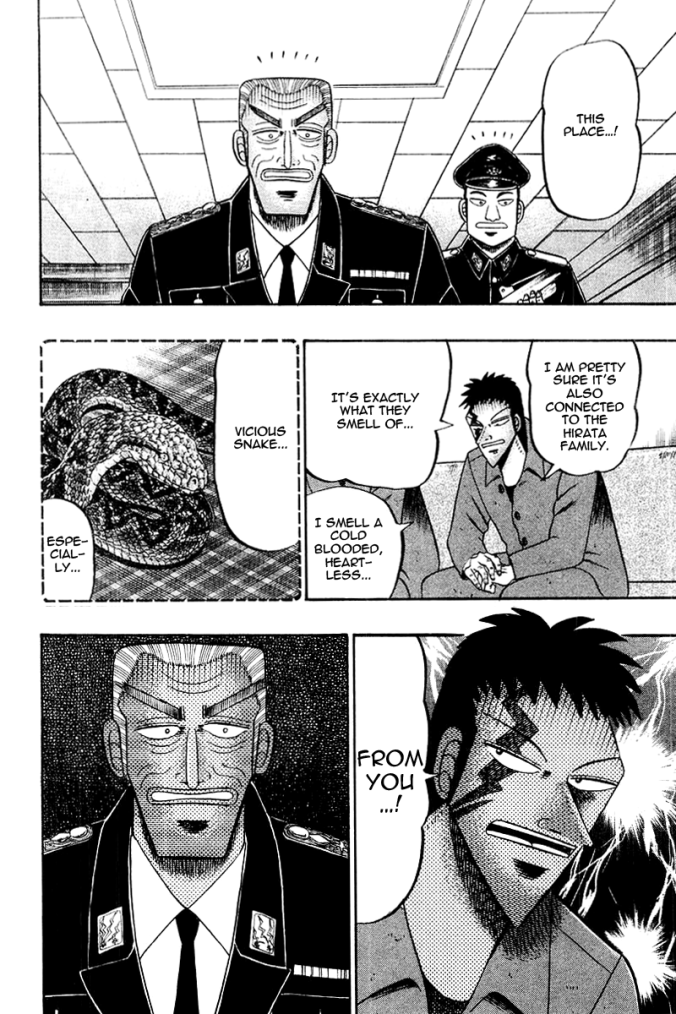
It is a bit sad that Buraiden Gai was not allowed not fully unfold itself, as the potential is there. A young hero with a no-nonsense direction but lacking life experience and maturity, against a smooth-talking villainous prison guard who thinks his own askew methods of education are right. In addition, the Hirata Clan, the powerful yakuza family, is maybe holding more threads than they seem.

x18 (2).png

Everything is connected. Is there a way out for Gai?

Even if the story is cut short, it still delivers the themes and questions it wants to. One can only wonder what it would have looked like if Fukumoto had the time to give it the vision he intended. Buraiden Gai could have been a big epic about the struggle of growing up and wishing for independence, as well as the conflict of generations. But as it stands, it is now a short, quick Shonen that delivers its punches and disappears again into the night, to leave you with its thoughts. Other Shonen might have pushed the boundary already what goes on in the genre, from Go Nagai’s Devilman to Hajime Isayama’s Attack on Titan, both violent and intense as well, but Buraiden Gai manages to even stand out among these. If a series can make me actively queasy with its ideas without being too graphic, then we got something unique here.

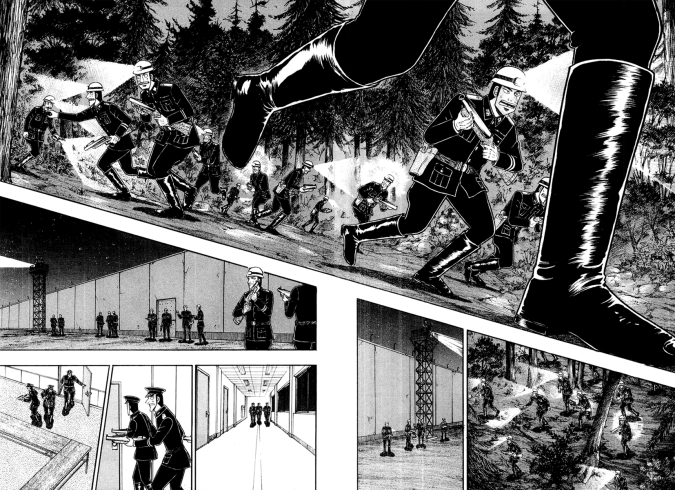
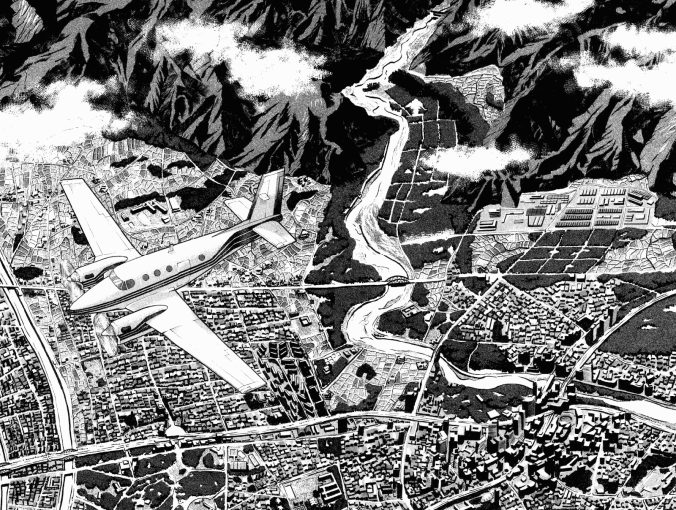
You can read all of Buraiden Gai in one or two days, maybe even in one sitting, and I highly recommend doing so. Not only for its intense story and philosophy, but also for Fukumoto’s artstyle. His longer stories rarely change settings, but Buraiden Gai displays a surprising amount of setting changes, brought to great effect in great spreads.

x5 (8).png

x14 (2).png

Some double-spreads are absolutely beautiful.

Buraiden Gai is the unique little Shonen outlaw in Fukumoto’s catalogue, without gambling themes or spinoffs, and I highly recommend reading it – for seeing what can be done in a Shonen Magazine, and for its philosophic content that it delivers with a sympathetic, strong and likeable protagonist.

The series had no time to show its true potential, but what it did was great, and it can nicely sit with all the other Fukumoto series in a big serious universe full of intense life stories. Will Gai break out of the youth detention prison? Will Gai defeat the yakuza? And will Gai find what he wants in life?

Give Gai a chance, he won’t take much out of your time, but I’m sure that he will stay with you for a longer while.

bura

The End.

PS: And once you’re done, check out this fantastic mock-up of an Anime OP, in the style of the Death Note OP2.

Sources: Wikipedia entry: “Nobuyuki Fukumoto”, MyAnimeList entry: “Weekly Shounen Magazine” and “Buraiden Gai”