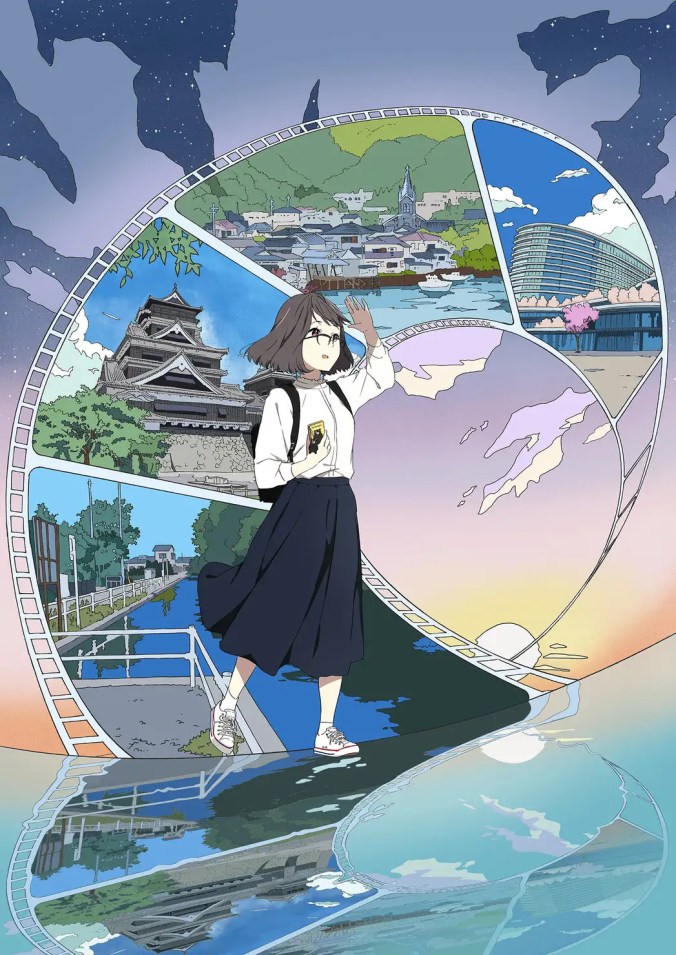
Natsunagu – The Importance of Community and Online Friendships

natsunagu

Anime seasons come and go. Every “season” is about 3 months long, and there are four each year, starting with Winter, Spring, Summer and finally Autumn. Each one of these seasons brings a new wave of anime to an international audience, who are more than happy to consume the tasty new media on the market.

However, with these many new releases, not all of them get the attention they deserve, and some even outright sink in this ocean of novelty – underrated, underwatched, forgotten. For me, those are the interesting ones, the ones that are far away from the bustling mainstream of long-awaited manga or light novel adaptations. Because in this little “underwatched” pile can be small gems, if you have the patience and curiosity to uncover them.

And one of those I would like to present to you, from Winter 2020, the anime short series: “Natsunagu“.

Story

vlcsnap-2020-04-12-13h35m19s531

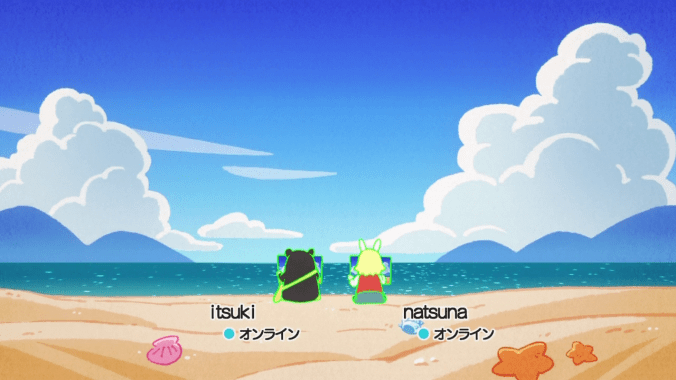
Protagonist Natsuna, chatting with her online friend, Izumi.

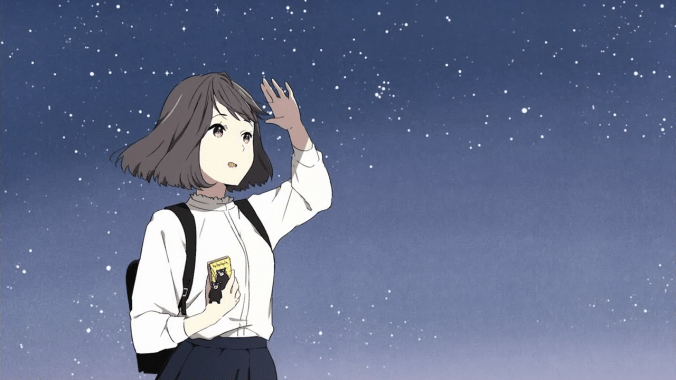
College students Natsuna and Izumi have been friends online for many years, but recently, the contact has calmed down a little. They often drew art together and shared many stories about their families and other worries. Despite never having seen each other, only their cute little avatars, they are good friends who can trust each other.

However, one day out of the blue, Izumi messages Natsuna that she wishes to see her.

In real life.

But before Natsuna can answer, the social media platform they had used all these years to communicate shuts down. With this unexpected and sudden course of events, they have no more means of talking to each other.

Natsuna is worried, especially since Izumi wants to talk with her now. She only knows one address, from way back when, and she knows that Izumi lives in the prefecture of Kumamoto.

With no more means and leads, Natsuna decides to go to this address, and check if her online friend is alright.

But as Natsuna arrives at the rural airport of Kumamoto, she soon is faced with the ugly truth: The address is too old. The house that once stood there was destroyed in an earthquake a few years ago.

With no more money in her pockets and no idea where to go next, a small road movie unfolds – to find her beloved online friend Izumi.
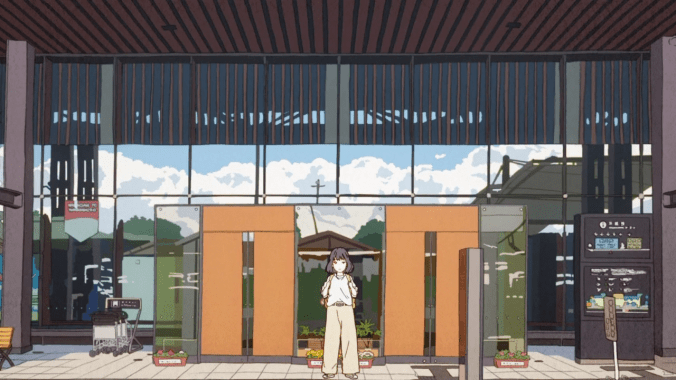
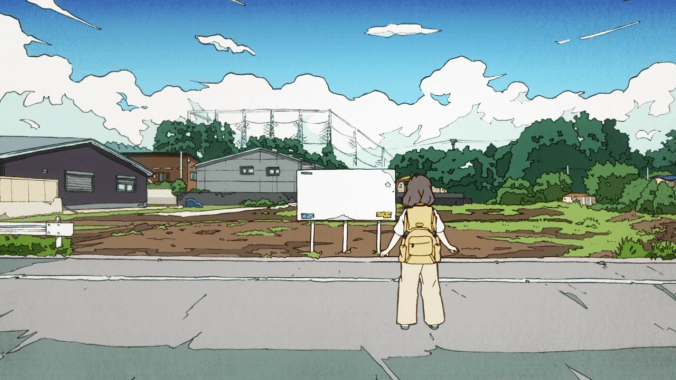
vlcsnap-2020-04-12-13h35m39s335vlcsnap-2020-04-12-13h35m53s805

Unknown region, no more house, and flat broke: It’s not looking good.

In 12 short 4-minute episodes, we follow Natsuna in her quest to find Izumi, and it will take a lot of help from locals and newly-gained friends.

And these characters in this rural town have a true core underneath it, which is worth looking at.

Fictional Characters, Real Setting

The region of Kumamoto is a real prefecture in Japan which suffered a major earthquake in 2016. And if you look closely in the credits of the anime, you can see that this anime was indeed produced by the Kumamoto prefecture.

This anime was intended to be not only a tourist advertisement for the prefecture, with real life sights and places, but also to raise funds for the rebuilding projects after the earthquake: A region paints a picture of itself to help itself.

And so, the region in this anime is real, but inhabited with fictional characters. Colourful locals from different professions, and they all try to help the protagonist out. If you look closely in the ED of every episode, you can see that the characters depicted change, depending on the story.
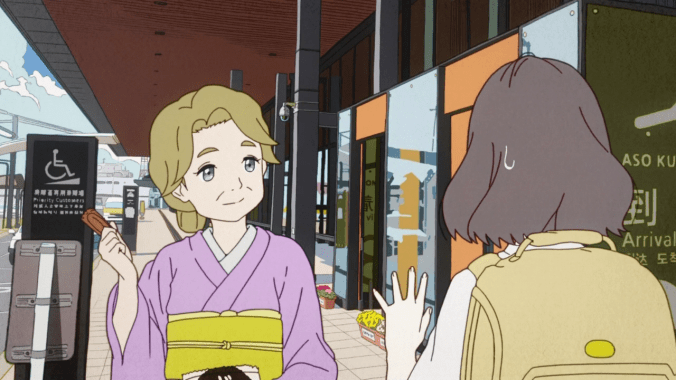
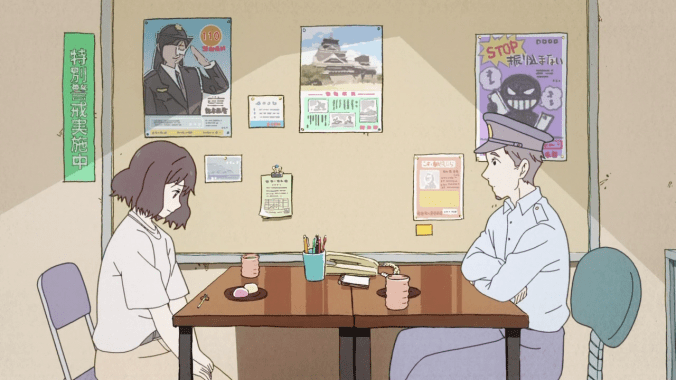
vlcsnap-2020-04-12-13h35m47s026vlcsnap-2020-04-12-13h36m26s613

The friendly grandma, or the supportive police man from around the corner.

If one were cynical, they might think that this initial setup would just end in a big advertisement that is either sappy or hollow, but it has a purpose within the story. These people show our protagonist what is important: community. More specifically, an offline community, which can help her to find a member of her online community that got shut down.

It is important to support and help each other, and to listen to each other if someone is in need. And even more so if it’s a person you care about. This small rural town in Kumamoto acts as a network in which Natsuna has to find and restore her connection with her online friend.

And as you can imagine, it’s not going to be easy.
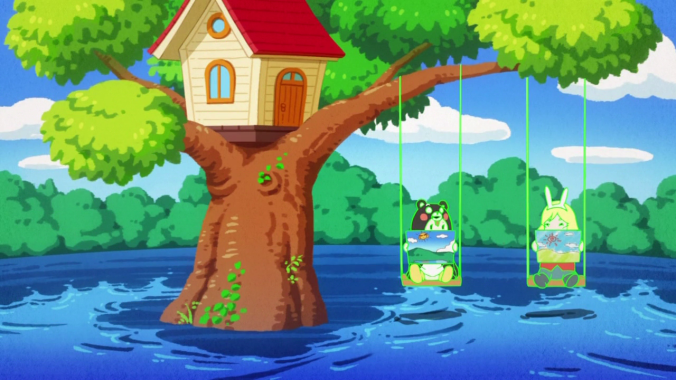
vlcsnap-2020-04-11-23h37m40s544

In their online world, Natsuna and Izumi used to draw together.

As the series is very short, 12 x 4 minutes, -1 minute for recap and ending, you can watch the entire season in just over 35 minutes. And yet, in this short span, this series managed to deliver an emotional punch in the end that I hadn’t seen so far in anime.

Online relationships can differ a bit in how they perform, if you only have text messages to communicate, without voice or body language. But they are just as valid and important as relationship in real life, even if they have different rules.

If you think about them yourself, what do they mean to you? A friend not reacting to an emotional post you did? Someone leaving you on read? Getting ghosted and ignored by someone you are close to?

And the anime tackles some of those internet-specific rules of online friendships and behaviour that are worth exploring and addressing.

vlcsnap-2020-04-11-09h18m13s564

The mascot of the Kumamoto prefecture: Kumamon, the bear!

Conclusion

“Natsunagu” is certainly not perfect or the “next underdog masterpiece”. It sadly feels way too short, the themes that are addressed could take far more exploration – but it could also be easily expanded into a full-length slice of life anime one day.

However, as a small underwatched snack, it is exceptionally pleasant. The style is soft, the outlines are in many different colours melding into the whole pastel aesthetic. The director, Yasuyuki Honda, had only worked so far as a storyboarder and episode director on larger series, (Aikatsu!, Gurren Lagann, Saint Seiya Lost Canvas), this is their directorial debut. But I would love to see more of them in the future, as this style is far too precious to be only used in an anime short series.

I would like to recommend this tiny anime, simply for the niche status it has, and  for the heart it displays – for its own real life community and the small story of saving an online friendship.
vlcsnap-2020-04-11-23h35m57s621

vlcsnap-2020-04-11-23h38m48s854

THE END


Thank you for reading!


Sources:

https://en.wikipedia.org/wiki/Kumamon

https://en.wikipedia.org/wiki/Kumamoto_Prefecture

https://www.animenewsnetwork.com/encyclopedia/anime.php?id=22911

https://www.animenewsnetwork.com/news/2019-11-17/kumamoto-prefecture-produces-natsunagu-tv-anime-for-january-2020/.153378


MANLY MONDAY – Lupin III Part IV “The Italian Adventure” TV Series – (Review and Episode Recommendations)

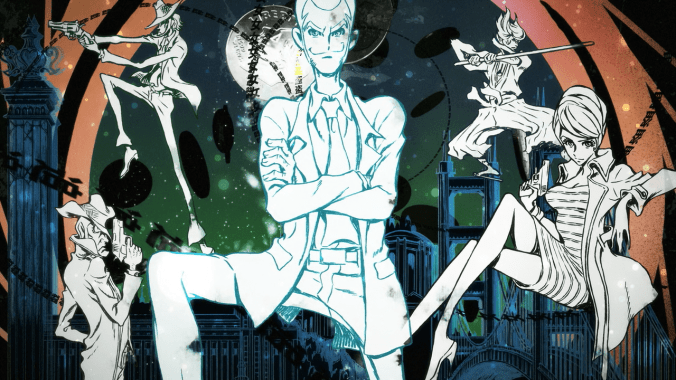
lupins 2015.jpg

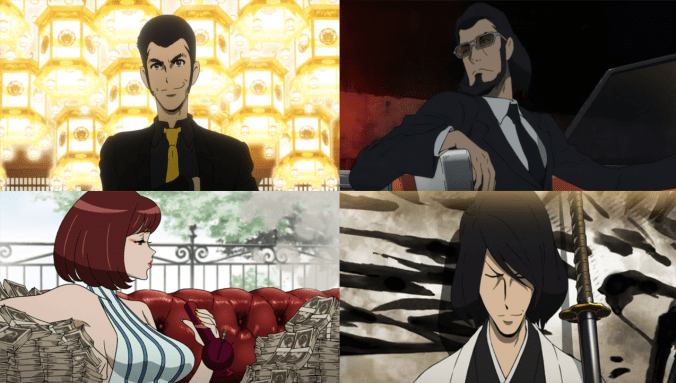
In one of my latest Manly Mondays, I talked about the Lupin III films by director Takeshi Koike, and how the hardboiled tone really fits the series.

As already mentioned in that article, the beauty of the now 50 year old “Lupin The Third” franchise is that it comes in many shapes, zeitgeists and forms: long running TV series, big cinema releases or short-running experimental shows.

Koike’s films in 2014 and 2017 were intended for a mature audience, given the depiction of violence and intensity of the themes it portrayed, and director Saya Yamamoto’s entry in 2012, A Woman Called Fujiko Mine, was equally adult – yet with a different focus as it explored sexuality and identity of the long-established characters.

However, Lupin III had always long-running TV series as a main focus, which were split into “Parts”. In addition, each of these Parts had a different suit jacket colour for protagonist Lupin to wear, so that it was immediately clear from the first glance which series you were watching: Part 1: Green Jacket (1971-1972), Part 2: Red Jacket (1977-1980), Part 3: Pink Jacket (1984-1985).

Each “jacket colour” is also unique in feel and tone, I highly recommend checking some episodes out to see what you might like the best. As these series are very often of episodic nature, you may pick and choose to your heart’s content.

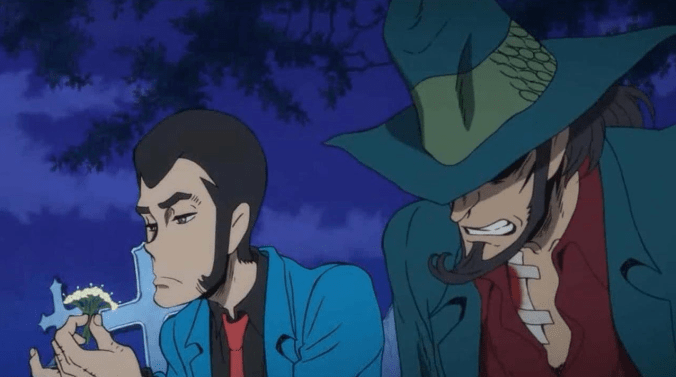
And in 2015, a new TV series came around – Part 4: Blue Jacket (2015-2016).

Let’s take a look at this new series in retrospective, what did it do and what was added to the long-running legacy of the franchise?

lupin2.jpg

A Love Letter to Italy

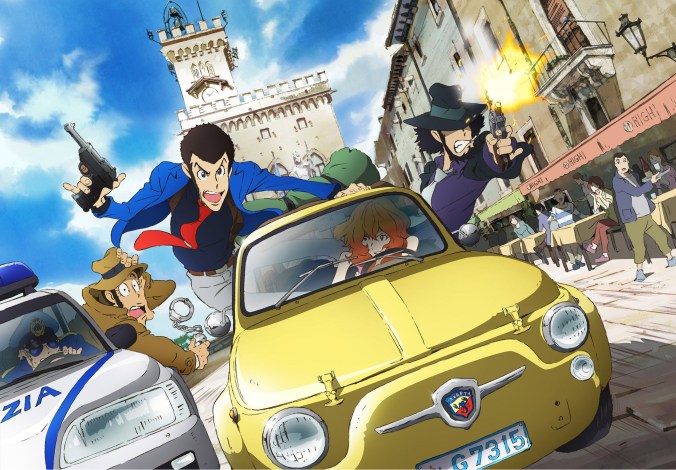
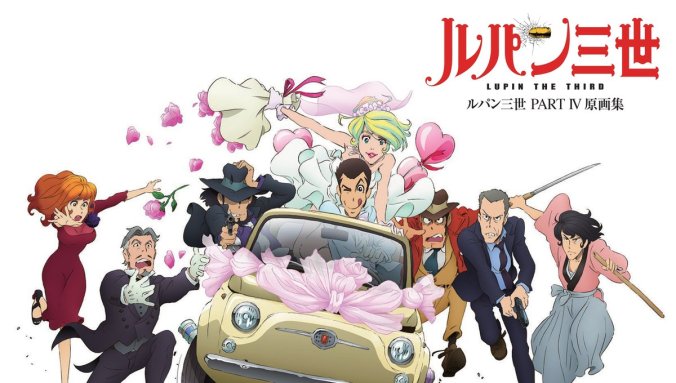
The story of Lupin III is very much grounded in the usual set-up: Lupin is a thief, roaming the lands with Jigen, his gun-slinging friend, in a tiny yellow Fiat 500, where they will be entangled in all sorts of adventures. On this journey, they will be supported by Goemon, a friendly yet stern samurai, and Fujiko Mine, a rival thief and love interest to Lupin. They are constantly chased by Inspector Zenigata from the ICPO, whose only goal in life it is to finally bring Lupin behind bars.

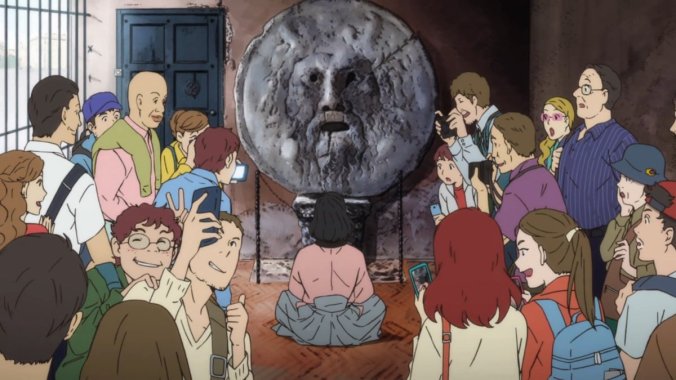
Lupin III Part 4 “L’avventura italiana” takes place, as the title says, in Italy, which makes for a gorgeous setting. The Mediterranean feeling with the sunny, bright lighting is always is a beautiful sight, and as the team has to flee and chase very often, we see a lot of Italy – the countryside, the beaches, the castles, and old inner cities.

city

goe castle

Dgzvjv-WkAEjVqs

Dg75pVHXkAAhD__.jpg

Apart from the usual sights and landmarks, the care that went into the details is astounding: euros are used throughout as currency, license plates are in the European style, and even newspapers, signs and police cars are in Italian, really selling the setting as a graspable place to be. In addition, Part 4 aired in Italy before it did in Japan, which is unusual, but fitting for this series, as Lupin III enjoys its cult status in this country.

New Friends and Foes

88c52a5142354d12ba114dbf38ce9285.jpg

Part 4 brings some new additions to the usual cast, most notably Rebecca and Nix. It’s difficult to introduce new characters to a web of already established relationships, but this series manages it quite well.

Rebecca Rossellini is a rich, spoiled, but quirky and fun girl with green-yellow hair, who has an acting career, a financial empire and good looks. Having lost her parents and now the sole heir of the conglomerate, she seeks thrills in her perfect life, things she cannot buy with money.

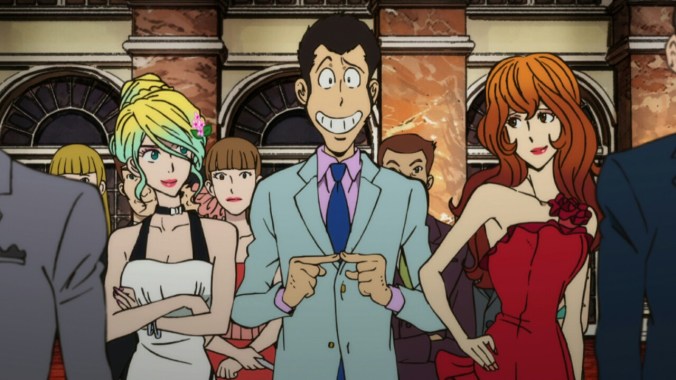
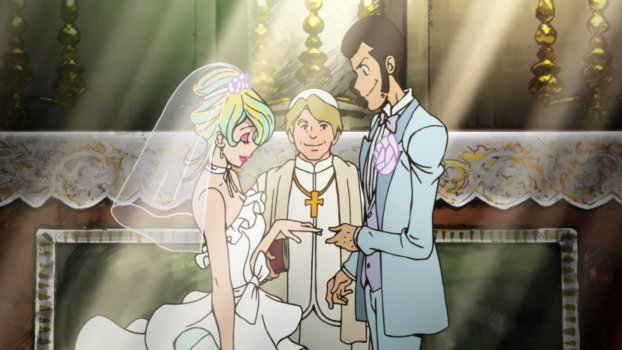
Lupin makes a marriage proposal to her, and surprisingly, she agrees – and after less than a month, they are standing in front of the altar. It turns out, of course, that this was all an elaborate plot by Lupin to steal a certain treasure, however, all the paperwork for the marriage already went through: Rebecca has become Ms. Lupin. What should have been a short scam turns out to be more complicated, and Lupin is officially married now – it will be one of his main goals over the course of the series to get Rebecca to sign the divorce papers.

But this creates an interesting love triangle with Fujiko Mine, as well as a thematic clash of femininity: Rebecca, the fun, young and quirky girl on one side, and Fujiko, the classy, mature and experienced woman on the other side. And while they are not explicitly fighting over Lupin, the banter, conflicts and hijinks that ensue are quite fun, even from Jigen and Goemon’s side who both cannot believe that Lupin is a “husband” now.

lupin3adultswim.jpg

Time to decide, Lupin!

Rebecca makes for a fun rival/romantic interest, but she is not universally present in every episode, nor does she have major influence on the complicated main story.

For me, it was the other new character that I was very fond of:

Nix, a British MI6 agent. He strictly follows his orders and thus has a few run-ins with Lupin’s crew, eiter because he actively has to fight them, or because their paths randomly cross.

nix.jpg

Agent Nix. (“Nix” being colloquial German for “Nothing”, not sure if intended.)

His design was a standout for me: the short slightly military-tinged haircut, the stern look, the wrinkles that give his face age and character, and especially the pointy ears (which serve not only an aesthetic purpose!)

While Nix seems like an uptight and efficient spy who doesn’t do anything besides following orders to 100%, more and more details about him will be revealed over the course of the series, and in the end, I was immensely happy to have him in this series.

As it turns out, Nix has problems to keep his emotions under control, and is often in danger of “snapping”, which might be hazardous for everyone involved. When his missions carry out well, he stays calm, but if he fails or a loved one is in danger, hell breaks loose. Nix is not only a spy, he is also a family man, with three cute daughters and a strong wife, so may God have mercy on your soul if you ever intend on hurting his family.

Nix carries emotional weight in his job and in his private life, and his role of being a responsible father clashes with his dangerous profession. He is a well-round character with a slightly tragic side too, but his likability and his switching between “deadpan serious” and “full on burning rage” serves for impressive, as well as funny moments within the story.

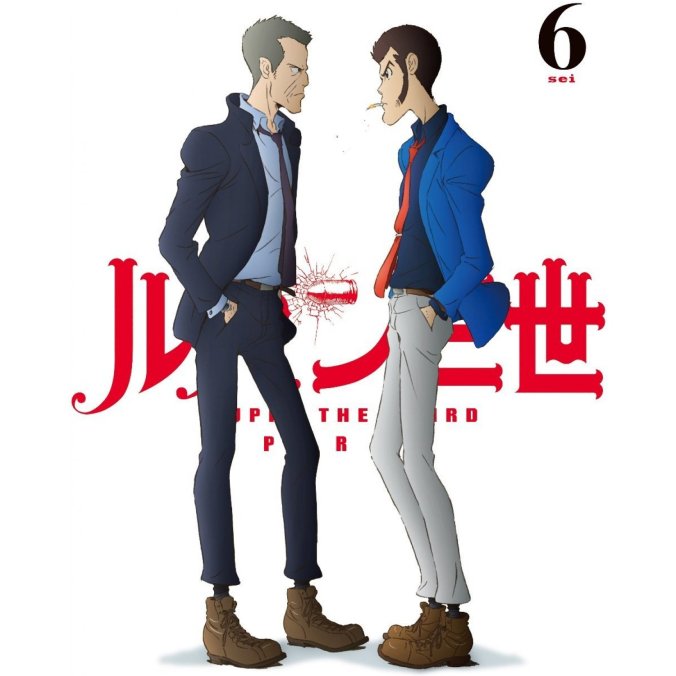
lupin-iii-part-iv-vol-6-468053.2.jpg

Nix, a great rival for Lupin.

As Nix is an important character with a lot of action segments and character acting, he gets some amazing animation cuts in Part 4, for example this cut by Shinya Ohira, where he fights a rebel spy. The unusual artstyle break and the pencil shading outlines give Nix’ actions visual power and strength.

Story and Standout Episodes

The story of Lupin III Part 4 is not the tightest, as not all episodes are here to drive the main plot forward. It is episodic, with an “Adventure of the Week” format, where you can enjoy every episode on its own, and occasionally be reminded of the big scheme in the background. The story goes off the rails somewhat to longer it goes, with some pretty incredible story twists and introductions, but it is all in good fun, as the strong cast can hold any outlandish plot together. The season finale might not have the biggest impact, but a nice ending overall.

However, there are some episodes that are able to absolutely stand on their own. If you want to get a taste, or if you simply want to visit the highlights this series has to offer, here is a small selection from my personal experience:

Themarriageoflupiniii_1

Episode 1: Lupin’s Wedding

“Rating”: Give it a Try!

Obvious choice to take the season opener, but this episode is a great character piece, with Lupin’s and Rebecca’s wedding and the controversy it causes with Fujiko, Jigen and Goemon. In addition, the animation is top-notch and delievers movie-quality action scenes to establish Rebecca’s character. A fun intro to the series!

img_30_m.jpg

Episode 3, 7 and 19: 0.2% Chance of SurvivalThe Zapping Operation and Dragons Sleep Soundly

“Rating”: Give it a Try!

Three episodes for Agent Nix, one being his introduction to his character and his skillset, being on par with Lupin and Jigen, and the other episode to show his family side and the caring father that he is. The third episode however takes a very dark spin on the spy business, with harsh violence and great danger to the protagonists. It makes for a strong tonal break that is worth checking out, if you are interested. (Keep in mind though that his episodes are more intertwined with the main plot and are not “pure” standalones!)

img_3344.jpg

Episode 13: The End of Lupin III

“Rating”: MUST WATCH

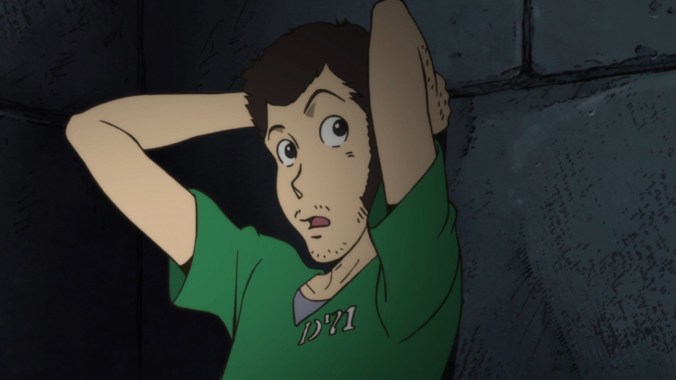
The mid-season finale and the episode that deeply touched me emotionally. In a surprising twist of events, Zenigata catches Lupin. Now that he has achieved his life goal, he gets a new goal: Keep Lupin behind bars. By removing the rest of the cast and only leaving Lupin and Zenigata in a 1-on-1 theatre piece in prison and total isolation, it goes far into the relationship of the two rivals.

I was highly impressed by this episode, and I would recommend it blindly to absolutely anyone.

DgDxdt0XcAAVp7n

Episode 16: Lupin’s Day Off

“Rating”: MUST WATCH

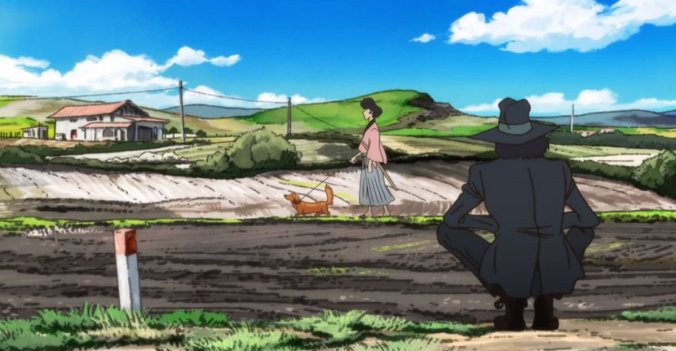
A simple premise: Lupin, Jigen and Goemon have a day off, so they book a table at a fancy sushi restaurant. They have to arrive at 6 PM, and it is only a short drive through the countryside to get there.

This episode is slice of life beauty with perfect comedic delivery, and how much a simple idea can escalate into madness. This one had me in stitches, from the fast action to the quick jokes. A jolly good time of an episode.

1516610431894.jpg

Episode 20: To Hear You Sing Again

“Rating”: Highly Recommended

A melancholic episode that I don’t want to spoil too much of. It is the story of an old Italian diva and her husband, and how long such a love can last through all the ages, through the good and the bad. A touching story that may move you to tears.

1646249_English_KeyArt-OfficialVideoImage_88e80ffd-4ba2-e711-8175-020165574d09

Episode 26: Nonstop Rendezvous

“Rating”: ABSOLUTE MUST WATCH

This second special Bluray episode, sometimes called “Episode 26”, serves as a prequel to all of Part 4 and is an all out action romp with everything you could wish for: Fun character interaction, high-speed chase scenes, action shenanigans and full on physical comedy of the first degree. It reminds me of other amazing car chases I have only seen in films so far, and it will have you thoroughly entertained! The last few minutes may be a bit slow, as it only serves as a lead-up to Episode 1, but everything before that is pure fun and the essence of Lupin III comedy action.

Conclusion

Lupin III Part 4 was a good time, and especially cosy to watch over a long time, basically like it aired, one episode per week and going faster if you feel like it. Not all episodes are stellar, some are outright bland, such as Episode 15 where Lupin infiltrates a high school to simply fight against bumbling teachers, but overall, I had a splendid time with a few amazing highlights.

If you want to get into the Lupin III franchise, I would maybe recommend other films instead, (The Castle of Cagliostro, The Fuma Conspiracy or Jigen’s Gravestone) as you may already need a bit of a grasp on who all these characters are, before you see them interact with newer ones. I’m still happy about the introduction of Nix, I hope that he may return for the next currently airing Part 5 in 2018.

The Italian adventure makes for a comfortable series to watch as a mood piece, to just see the cast hang out and enjoy themselves, with some great action sprinkled in here and there. It’s not the best of the franchise, but a very solid entry that you can check out if you want to – and if not, you can enjoy the standalone episodes I recommended to you as short film snacks.

Overall, I’m happy that I watched it, and I look forward to more adventures of the wonderful Lupin III cast.

end.png

The End.

Sources: Wikipedia “Lupin III”, MyAnimeList “Lupin III Part 4”

MANLY MONDAY – “Zombiepowder.” Tite Kubo’s Early Western Fun

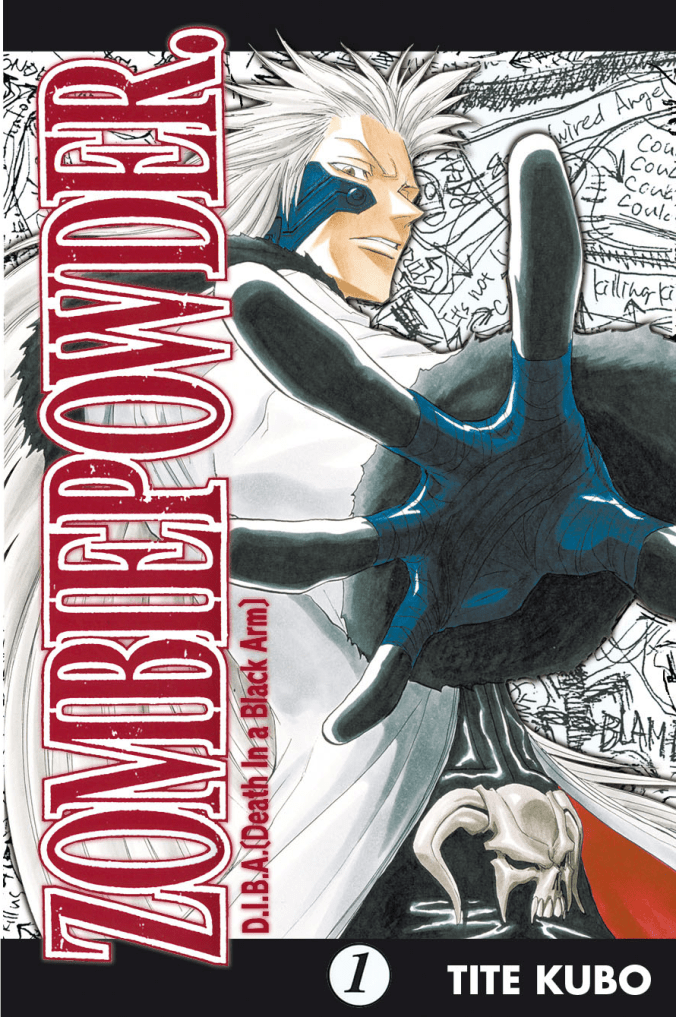
zombie-powder-vol-1.png

Back in the day when I was a little kid, the book shop was my world. I read many manga there, even right into the teenage years, as the store had comfy couches and chairs to sit on, so that you could browse and read for an unlimited time. It was here that I found Zombiepowder for the first time, by an author I had only heard a bit about: Tite Kubo, most famous for his series Bleach.

I would later find out in school exchanges and travels outside of Germany that Bleach was actually a huge thing. The internet told me that it was on the level with One Piece and Naruto, the “Big Three” of Shonen Jump, and I was quite surprised. Bleach was never a gigantic thing in Germany, most likely due to the anime not being widely available, especially in the “golden early days”. (One Piece ran since 2003, Naruto since 2006 – in a dreadful version, don’t remind me of the opening, the One Piece one is amazing, watch that instead – both on the big channel RTL II, while Bleach started only in 2010, on a niche channel called Animax.)

And so, in 2008, I held a volume of Zombiepowder in my hands, not knowing about Bleach, and started reading this new series I had never seen before. 10 years later, I revisited it.

02-03

Zombiepowder is the story of Gamma Akutabi, a silverhaired hero with a big sword and big heart, in a Wild Western world. He is a “powder hunter”, someone who is on the quest to hunt down the “Rings of Death”. If you collect all twelve rings, you can produce the eponymous “zombie powder”, a substance that brings life: If used on a dead person, that person becomes alive again, and if used on a living person, that person becomes immortal.

Hence, many people are after these rings for different reasons, and so far, no one has managed to gather all twelve into one place. Gamma Akutabi is after it for the immortality, and on his quest three other characters will join: C.T. Smith, his partner in crime, a very upright classy gunslinger complete with suit and bowler hat, Elwood, a young teenage pickpocket, and Wolfina, an energetic paparazzi  lady who fights with forged press releases and a modified tripod.

x2 (1)

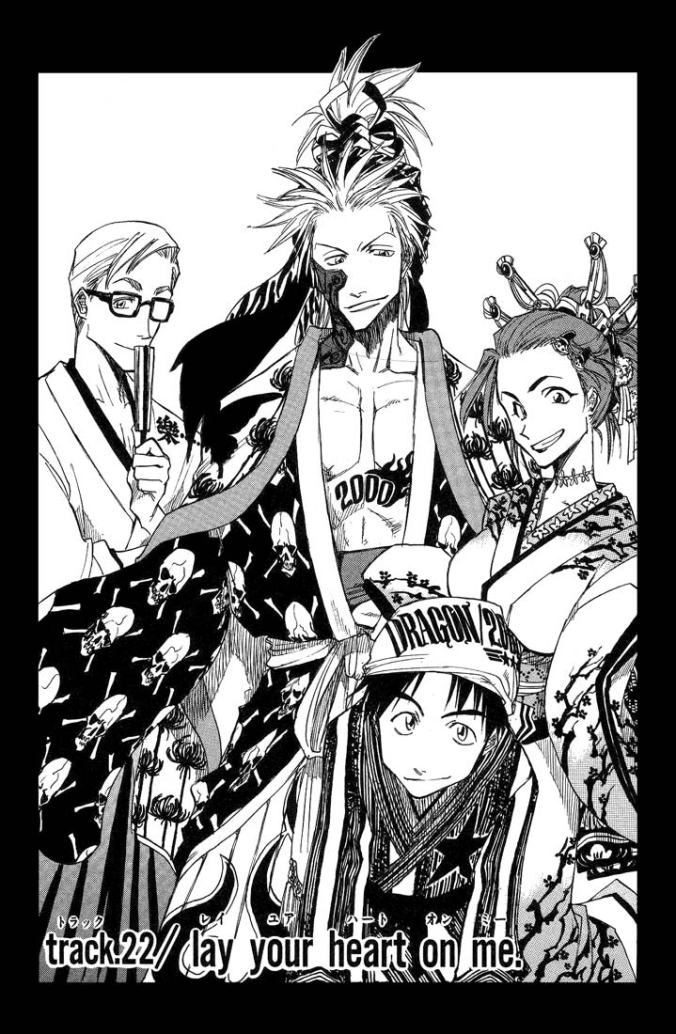
From left to right: Elwood, Smith, Gamma and Wolfina.

As this manga is quite short, with 27 chapters only before it was cancelled by Shonen Jump, I wish to talk less about the plot and more about the characters and style that Kubo shows us here.

Kubo’s artstyle and linework have always been immensely stylish. Even though I have never seen or read much of Bleach, I can tell you that his design is instantly recognisable and very pleasing to look at. Clothes are wonderfully designed and fitted, characters have sleek shapes and sharp features, and the action makes it all shine with simple to understand panelling and framing.

x11
x17 (1)

x18

Simple, clear, and straight to the point.

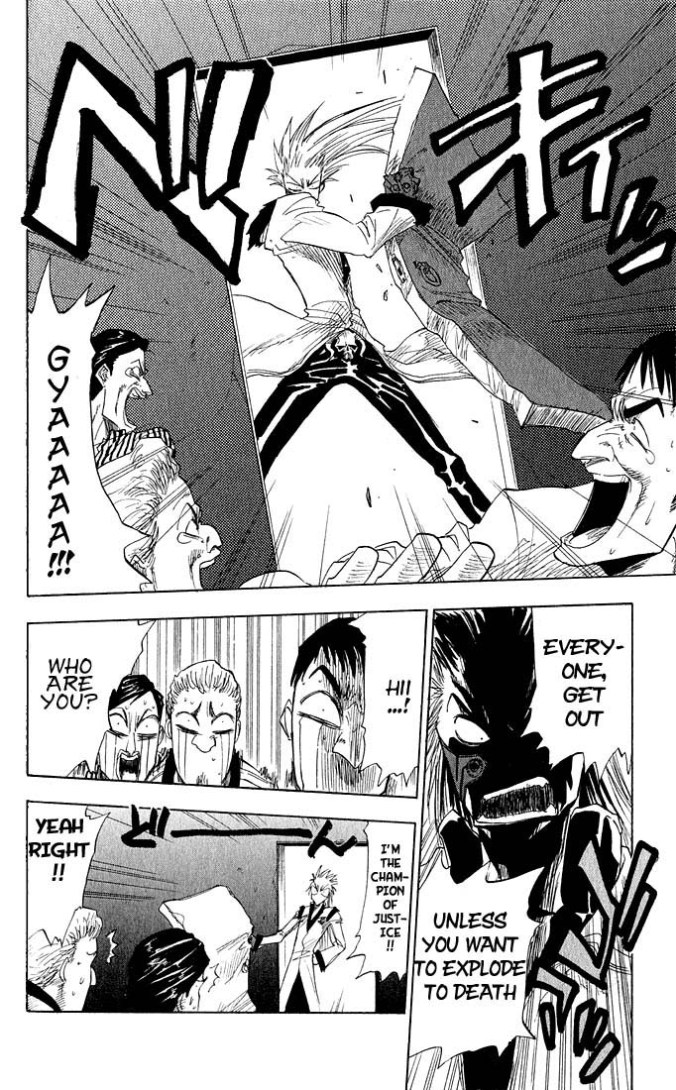
The tone of the series alternates between “serious” and “goofy” quite easily, and the characters can carry it as well. The more outlandish moments serve as nice breathers between the onslaught of action.

x37

From serious busting through a wall…

x9.jpg

…to silly busting through a door.

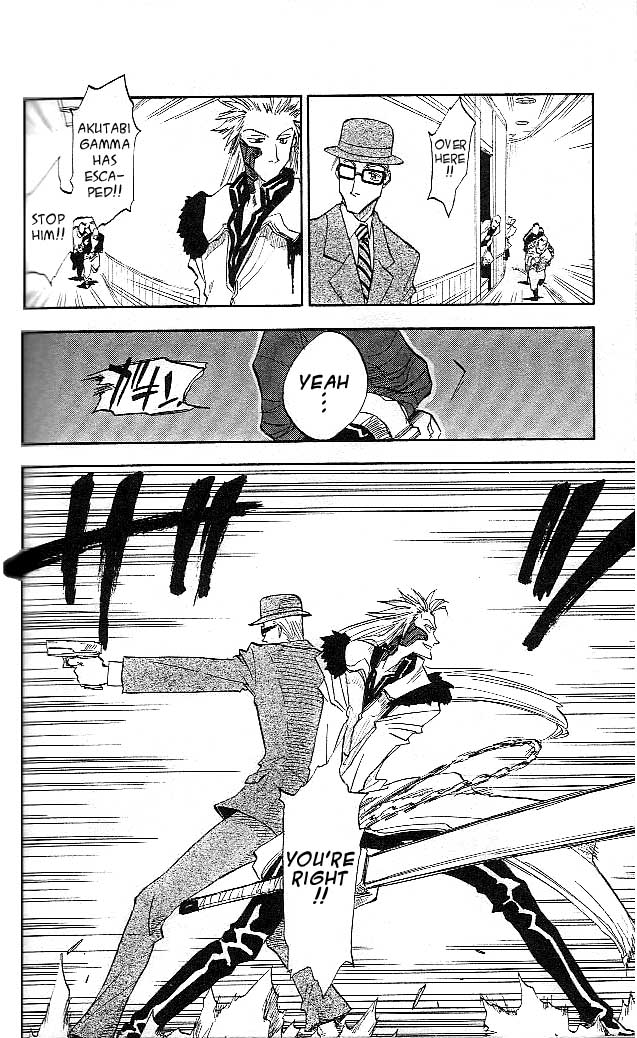
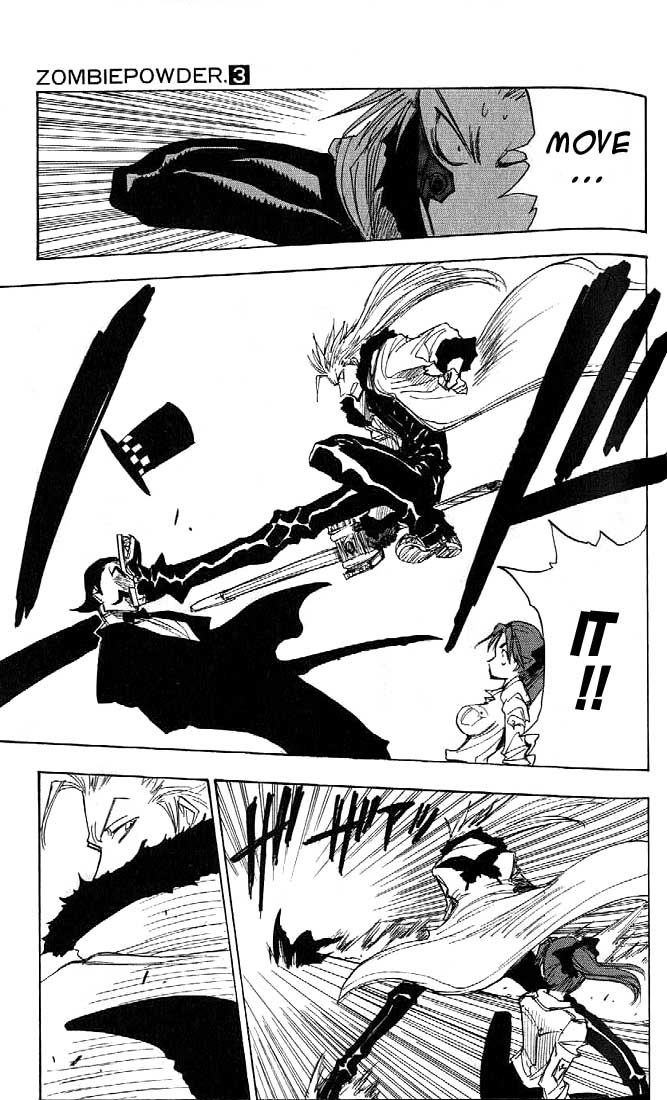
And there is A LOT of action in Zombiepowder, the series consists of battles pretty much every chapter, and – surprisingly – it works! Characterisation is interwoven with the respective fighting styles of the protagonists, everyone with their own strengths and weaknesses. Cool stuff happening with cool people, nice.

Gamma Akutabi’s design, the silver hair and coat, together with his chainsaw sword and later magic use was a design I particularly loved, and sadly it had to go too soon. He could have been a classic Shonen protagonist to stand alongside others, even with the slight accusations of Kubo taking too much visual inspiration of Trigun and Western/Mad Max settings à la Fist of the North Star and Battle Angel Alita.

xff46

That’s rad.

While I recommend reading Zombiepowder to everyone, it’s going to be interesting what you take away from it.

It’s pre-Bleach, opening itself up to comparison, but it’s also its own thing of a young upcoming artist trying to find his voice.

It’s also a short Shonen riddled with strange decisions, as Kubo says in the behind-the-scenes: This was his first work in the magazine Shonen Jump, and he was under “great emotional trauma” while drawing Zombiepowder – due to the crushing workload of having to produce a chapter each week, and due to him not knowing how to communicate with his editor, sometimes taking decisions he didn’t want to, accepting them without discussion.

The manga ends abruptly as well, it manages to round off its first arc, and then suddenly introduces three finishing chapters with many new characters and a sort of style-breaking feeling. While I was not a fan of how it leads to the ending – it leaves two protagonists behind in an uncertain path and has some questionable character designs – it does leave on a nice, if short bitter-sweet note.

If you wish to read Zombiepowder, I will recommend the physical release in 4 volumes, as it comes with a lot of making-ofs, other early Tite Kubo manga (which are all worth of analysis as well), special artwork and even a playlist of music for every character in the manga. Hey, I didn’t knew Kubo liked Rhapsody, an Italian powermetal band, one of my absolute favourites!

Conclusion

Essentially, this manga is a great stepping stone into a genre that Kubo would help to shape, and a short fun romp by someone who would later on do great things. To my personal shame, I must confess that Zombiepowder was the reason I put off Bleach for a decade: Gamma Akutabi and his gang were so energetic and fun, that Ichigo Kurosaki and his friends paled for me in comparison. Given, of course, that I had only read the first volume of Bleach, but alas, I was having more fun with this Wacky Western than Supernatural Highschool.

10 years later, it’s still very fun, even if a bit wonky in retrospect, and I will check out Bleach soon, it’s about time I reckon. And while I do that, walk the path into the other direction, and check out Zombiepowder, and see how you will like it. It may not be your new favourite, but it will be a powerful time capsule to rediscover.

x3 (3)

The End.

Sources: Zombiepowder Wikipedia, Zombiepowder making-ofs (Physical Release, Tokyopop)

MANLY MONDAY – “Thumper” That Inescapable Lovecraftian Rhythm Violence

thumper_cover_loop.png

I love rhythm games. The combination of music and gameplay that comes together with precise timing and satisfying crispy button presses is always great fun. It can make your adrenaline rise like nothing else, make yourself dissolve into music, thinking only about keeping and following the rhythm. And once you succeed at a very hard level, you can relax and marvel how you even made it through that onslaught of notes.

Quite a few games have accompanied me in the past, some even right into the present, Donkey Konga (with bongo controllers!), Elite Beat Agents (basically Proto-Osu!), Love Live School Idol Festival (my first entry point into the Love Live franchise, don’t look at me like that), Final Fantasy Theatrhythm (Why is “One-Winged Angel” DLC?), and Audiosurf 1 & 2 (which let you play your own music!). It is a little dream of mine to own a Dance Dance Revolution arcade machine one day, as I ever saw them in films and my country doesn’t have arcades – and people who know me in real life know that I will immediately play it if I encounter one. I’m not super good at DDR, but, goddamn, do I love it.
Once I saw the trailer for this specific game here last year ago, I was interested. It looked sort of like Audiosurf, but more intense, far more intense. However, it just trickled to the back of my mind to stay there, not a huge wish to immediately pick it up, but maybe I would give it a shot one day. And as one Steam sale rolled around, I finally bought it for myself.

It was a trip I had never experienced before.

437132-Thumper crystalline

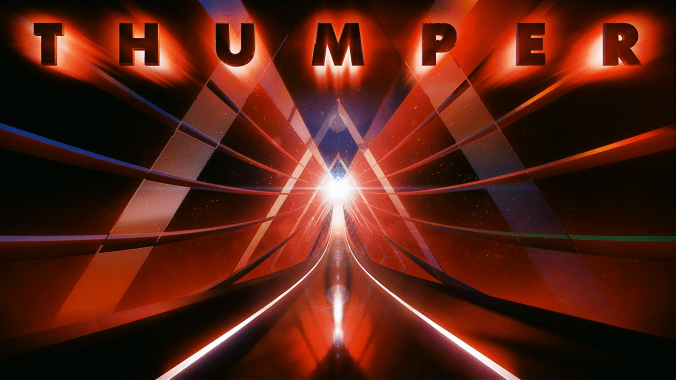
The game was called Thumper. You are a little metallic space beetle, rushing along a single path in an unknown galaxy. Little spots of light are on your track, you press a button to hit them with a shockwave. Some metallic barriers will spring up in curves, so you need to lean in with the control stick to not frontally hit them. And sometimes, laser barriers will get into your path that you must speed through while holding the same button. Essentially, all you need it a control stick and a button. These obstacles follow the same rhythm as the music, no problem. It’s one big track separated into little segments, you can even quit midway through a song and return at a later time. As simple as that.

Or so one might think.

This world is visceral, dark, haunting and fast. Two hits and you’re dead. When you hit a curve barrier or a laser, your metal wings get blown off, leaving you only with your riffled little beetle body whizzing along a nightmarish highway through space. Of course, you get your wings back if you finish a section of a level, but it puts pressure on you. You want to protect yourself and your beetle. What your beetle does or what they feel, but the goal is clear: forward. The only way is forward for you and your space beetle.

And the most driving factor of your quest forward is the music. Although, can it be described as music? I had extraordinary fun with Donkey Konga and Elite Beat Agents, as they feature songs from Earth, Wind and Fire, Queen and even Smash Mouth, all songs you recognise and can sing along to to your heart’s content. They make you tap your foot and bop your head to the music, and they will be earworms for the rest of the day!

Not so in Thumper. You cannot sing to Thumper.

The music is a beat, from ‘calm and eerie’ to ‘loud and clanging’, and you are building on the beat by interacting with the obstacles that come at you: barriers make a “clank” sound and “swoosh” past you as you lean so far into the curve that the rear end of your beetle touches the wall for a second, the spots of light go “booom” as you give them a shockwave, and the laser barriers break with high “click click” sounds. To that, once you notice that you can spread your wings to fly, a risky but rewarding move, you can add “ding ding dings” as your metal wings break little light arcs above the track. And once you manage to successfully fly and land from soundwave to soundwave spot, you smash downwards with a satisfying “FOOOOMF” that even makes your screen go into slow-motion for a second.

To all of this rhythmic noise in time signatures foreign to untrained ears comes the background – a deep, heavy sound carpet that spreads all over, a dissonant and intimidating soundscape that does more than just to amplify the empty space you fly in. You notice it, this is more than just a long metal highway through the galaxy, it is something else. And as the track suddenly grows insect-like legs and narrow geometric tunnels that close in on you, the doom orchestra in the background doesn’t stop with its loud drums and haunting strings, all it does is pushing you forward, forward, forward – towards what? What is the goal? What is the purpose? The bosses are too big to understand, too strange to grasp, fighting in ways you need to analyse to survive, twisting, disrupting, blocking your path, that never ending path hurtling towards them. You need to follow the beat to continue. The droning beat dictating your heart.

thumper4.png

To make a long story short: Thumper is a lovecraftian rhythm horror game.

“Horror” not the sense of spooky imagery or jumpscares, “horror” in the sense of existential dread and the fear of not knowing what will come next. New types of enemies may appear, the music might change, or tunnels might block your view, pushing the reaction time further down. All with that fast and immense pressure of timing, understanding and reading in a matter of seconds. The visuals in combination with the music alone are haunting, putting you in a state of alertness, but what is the true kicker is the gameplay, which merges perfectly with the rest – creating one cohesive dark beauty.

This game is difficult. The learning curve is steep, but it remains always 100% fair. If you died, it was absolutely your own fault for not reacting in time. Every obstacle is clearly telegraphed, not only with a distinguishable colour and look (sound spots are blue, barriers are red-silver and appear vertically, lasers are red-only and appear horizontally) but also with a sound. Barriers come up with a big “clack“, lasers shoot in from the side with a “clink” and enemies slither in with a “shhhhh” or intimidate you with a loud “BWAAM“. Combining with all of these sound words I already described earlier: That’s a lot of noise. Noise that becomes music. Noise that is useful.

I have talked a lot about this game now, and haven’t actually shown you any gameplay footage yet. Take a look at the trailer:

It’s an onslaught of information, strange imagery and rhythmic loudness that wants your full concentration and focus. Game marketing loves to talk about “immersive gameplay”, but I have rarely seen it more fitting here. The game draws you in with its carpet of noise, the ungraspable atmosphere and quick, unforgiving, but fair judgement of your skills. As I said, the game is fair, the learning curve is steep, but it never feels disheartening. This game pushes you to go forward, forward, forward – the same way your little beetle goes forward, forward, forward. And the only way to do that is to simply ‘git gud’.

I only played it with headphones, which I highly recommend, and there is a VR version available as well. From what I’ve seen in other reviews, this version is even far more intense, and my head-phones-only adventure already was. You will be frustrated, you will put the controller down, only to return after 2 minutes, as the noise and the lights draw you inside again. You will scream, yell, be relieved, celebrate and curse a lot, and that’s beautiful.

Conclusion

Thumper is an intense game that I would recommend to everyone who loves fast and furious precise gameplay with strong immersion. It’s “short”, with only 9 levels, but you will have to bite and fight yourself through those, so I was entertained for a few weeks. Post-game contents include world-wide leaderboards, highscores and rankings, and you will love to return to it and be astonished at how fast your accumulated skill crumbles apart again.

The “story” is simple, if there even is any, and yet it managed to surprise me in the end with one of the most memorable and gameplay-bending end bosses. Any game that can make me have my jaw fall to the ground in surprise and dread is a great one, and Thumper managed it several times.

If you like rhythm games, this one is a must-play for you, for everyone else, this is a trip you should not miss out on. Dive into the lovecraftian world of noise and loudness, and fight your way forward and ever forward.

3138612-thumper-screenshot-boss-hit-ps4-us-5jun15

To infinity and beyond.

The End.

MANLY MONDAY – “Avengers: Infinity War”, The Grand Finale 10 Years in the Making (SPOILER-FREE REVIEW)

dadd9e76fa61ca787557cf8ce6a7d8a1.jpg

Way, way back when I was a little kid in the midst of Europe, I didn’t grew up with superhero comics. My heroes were “normal heroes” with inseparable partners: Astérix and Obélix, Tintin and Haddock, Don Rosa’s Donald Duck and Uncle Scrooge stories, Vicky the Viking and the crew of his dad, or Alfred J. Kwak and his friends.

This all somewhat changed, when Spiderman by Sam Raimi hit the theatres, I must have been around 11 years old. I was just so fun! Spiderman 2 cemented that wonderful feeling, I went to see them with my childhood friend several times in the cinema.

The Spiderman 2 Gamecube game thus also holds a special place in my heart, not only for being a splendid game with a fantastic open world, but also for my childhood friend and me beating the final boss together. We both held the controller together, one pushing the button to dodge, the other with the punch button to wait for an opening to finally take down that villainous Doctor Octopus. What a wonderful time that was, to see the joined effort come together and to celebrate in the flicker of the end credits.

Many years later then, when I was in middle school, I heard of Iron Man in 2008, and I was surprised. There are even more heroes? And apparently they had been around for many decades? In comics? Like my Tintin and Astérix? My nostalgia was not for them, Spiderman was a lovely memory of my past, but nothing that would carry significantly into the present.

Iron Man and Thor were fun, the rest was so-so or didn’t even catch my interest, and when it was finally revealed that all these heroes would come together in a thing called “Avengers”, a name I had never heard before, I remember sitting in the cinema and muttering after the title came on screen: “Oh man, I would so laugh if this film sucks.”

I would be very wrong.

rFtsE7Lhlc2jRWF7SRAU0fvrveQ

Because it was very, very fun.

Avengers showed that the big superhero crossover was possible. Many heroes with backstories in their own films, then coming together in another movie, leaving time for the crossover event itself, not needing additional time for character introductions or presentations. Even the villain, Loki, had been introduced before, getting his chance to shine – with many jokes, big action setpieces and a simple, yet engaging plot, Avengers took the world by storm. In the background, it was also building up to something.

More heroes got introduced, the universe got bigger. Antman got my interest, as it was by one of my favourite directors, Edgar Wright, and even if he didn’t direct it in the end, his tone shined through, making it immensely fun. Guardians of the Galaxy came in with technicolour rainbow fun and an oldschool groovin’ soundtrack, and then the second Avengers rolled around, not as super satisfying as the first one, but still a great time in the theatre. And it was still building up to something.

Phase Three rolled around, where Marvel really got into their groove, and here you will find my favourites: Thor: Ragnarök and Guardians of the Galaxy Vol.2, films which combined emotional strength and comedy to entertaining cohesive bundles of joy – Doctor Strange and Spiderman: Homecoming also being very strong entries that I would wholeheartedly recommend. And they continued to build up to something.

That something has now arrived, after being 10 years in the making:

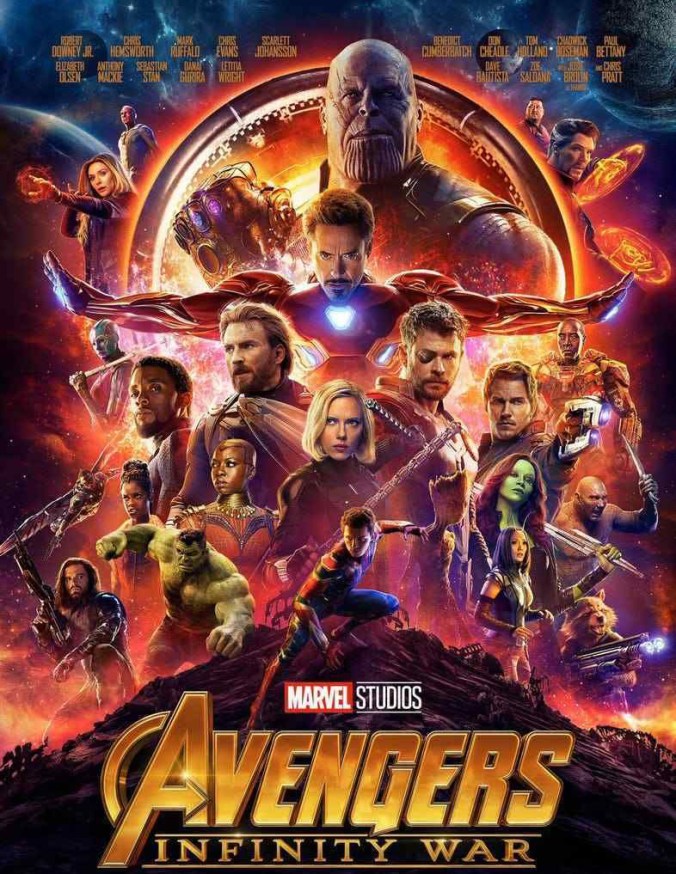
Avengers Infinity War.

https_blogs-images.forbes.comscottmendelsonfiles201804MV5BMTU3NDExMjQyNl5BMl5BanBnXkFtZTgwMjk2MTUwNTM@._V1_SX1500_CR001500999_AL_-1200x675

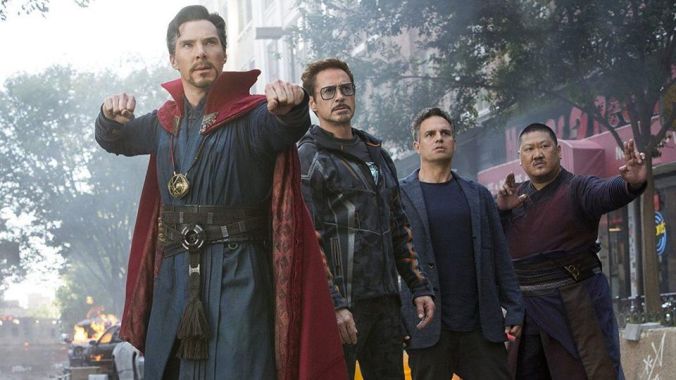
Just a fraction of the gigantic main cast, with three intersecting franchises: Doctor Strange, Iron Man and Hulk.

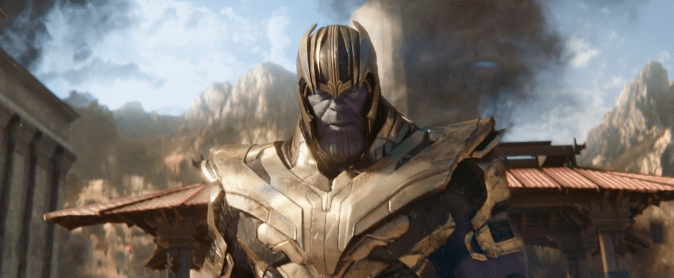
A gigantic threat is looming upon the galaxy: Thanos. A galactic overlord who wants to collect all six Infinity Stones, which grant the power to rewrite reality if they are combined into one weapon – a gauntlet in this case. In many different films before that, we know where the Infinity Stones are, and in some, they even played very big roles.

The plot is simple, yet effective: Thanos is coming, he must be stopped. And in order to do that, the power of all the Avengers and their friends is needed. Good guys set out to defeat the bad guy. Simple, straightforward, boom, done.

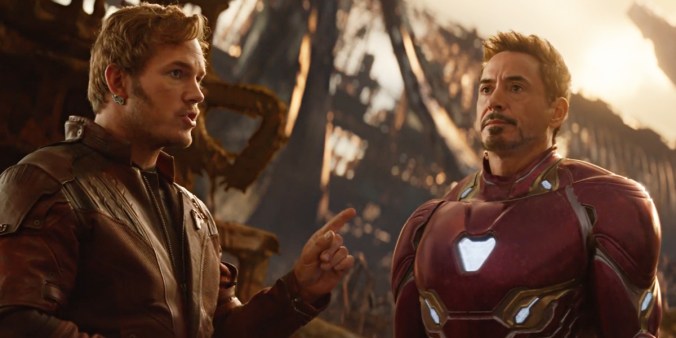
However: It’s the execution where this film shines. To take over 20 main characters and fit them into one big story is not an easy task, but it succeeds in an entertaining and satisfying way. Not all characters appear at the same time, they enter the stories at different points, and then get split up into groups. Some combinations are logical, the Guardians of the Galaxy are one group, surely, and Iron Man will team up with Spiderman, that much is clear from the previous films.

Avengers-Infinity-War-Cover

This team-up can only go well. Just look at them.

But over the course of the film, they get re-shuffled, and go to their own intertwining substories, and this is where the main fun is to be had. As the audience already knows all of these characters, the burning question is: How will they all react to each other? Will they get along? Will there be banter? Or will they end up as a harmonious bunch? Some of these combinations I had never seen coming, and also never expected them to work so well. Especially [backwards: tibbar hsart eht dna dog esron eht] was a duo that really hit home, and if you would have told me that before, I wouldn’t have believed you.

The character interactions are where the fun lies, and the smaller teams with unique combinations keep everything fresh and interesting. (Hence, I would also recommend that you watch many of the MCU films before Infinity War, if not all. Some people will tell you different things on what to skip or not, but I think most people will agree that you will absolutely need Thor: Ragnarök and Guardians of the Galaxy Vol.2, as the events of the two lead directly into this film.)

Of course, not everything is fun and games in this film, there will be emotional moments as well, and these blend perfectly into the comedic segments. It never feels like one mood is overstaying its welcome, the mix between “funny and sad” is balanced out extremely well, and gives a great flow to the film. In the 149 minutes of film, I never felt as if it had lengths or dragged out moments, everything felt snappy, powerful and going forward.

In addition, the villain of the story, Thanos, is given enough room, and even his own parallel plotline, so that he receives depth as well, making him one of the best, if not the best villain in the MCU so far. All I can say is: This finale (or rather, the first part of the finale, as the continuation will be next year) was absolutely worth the time waiting.

Screen-Shot-2018-03-16-at-12.50.13-PM.png

Sidenote: I also want to praise Klaus-Dieter Klebsch as the German voice of Thanos, he is one of my favourite voice actors, and he was born for that role. He has spoken many villains from my childhood as well, maybe adding that little bit of extra to my enjoyment.

Conclusion

Back in 2008, when I was saw Iron Man with doubtful eyes, I could have never imagined where it would all lead. I was proven very wrong in my prediction, and I am pretty sure that many were too, such a big film franchise had never been attempted before, and some other franchises have tried to copy it afterwards, but nobody achieving it to this extend.

While some initial films of Phase 1 or 2 were drab or not very engaging, Marvel has now found the perfect formula of entertainment, big bombastic fun with an equally big, beating heart, that ties everything together emotionally.
And Avengers Infinity War also managed something that many films hadn’t done recently: to surprise me. Not only in shocking moments, but also in emotional ones I hadn’t seen coming, without being “out of nowhere”. It’s a tight bundle of many cohesive and strong storylines, that comes together after many, many years. And it was beautiful.

Behind me in the cinema was a little kid with their parents, maybe 11 years old or so, and it was very well behaved, didn’t interrupt others, enjoyed the film and only occasionally spoke something out loud. And yet, I couldn’t help but smile at the little hollers and exclamations of “Oh no!”, “Yes!”, “Whoa!” and several very big “What?!”.

I remember a little kiddo also sitting in the cinema, being very excited about Spiderman 2, and looking forward to seeing my fantastic super heroes on screen, and going to see the films several times in the theatre, smiling at the visual fireworks of action and heart in front of my gleaming eyes.

The eyes full of doubt from a decade ago were finally shining again like they did on this very day.

The End.

MANLY MONDAY – “Blacksad” When Ex-Disney goes Film Noir

The Disney Company owns quite a lot of franchises these days: From Star Wars to Marvel, the Big Mouse has accumulated a vast gallery of rights, artists and studios under its white-gloved hands. Many wonder what Disney doesn’t own at this point.

This poses a more important and certainly more intriguing question: What if someone leaves Disney? What do they do after their time at one of the biggest companies in the world? Here is one of them: Juanjo Guarnido.

Juanjo Guarnido, born 1967 in Spain, always had a love for comics. He drew and joined many fanzines, gained the attention of Marvel, and started doing work for them. In 1993, Guarnido became an animator at Disney Animation Studios in Montreuil, France, and I am fairly certain that you have seen some of his animation work: strong and classy “Helga” in Atlantis: The Lost Empire, the expressive and emotional “Hades” in Hercules, and he was the lead animator of villainous leopard “Sabor” in Tarzan.

However, Guarnido decided to leave Disney and to rejoin with one of his older friends from his comic days in Spain: Juan Díaz Canales – they had been discussing producing comics together for a long time. And so, both of them came together as an artist-writer team to produce their own original comic, which was published in 2000: Blacksad.

They surely couldn’t imagine what this comic would later become: Universally loved by critics and the public, a strong, respected and recognisable franchise with 5 comics in total, and several outstanding awards, such as the Eisner Award in 2011 for the whole series. Let us take a look at this wonderful graphic novel:

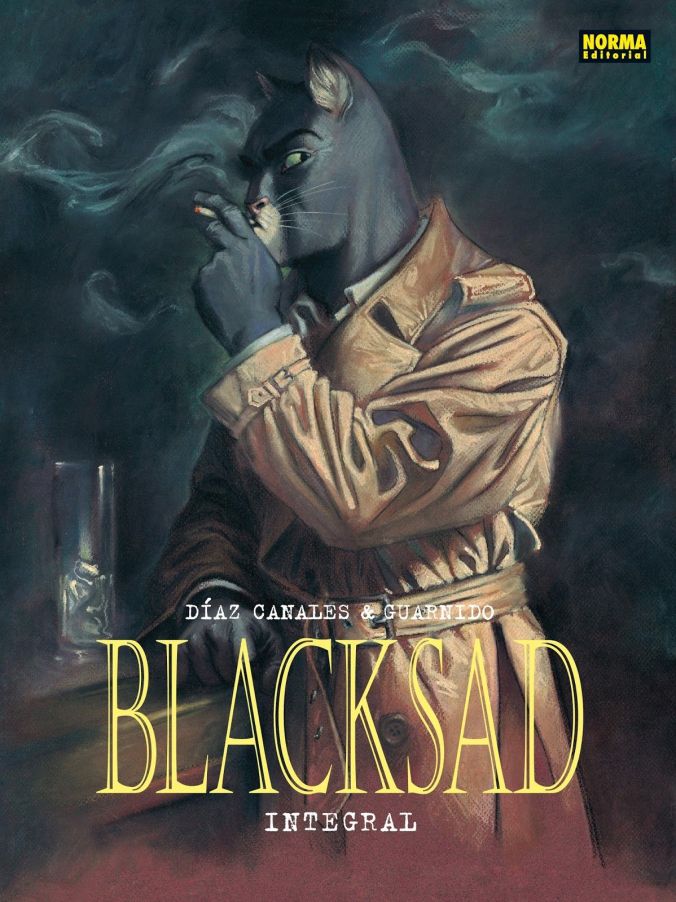
68d33259fd0a85a9a028db27ad0a9db3

[Spanish Complete Edition Cover.]

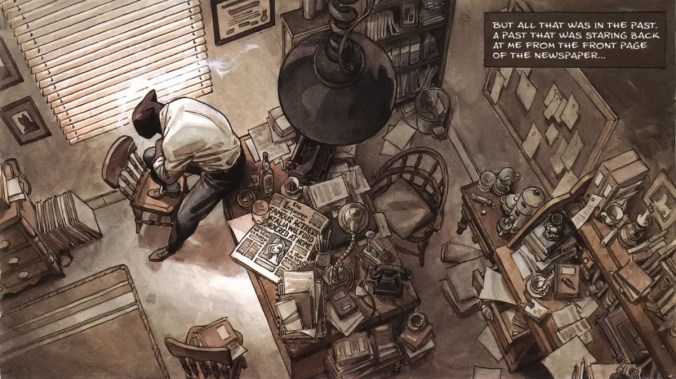
Blacksad is the story of the title-giving John Blacksad, black cat and private detective. His cases range from investigating a murder, to being a bodyguard, to simply fighting for his life which has gone downhill. Blacksad himself is the classic Film Noir protagonist, complete with badass traits and strength, but also emotional vulnerability and other flaws. The first volume, Somewhere Within The Shadows, shows the broken cat man in his messy yet functional office, telling of the character that works here.

blacksad-2

Guarnido’s backgrounds are brimming with detail.

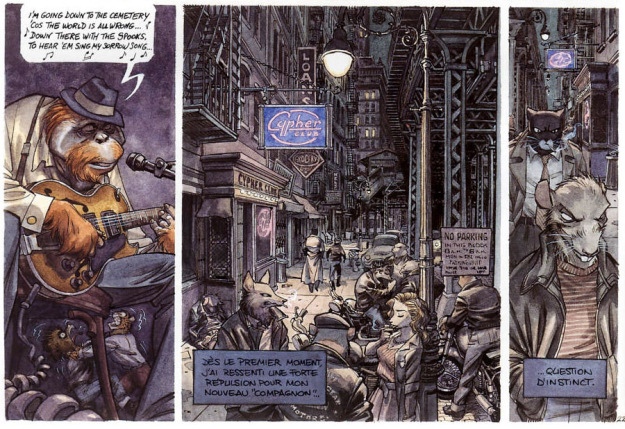
The first volume is a celebration of all that makes the Noir genre, chiseled men who believe in justice, bad guys who must be defeated, shady bars full of questionable characters, and a looming sense of villainy seeping through every rusty crack of the city. The Blacksad series is the distillation of 1950’s America: freedom, style, beatnik, jazz, but also racism, inequality, street violence, and everpresent crime.

blacksad_within-shadows_2000_03.jpg

Every volume plays in a different setting with a different theme, keeping the feeling fresh and interesting, with a reoccuring cast of colourful characters introduced slowly over time. And of course, these adventures will be intense, as the hardboiled genre asks it – action will go down.

blacksad

C54FNQ5

blacksad19

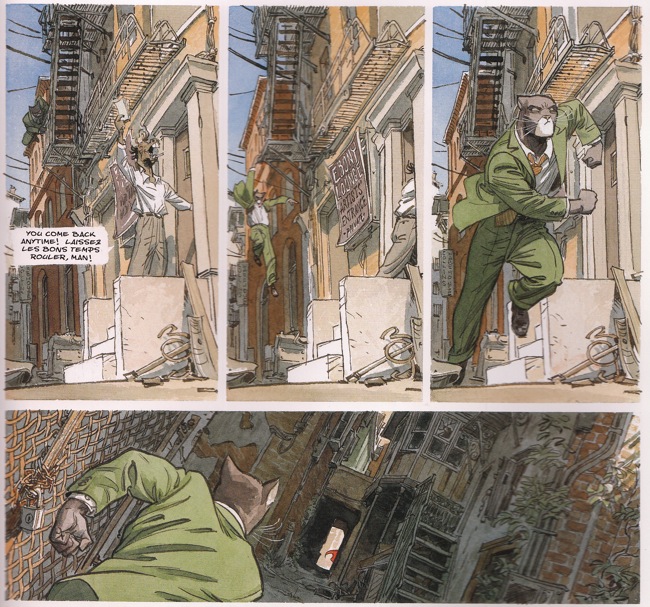
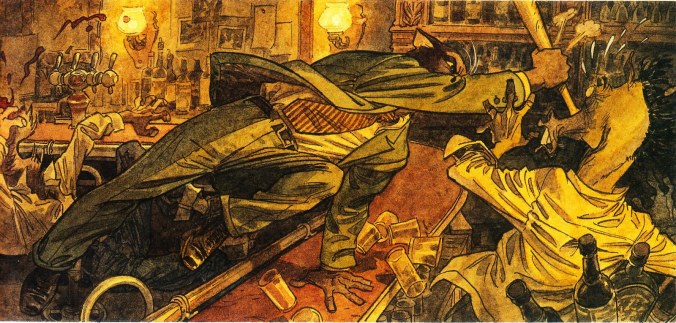
Action inBlacksad” is strong, clear and perfectly framed.

Here is where Guranido’s artwork shows its pure strength: Due to his experience as an animator, of drawing art in motion, he is masterful in his depiction of movement. Shots, punches, beatdowns and explosions all look visceral, right in the execution, as if stopped in a wonderous intense timeframe where one can look at all the details that only a comic book can allow.

If you wish to explore his animation style a bit closer, to also understand his way of framing action, look no further than his animated music video Freak of the Week by Swedish metal band Freak Kitchen. This 5-minute kickstarter-funded marvel is filled with some of the most vivid and expressive character animation in recent years, showing musicians in their fiery strong element, with rough outlines full of camera turns and fluid motion.

Especially that wonderful metal hair animation, fantastic. Sakugabooru.

But not only is the action stellar, the colouring and lighting are wonderfully crafted as well. The watercolour settings spring to life, with astonishing detail and such a graspable sense of space that one wishes to simply step into the frame.

blacksad_a-silent-hell_2012_02blacksad_a-silent-hell_2012_04blacksad_a-silent-hell_2012_03blacksad_a-silent-hell_2012_06

All frames from Vol. 4, “Hell, Silence”, which focuses on the world of jazz.

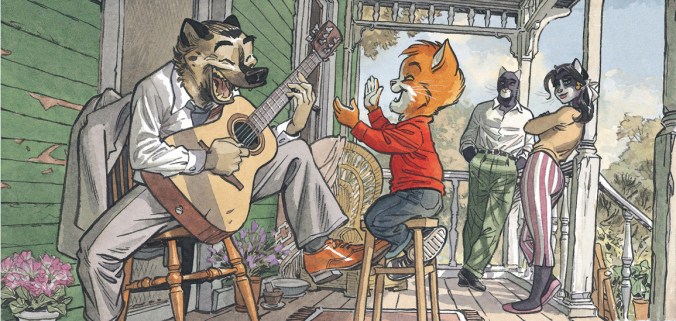
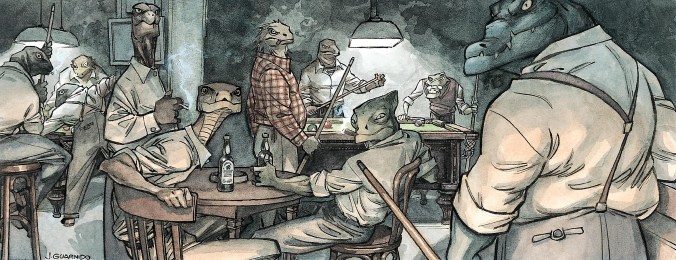
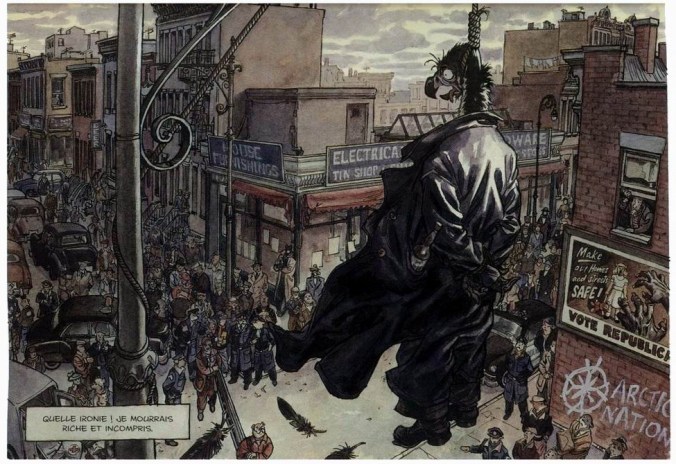
To adress the elephant in the room and the reason many people start this series in the first place: the world is inhabited by anthropomorphised animals. And to see these Disney-esque character designs in dark stories is intriguing as a concept in itself. Together with the brilliant execution and talent of artist Guarnido and writer Díaz Canales, it has an inescapable charm and fascination – and when these bright character designs clash with the harsh reality of society, it is exponentially more shocking.

blacksad-5-750

From happy times with friends…

565587.jpg

…to shady places of the underground…

blacksad_arctic-nation_2003_02

…to the hatecrime against a black-feathered bird in a small town.

This “Disney but not-Disney” feel is one of the main points that draws readers initially in. These themes and topics would never be touched by the family friendly corporation, but with Blacksad, it opens the possibility to a dreamland what-if scenario: What if Disney had never left 2D animation, and had started becoming adult with its content?

However, one should not reduce this graphic novel series to the past of one of the creators. These are expertly crafted comic books with masterful artwork, and I highly recommend that you experience this series yourself. (There was even word around of a Hollywood adaptation with a budget of up to 100 million dollars, however, the project seems to be stuck in development hell since 2009. This is not a problem, as the comics can easily stand on their own.)

An additional note I want to make here: Blacksad was released in France first, and was thus intended for the standard publishing size of that market. Franco-Belgian comic books have a larger format than their international brethren, which is perfect for detailed artwork and has a long tradition in itself. Hence, I would not recommend buying Blacksad digitally, as it can easily lose its impact on a small screen. Treat yourself to the physical release of your choice, Collector’s Edition or single volumes, and enjoy Blacksad as it was intended.

20180525_101112.jpg

From left to right: manga size, American comic size, and the French standard size. Above, you see the full effect of the artwork if the book is flipped open.

Blacksad is a fantastic graphic novel series that I would recommend to anyone who is even remotely interested in comics, artwork and/or colouring. For fans of the Noir genre, this is an absolute must, and even if you are not into the genre – open the pages and let yourself soak in this retro atmosphere of a time long gone, now told with a charismatic cat man by a beloved and insanely talented artist/writer duo.

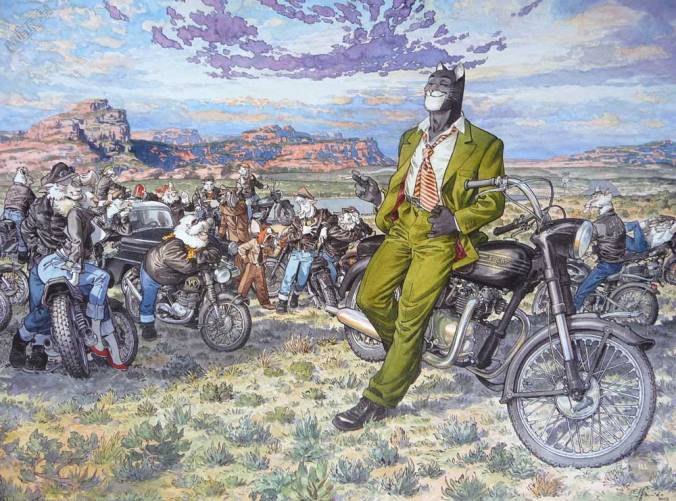
juanjo-guarnido-affiche-art-poster-bd-deco-illustration-blacksad-amarillo-road

The End.

Sources: Wikipedia “Junjo Guarnido” “Blacksad”, Disney Wiki “Juanjo Guarnido”, Sakugabooru.

MANLY MONDAY – The Hardboiled Beauty of Takeshi Koike’s “Lupin III”

vlcsnap-2014-12-16-00h33m42s199.png

The beauty of any long-running franchise is to see the different interpretations over time. How does the zeitgeist influence an adaptation? How does the director influence the style on a narrative or visual level? What does the new look or re-design say about the characters?

Here comes Lupin III into the game. This franchise about a suave thief and his team has had many entries over the decades, from the original manga by Monkey Punch in 1967, to long-form TV series 1969 and 1977, to many OVAs and films in the 80s and 90s – some even by great and popular names in the industry like Hayao Miyazaki’s Castle of Cagliostro and Osamu Dezaki’s Harimao’s Treasure. And every creator brought their signature styles to the table.

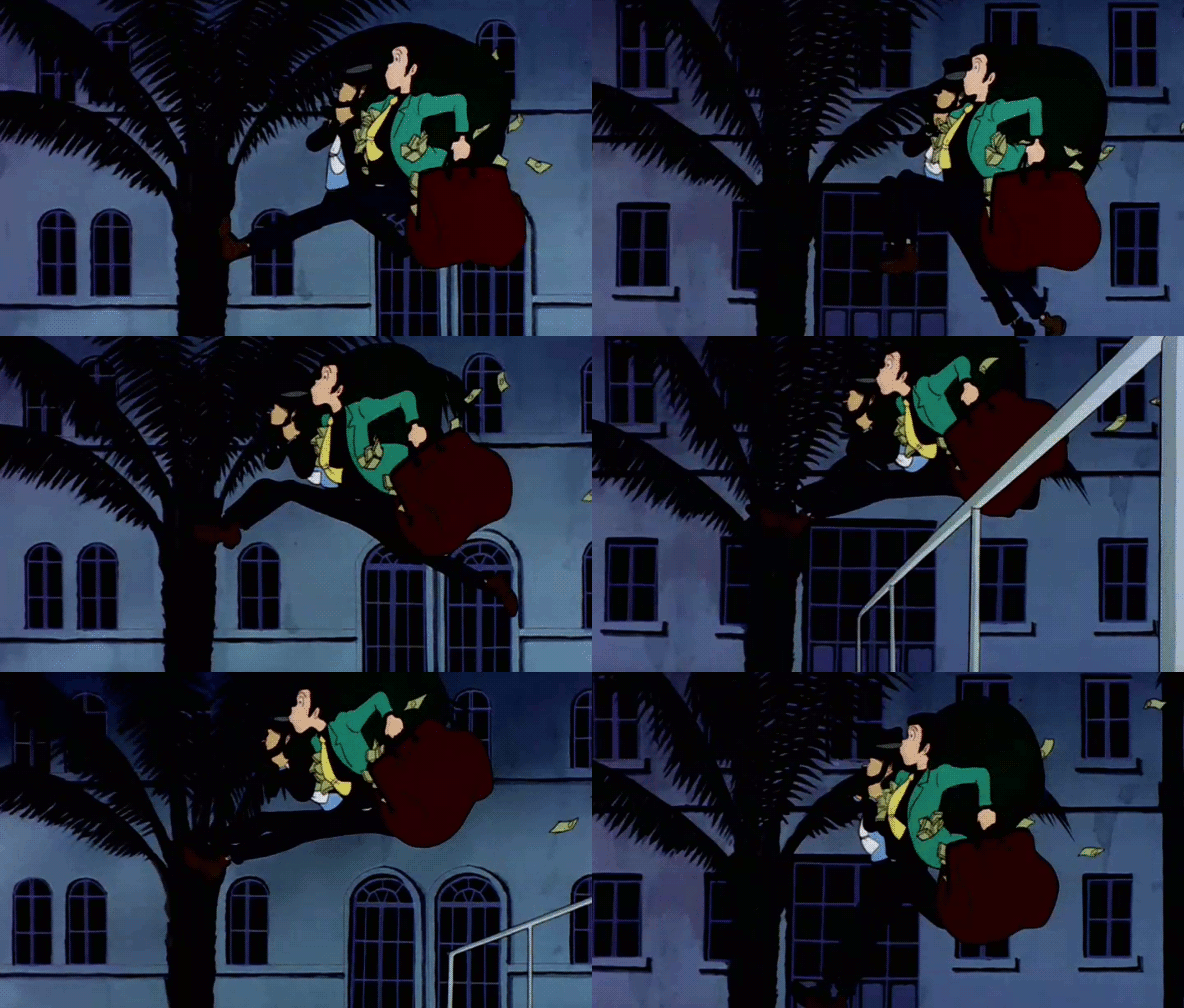
lup.gif

From Miyazaki’s bouncy fun and super-smooth animation… 

dezaki.png

… to Dezaki’s signature style “Postcard Memories” still frames.

This, to me, is the fun of Lupin III.

It’s essentially a gigantic toybox where any creator can come along and pick up the characters to play out a story for you, and in the end, they put the toys back for the next one to pick up. Do you have a favourite creator? Look up if they did anything on any Lupin III, they most likely will have an entry somewhere! You can explore freely through many styles and time periods, and find the Lupin III adaptation that you will like the most.

You only need to know the very basics and you’re good to go: Lupin is a thief, Fujiko is a rival thief and love/lust interest, Jigen is a relaxed gunslinger, Goemon is a honourable samurai, and frantic INTERPOL Inspector Zenigata is always hunting them. And then, adventures happen – car chases, shootouts, sword fights, trickery and thievery, helping friends and defeating foes, you name it.

This toybox freedom allows for great experiments and more outlandish interpretations of the characters. Lupin III: A Woman Called Fujiko Mine (2012) by Sayo Yamamoto for example told the story from Fujiko’s side of things, with heavy themes and explorations of sexuality – heterosexual and homosexual alike – giving the franchise a very adult and interesting not-very-canon-feeling entry.

To give you a short overview of styles through the ages:

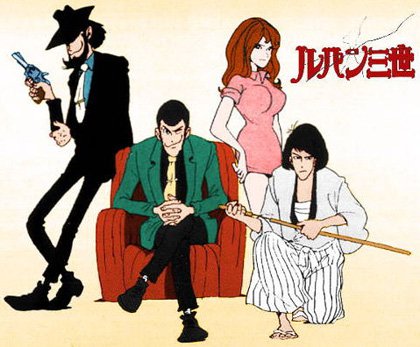
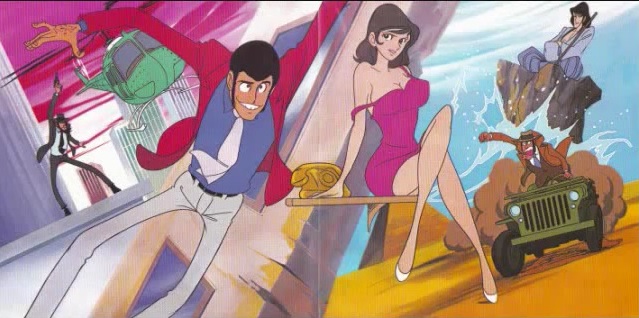
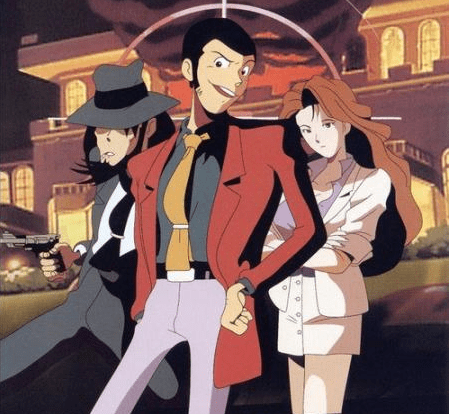
cast.jpg

Lupin III: Part 1 (1972)

Lpn3

Lupin III: Part 2 (1977)

voy.png

Lupin III: Voyage to Danger (Special, 1993)

Fujiko-Mine

Lupin III: A Woman Called Fujiko Mine (2012)

lupin

Lupin III: Part V (2018)

In 2015, the next Lupin III TV series started, called Part IV, with a light fun tone, classic thieving hijinks, and new characters to add to the roster. The opening alone will tell you the fun it has with itself, it certainly is a feel-good series where you can relax with a big smile. This year, in 2018, Lupin III Part V has started airing, with a heavier focus on the internet and the digital world, giving it its unique spin on the world too – and again, it has a fun opening, which underlines the sci-fi and digital aspect more, with Lupin’s little  signature Fiat 500 flying into space to install a camera on a satellite.

So, the TV series are doing fine and are absolutely fun, what else is going on? We have the funny Lupin III airing on TV, is there a serious Lupin III at the moment too? Some other interpretation? Another creator putting their own spin on the franchise?

Enter director and animator Takeshi Koike.

goemon.jpg

Takeshi Koike’s character design for Goemon Ichikawa.

Takeshi Koike made a name for himself with the animated film Redline, which is an absolute MUST-WATCH for any fan of animation. A story about intergalactic racers, a yakuza plot, three friends who must grow together, and the most insane race the universe has ever seen – I could speak for hours about this film, as it is one of my favourites. Koike was the director, storyboarder, character and machine designer (and probably even more, as he mostly went uncredited in his own work) for this film, and it is simply a masterpiece in the medium.

Even before his directorial debut with Redline he was a talented animator and worked on many projects: Koike is the protégée of Yoshiaki Kawajiri, the stellar director behind aesthetic and atmospheric masterpieces such as Vampire Hunter D Bloodlust, Ninja Scroll and Running Man. Koike even worked on some of these films under his mentor. And the influence is more than visible: Both use stylish sharp character design, precise and breathtaking slow motion, strong shadows with stark contrast. To this, Koike adds his own flavour: extreme and atmospheric camera angles, immense power and speed in action, and some realistic violence with impressive outlandish sword- and gunplay. (For more information and examples: Here is a sakuga compilation of his work and here a piece by The Canipa Effect.)

So, what happens if such a skilled director takes on the Lupin III franchise?

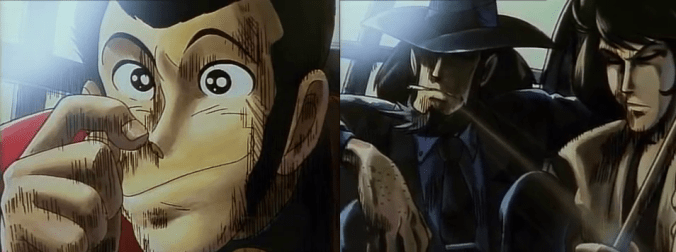
Detailed, powerful, well-directed pure fun. (Source: Jigen’s Gravestone)

Koike’s Lupin III films are intense, fun and an absolute blast.

As you can see from the scene above, Koike brings the fantastic car sequences from Redline into the mix, and as the franchise always has had outstanding chase sequences, it fits perfectly into the whole canon. Little details can be found as well, like Lupin cranking down the window and covering his ears before Jigen shoots, the outline smear on the villain when he the cars collide, or Lupin’s expressive yelling you can hear even without sound.

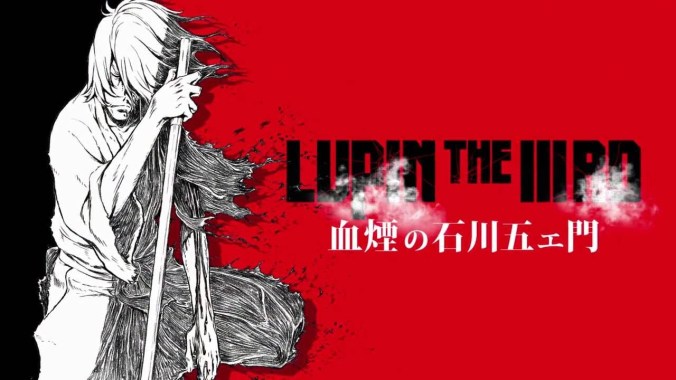
Takeshi Koike has so far directed and designed two Lupin III films, Jigen’s Gravestone (2014) and Goemon’s Spray of Blood (2017). They are considered “spin-off continuations” of A Woman Called Fujiko Mine (2012), however, the Fujiko series is not needed in order to watch these two, they work as a standalone duo of movies and do not reference the previous series.

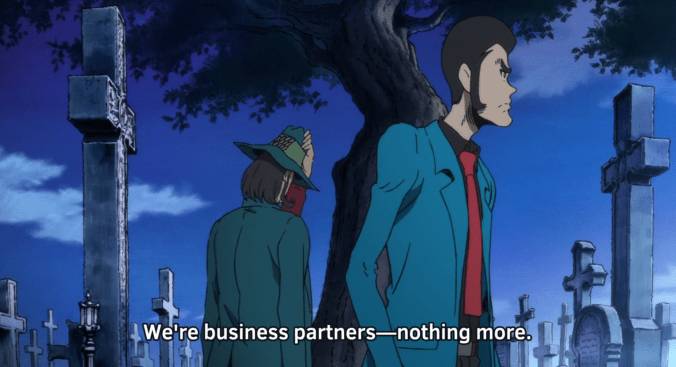
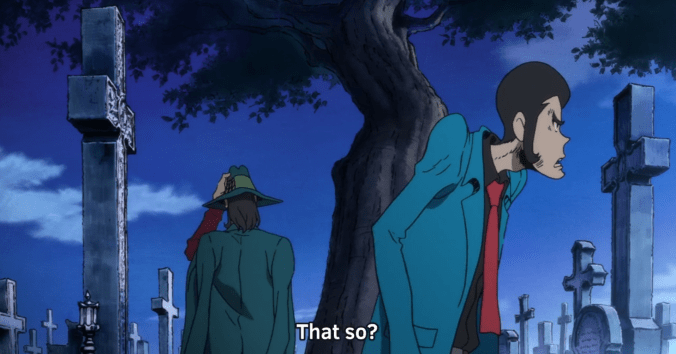
In the first film, Jigen’s Gravestone, Lupin the 3rd and Jigen Daisuke are a team of a thief and a sharpshooter – however, they are not yet the “best friends” they will grow into, they are only business partners at this point. But it soon turns out that the two are being trailed by a dangerous sniper, Okuzaki, who is set out to kill them – he already has prepared their graves for them to see: The titular gravestones. Jigen is not ok with this, as this sniper has also recently killed a client Jigen swore to protect. And so, the hunt and battle between the two begins.

grave-1.png

Jigen is upset, but Lupin is rather calm about getting a death threat.

In the second film, Goemon’s Spray of Blood, the two heroes Lupin and Jigen meet Goemon, a samurai they have seen a few times around. Goemon is the body guard of a yakuza boss, but as he fails to protect him, the clan turns against him. Not only that, Goemon’s spirit will be broken by the assassin of his former boss, a man called Hawk, a big, bearish unit of a lad who fights with heavy dual-wielding axes. This is the story of how Goemon joins the Lupin team and how he became what is today: one of the best samurai in the world.

e70f4aaaae1d123dd2045a6ef7118997d853e0b5_hq.jpg

Goemon vs. Hawk. This won’t go well.

As these films are quite short, about 50 minutes long each, I do not wish to talk too much about the plot of these. The are essentially introduction films, one for Jigen and his friendship to Lupin, and the other one as a character piece for Goemon, all held neatly together by the charming ensemble cast of the Lupin III franchise and charismatic villains they need to fight.

The big center pieces of the two films are the two main conflicts: Jigen vs. Okuzaki and Goemon vs. Hawk. And let me tell you that these are absolutely worth it – battles of strength, mentally and physically, but also of wit, observation and skill.

These are some of the more serious Lupin III entries, far away from the current jolly TV adaptations of Part IV and V. All of the fun aspects are still there, the car chases, the banter and the fights – however, they are all presented through a lens of hardboiled intensity. Meaning, if characters get hurt, they get hurt. It’s violent. Some of the most violent I have ever seen in the animated medium, and I like watching hyperviolent OVAs from the 80’s.

C-Iaa1-XUAAGURP

This is tame.

If you say: “But I can deal with splatter, no problem!”, then I will warn you of some of the body horror that swords, blades and guns can produce. You will definitely do your sharp air inhale of “Oooouh, that must’ve hurt.

And it’s this hardboiled intensity that is so strong and refreshing. It’s not trying to be “edgy” or deliberately over the top, it’s a whole new adaptation that paints the Lupin III franchise in the colours it always had if one thinks about it: Theft, murder, yakuza, gunmen, samurai, and the general underworld. The darker tone fits like a glove. It wants to be that, and it is exactly that.

But more than that, Koike finds the perfect balance between the fun action segments and heavier dramatic scenes, never feeling like a tonal break or betrayal of itself or the source material. These characters suffer, fight and grow, battle their fears and rivals, and in the end, you will be immensely satisfied.

Goemon’s Spray of Blood was such an adrenaline ride for me, that I watched the whole film with a smile, alternating between laughter at outlandish action scenes and quick comedy bits, and being in awe of the violence and intensity of the fights that carry importance to the characters and the overall story.

In addition, Takeshi Koike’s signature character design and artwork with thicker outlines than usual just fits perfectly to the Lupin III franchise. It is safe to say that the cast has rarely looked so suave.

codmp.png

Especially in “Goemon’s Spray of Blood”, with its yakuza setting.

Every character is animated extraordinarily well, not only in the big set-pieces, but also in dialogue scenes and small movements. Let’s take the scene I showed you a still frame earlier, the first round of Goemon vs. Hawk – katana against axe, samurai against biker, on an exploding ship, while Lupin, Jigen and Fujiko get away on a boat.

This is only the beginning. (Source: Goemon’s Spray of Blood)

The gigantic flames in the background, the water animation, the debris of flying roof tiles, the heaviness of Hawk, Goemon putting his sword away, the wind flying through his hair – there is so much love and care poured into film, from the big scenes, all the way into these tiny details.

Everything comes together perfectly, Koike’s style, animation, tone, action and drama, even the soundtrack, which, for example, gives gunslinger Jigen a James Bond style opening credits theme – I’m sure you will find something that especially stands out for you in these marvelous films.

Conclusion

I highly recommend watching Takeshi Koike’s two Lupin III films, Jigen’s Gravestone and Goemon’s Spray of Blood, purely because they are such fun, intense and wonderful productions, that ooze style and power in every second they are on screen. You can go in blind, or maybe check out another Lupin III adaptation that catches your interest, many start with Castle of Cagliostro, for example, for the taste of a young and fresh pre-Ghibli Hayao Miyazaki.

In the end, you will have a marvellous duo of films by one of the best directors in the industry. Two films that belong together, which also describe how one of the most beautiful friendships in the medium came to be. Lupin and Jigen – a friendship that has now existed for over 50 years.

And that alone is absolutely beautiful.

dai

dai2

dai3

dai4

The End.

Sources: Sakugabooru, Wikipedia entry “Lupin III: Jigen’s Gravestone“, MyAnimelist, Anime News Network

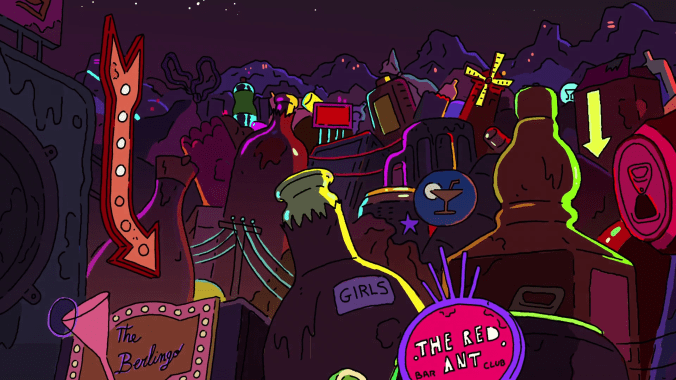
MANLY MONDAY – “Vermin” French Animation Goodness with Buddy Cop Insects

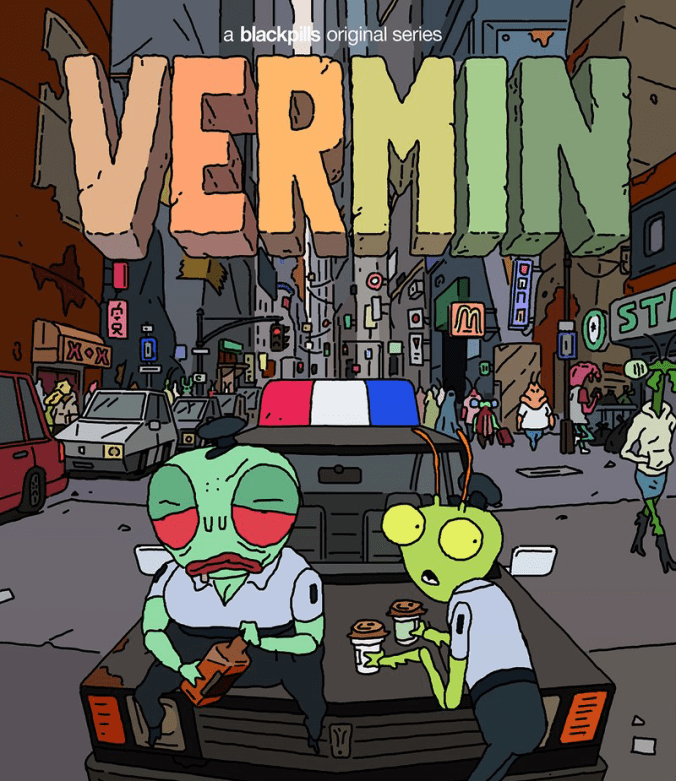
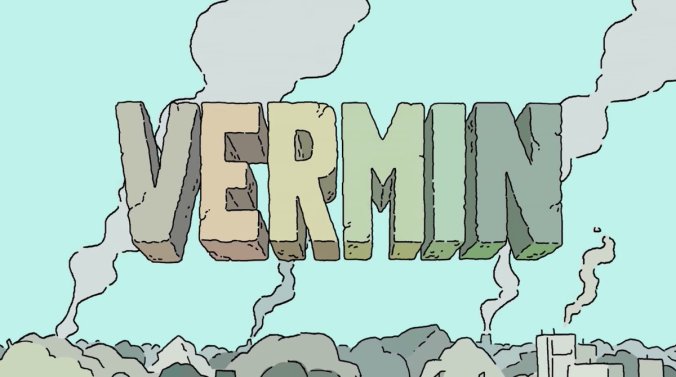
title.png

When talking about “Modern Animation” today, the focus tends to be predominantly on North-American and Japanese productions. But outside of this massive circle are other international productions that are absolutely worth of your attention.

One of these are the works of Balak and Studio Bobbypills (former Bobby Prod), a studio specifically setting out to do adult animation. In this case, “adult” meaning crass, explicit humour, satire and imagery, with the intensity and directness of an oncoming truck.

Previous works from the same staff include Les Kassos (or “The Wakos” in English), a French webseries about many popular pop culture figures trying to solve their problems with the help of a social worker.

For example: The Teletubbies fighting their drug problems, Han Solo not being able to cope with his father-in-law Mr. Vader, or Ash Ketchum getting into trouble for animal fighting, and many, many others. While these sound like classic jokes or “dark” concepts that have been already done, it’s the fast and direct presentation with snappy dialogue and impeccable comedic timing that makes these little skits shine. Especially the wild character design remakes which can go from parody to the straight-up grotesque, are fantastic highlights.

From “Star Wars” to “Game of Thrones”, over to “Teenage Mutant Ninja Turtles”, the “Smurfs” and “Astérix & Obélix”, you will find everyone in “Les Kassos”.

The whole series of Les Kassos can be found for free on Youtube, in French with English subtitles, or on the free Blackpills App in an English Dub. Three complete seasons exist, and they make for a very fun and highly inappropriate romp through nostalgic properties and through your laugh muscles.

So, what if this team sets out to do a new series that is not a sketch show, but an adult drama with original characters? Let us look at their newest production: Vermin.

DbOgjTMUQAAO1BE

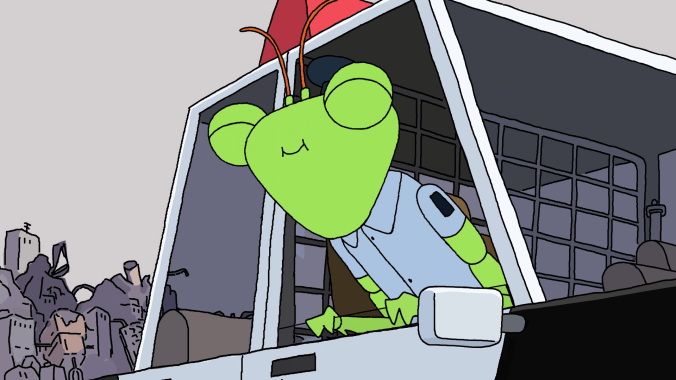
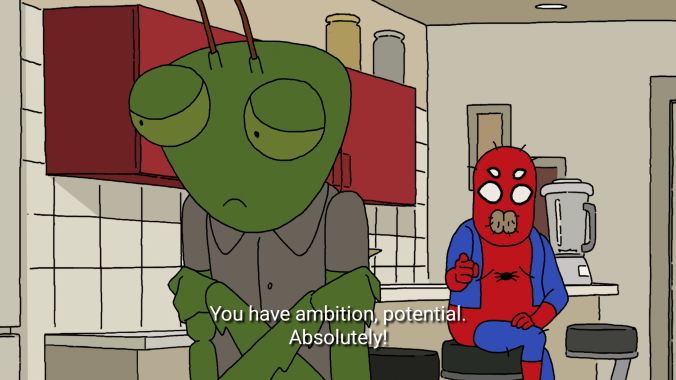
Vermin is the story of Mantos, a young praying mantis, who is finally old enough to start his job in the big city. Saying goodbye to his family and beloved fiancee, he is ready to walk into the foot steps of his father before him: to become a proper police officer.

Screenshot_20180425-003657.png

So young, so innocent.

And so, he embarks on his adventure.

Then all goes wrong.

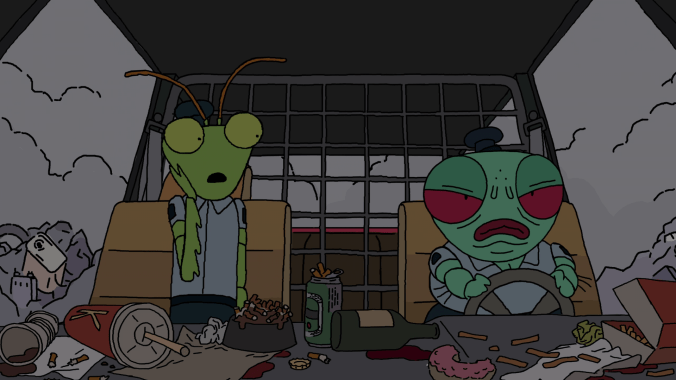
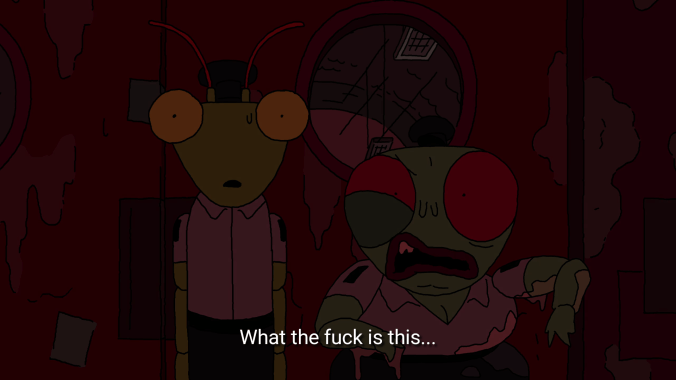
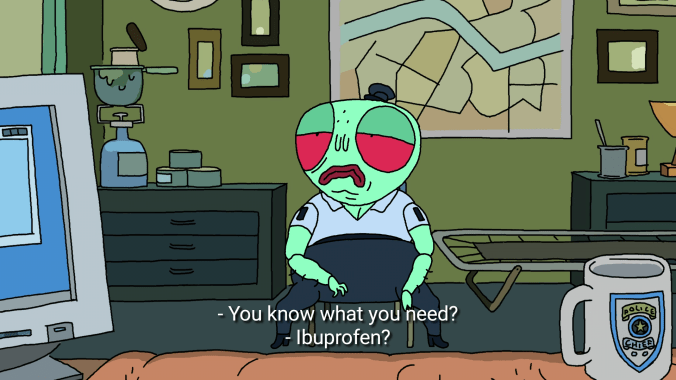
As it turns out, the big city is rough. Gang wars, prostitution, violence everywhere, decaying cityscape, crumbling society and his co-workers are a equally tough bunch. He is paired with Shermock, a fly, middle aged hard-drinking lady with a shady past and even shadier mindset.

Screenshot_20180425-003711

They don’t get along, really.

As these two worlds crash, this unlikely duo of Mantos and Shermock must solve cases, stop crime and grow together as a team, in 10 episodes, each 8 minutes long.

It is essentially the set-up for a classic buddy cop film, however, the two main characters are splendid. Especially refreshing is the middle-aged lady Shermock as a lead, who has seen far too much in life, and who has her own arc, together with Mantos, who in return must learn to be strong in this harsh world. The duo goes through many episodic adventures, with re-occuring characters and many different cases, from abductions to robberies.

While this still sounds like your standard cop story business, it’s the presentation, detail and care that his been put into this series that makes it shine brightly.

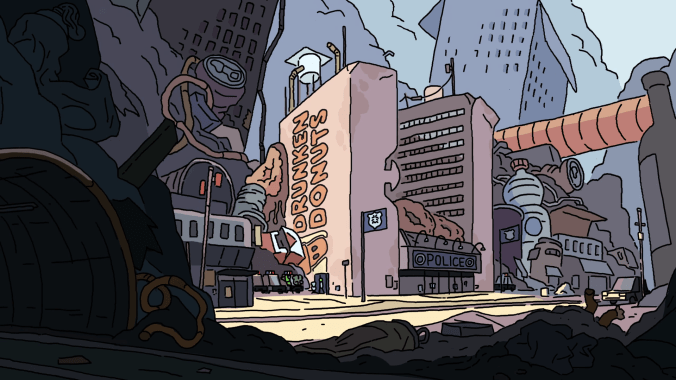
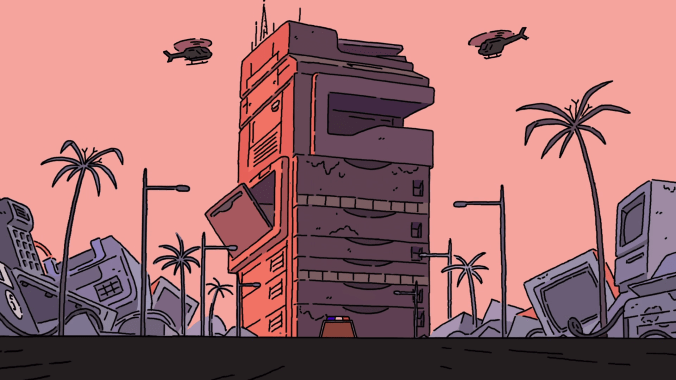
First of all, the art and animation. This megalopolis of insects has a unique and creative design of thrown away household items and trash, with many backdrops and fittingcolour choice that feel all unique, dirty and run-down at the same time: The worldbuilding and backgrounds are simply amazing.

Screenshot_20180425-003608Screenshot_20180425-003646Screenshot_20180425-003830Screenshot_20180425-003924Screenshot_20180428-180214Screenshot_20180428-181300Screenshot_20180428-181803Screenshot_20180428-182055Screenshot_20180428-182311Screenshot_20180428-183734Screenshot_20180428-183810Screenshot_20180428-184444

These backgrounds are fantastic highlights.

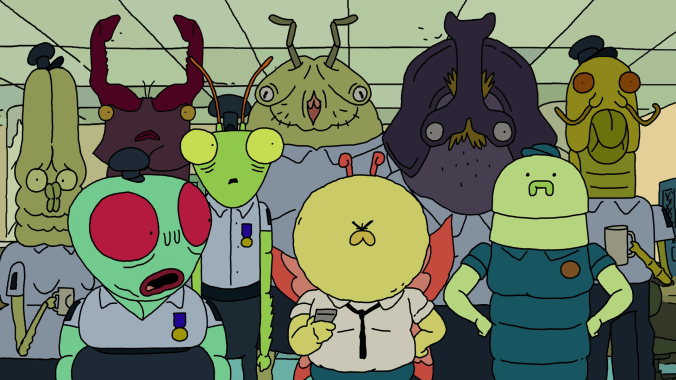
Same goes for the inhabitants of the city, who are mostly insects, some are smaller animals, like scorpions or snails for example, and some are pure original designs, where you can feel different animal elements coming together. In short, the visual design is unique and worth it, and fits the darker humour and adult themes of the story.

Screenshot_20180428-184408.png

The Police Department, many shapes and forms!

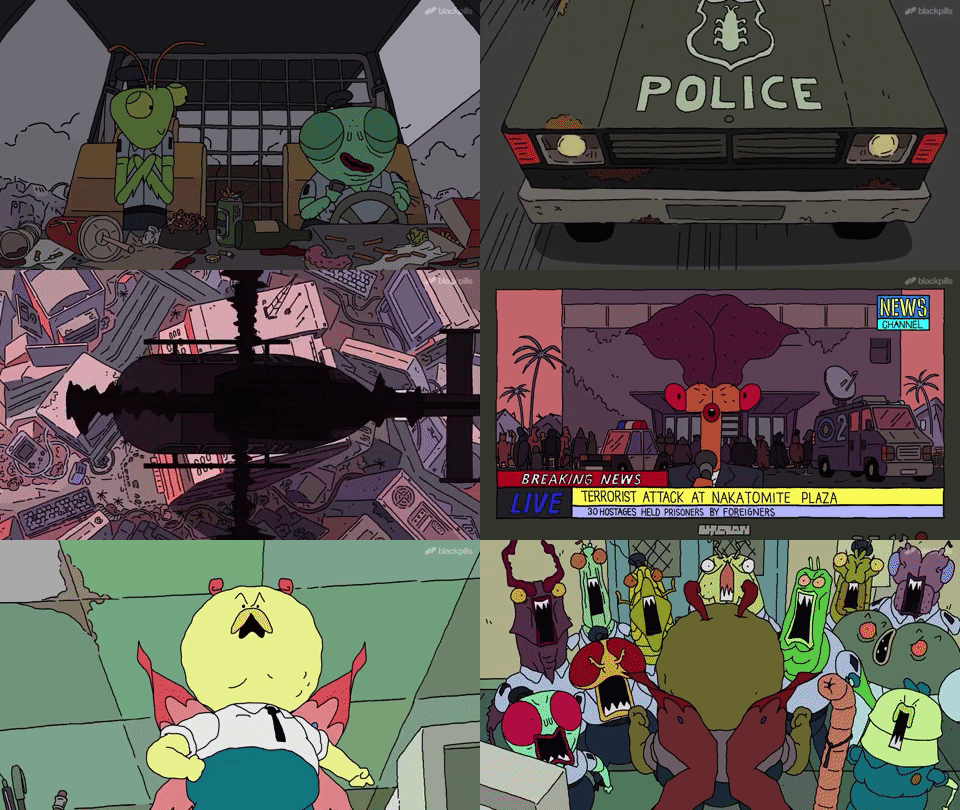
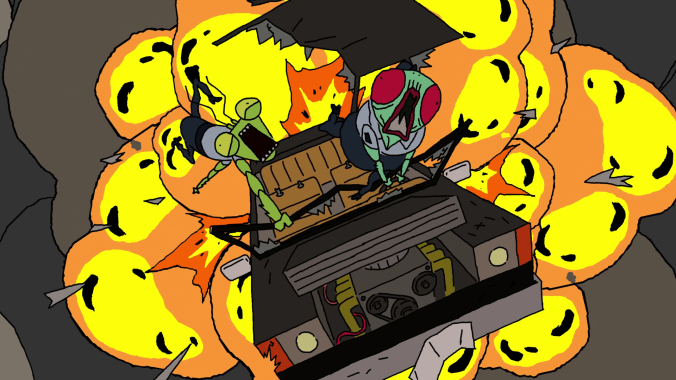
Not only is the artstyle of this series fitting, but the animation as well. The style is reminiscent of Les Kassos – however, while their previous series only dealt with one static POV camera as a stylistic choice, Vermin has the complete added benefit of being a buddy cop film, with fantastically framed and choreographed action scenes, which I won’t spoil here.

The animation seems to run on carefully chosen keyframes with not many inbetweens, giving a choppy feel to the look, but this is used to great effect, most notably in the comedic timing and immense speed of the action. Movement feels rapid, fast, frantic, and so energetic, that it brings the whole cast to life. Together with the “ligne claire” style of Franco-Belgian comic that date back to Hergé’s “The Adventures of Tintin” and its bold colour choice, it feels clean, snappy, and very satisfying.

giphy (1).gif

Movement makes a difference! (Source: Trailer)

There is, however, another thing that I must point out when approaching Vermin: Similar to Les Kassos, this series humour is dark, crass, on-the-nose, and to a level it will offend someone somewhere. We are talking full on NSFW scenes in nightclubs, crass language, alcohol and drug abuse, a high amount of graphic violence, and dark adult themes.

Screenshot_20180428-183747

A random tweet on my timeline brought me to this series, and it described Vermin as “a mix of Zootopia and Devilman crybaby” and this is quite fitting on many levels.

For one, the small town character going to the big city to become a great police officer and the city of animals setting feels very Zootopia, but it is the Devilman crybaby part I wish to elaborate on.

Masaaki Yuasa’s Devilman crybaby, a Netflix exclusive anime that aired in early 2018, was a new adaptation of Go Nagai’s classic manga Devilman from 1972. It built on the source material, putting a new modern spin on a long-running franchise, with many NSFW and explicit scenes of violence and sexual content – fitting for the equally groundbreaking source material.

However, this was mostly only possible due to this anime series being a web-exclusive. All of this content would have been omitted or adapted differently if it had to conform to the rules and restrictions of TV productions. With the freedom of being a series that doesn’t need to change itself in order to be broadcast, the creators can act with complete liberty in their own visions and ambitions. And this is a great step in animation, reminiscent of the times when hyperviolent OVAs could flourish in the 80’s and 90’s, simply because they did not run on television. Hidden behind a paywall, behind a VHS back in the day, and behind an app download or stream service today, they can do however they please. And this artistic freedom that allows for unique, new and surprising projects.

Just make sure that you know this going into Vermin. This show can get very intense and dark. And very, very explicit. Very much.

Screenshot_20180428-180427.png

Nope. Can’t show that here.

If you can deal with the direct approach this series takes to everything, you will have a fantastic time. The characters are endearing, the dialogue is snappy and fast, the action is intense and strong, and the comedy will have you in stitches.

In this raunchy, violent world are characters that look out for each other and try to do their best, even if their friendships start off on the wrong foot. Mantos is a great main character, one who has to grow and learn, and Shermock has to overcome her bad habits, sombre past and terrible lifestyle.

Screenshot_20180428-175554.png

Mantos. Young and inexperienced.

(Spider-Spider gives support. He is a superhero spider. Spider-Spider. Swings around with his butt.)

Screenshot_20180425-003517

Shermock. Shining justice.

Screenshot_20180425-004044

Mantos and Shermock. An unstoppable team.

Vermin is a great production by Studio Bobbypills that you should check out if you are even remotely interested (and if you have no problem with raunchy, violent and intense imagery). With its short runtime of 10 episodes à 8 minutes, you can easily binge the series in one or two days. Vermin is exclusive to the app Blackpills, a new streaming platform for short webseries, which is free to use, with only one or two 5-second ad breaks inbetween.

On the question of which version you should watch, there is a French Dub, an English Dub and a Spanish Dub, which you can all combine to your heart’s content with a plethora of subtitles, ranging from German, to Italian, to Arabic.

I watched Vermin in its French Dub with English subtitles, as it had the added benefit of a few re-occurring stellar voice actors I already knew from Les Kassos. I especially wish to praise French female rapper Casey for her performance as Shermock, who really breathed her character to life with her rough charme and deep lovable voice.

(I looked into the English and Spanish Dubs as well, and from a first impression, they sound absolutely fine to me too. Down below I have linked all three trailer versions, you are free to choose, as you can put your favourite subtitles under any version whatsoever.)

Conclusion

Vermin is one of those series that nail the premise of: “It’s not for everyone, but if it’s for you, it’s for you.” Not many comedy series can make me laugh so hard that I fall into a minute-long coughing fit, and I highly respect Vermin for that. In the end, it even felt too short, this series could have easily been full-length instead of short-form, as I wanted more of this world, these characters and their adventures. The finale was surprising and a bit abrupt, but fitting, and I certainly would be immensely happy about a Season 2.

Studio Bobbypills, (especially director Alexis Beaumont, producers Hafid F. Benamar and Balak) really have produced a little gem here that deserves more praise, coverage and spotlight. I had a ton of fun, and I will rewatch some of these episodes as they make me laugh hard, and more than once. As I said, if you are interested, check it out, and if not, at least keep this studio on the radar – they will do some more great productions in the future, I can already feel it.

The End.

ENGLISH TRAILER:

FRENCH TRAILER:

SPANISH TRAILER:

Sources: Wikipedia entry “OVA”, Vermin IMDB, Bobbypills, Bobby Prod [1 2 3 4]

MANLY MONDAY: “LifE”and “Confession”- Fukumoto Double Feature

Nobuyuki Fukumoto, or nicknamed “FKMT” for short, is most known for his unique, sharp expressive artstyle, and hard-boiled underworld stories, that cut to the core of human emotions.

Since the 90’s, he is a successful mangaka, with several long-running series, that are all beloved by critics and fans alike. But one of the downsides would be that therefore his work is not easily accessible. His manga are fantastic, but insanely long -“Kaiji” and “Akagi” have both been running for 20 years now, and other series have had spin-offs, parodies, prequels and sequels. The “Fukumotoverse” is immensely big and vast, yet so very lovely to get lost in. Intense long stories all around.

So, is there a way to get a glimpse of his work, for a newcomer for example? A “snack-sized” FKMT story?

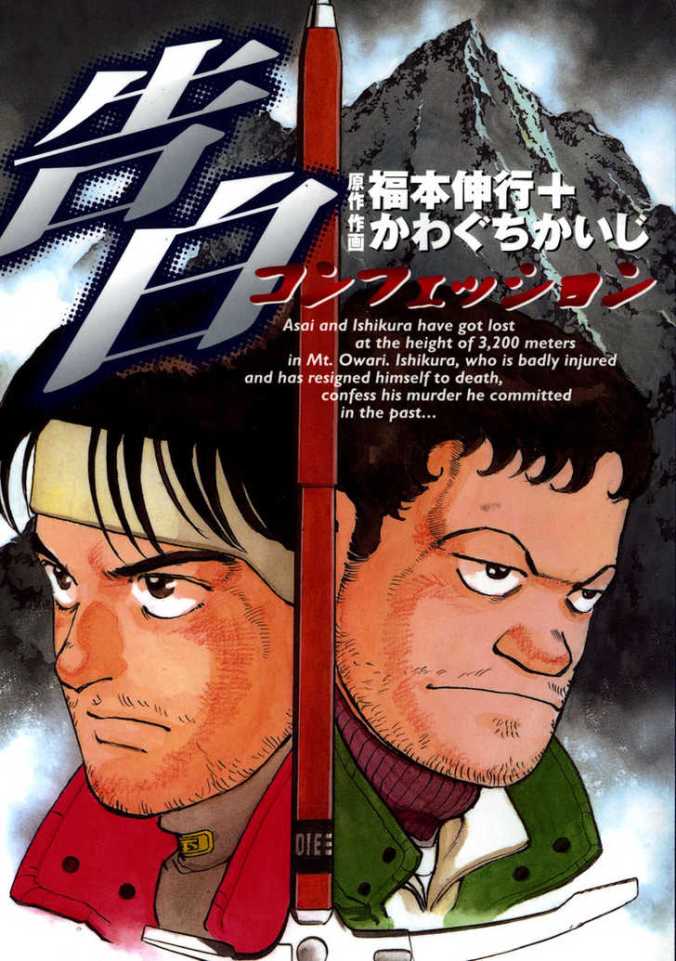
There are two short stories written by him, illustrated by Kaiji Kawaguchi (Ha! Kaiji!), that are short, intense and have all the traits of the author. These two manga are “LifE” and “Confession”.

LifE

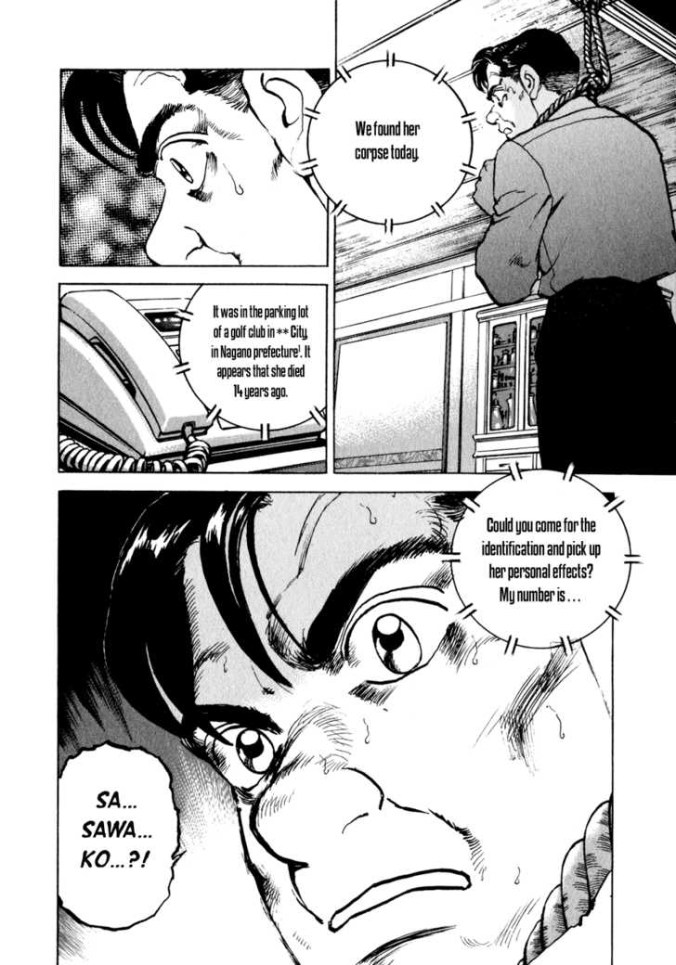
“LifE” or “Seizon Life” is the story of Masao Takeda. His wife died after a hard and long fight with cancer, and now, he has been diagnosed with the same cancer as well. Devastated and emotionally destroyed, he wants to take his own life.

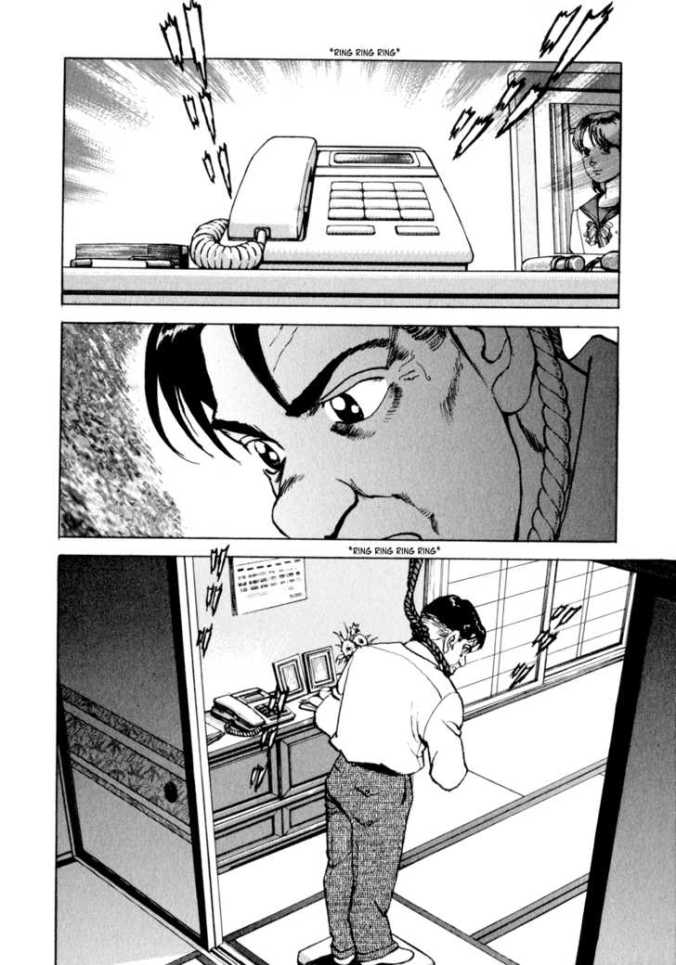
But as he steps up to the noose to hang himself, his phone suddenly rings.

edc3852bbddba4e00c5b07e9ec84adb20ac74559e7af3b86bd7e3656369bc8121cb8d8403866c552b16846a90aeff2b6

They found the corpse of his teenage daughter, Sawako, who went missing about 14 years ago. As he goes to the police station, and finally sees his daughter, he asks if the murderer can be found. He is informed of a crucial fact:

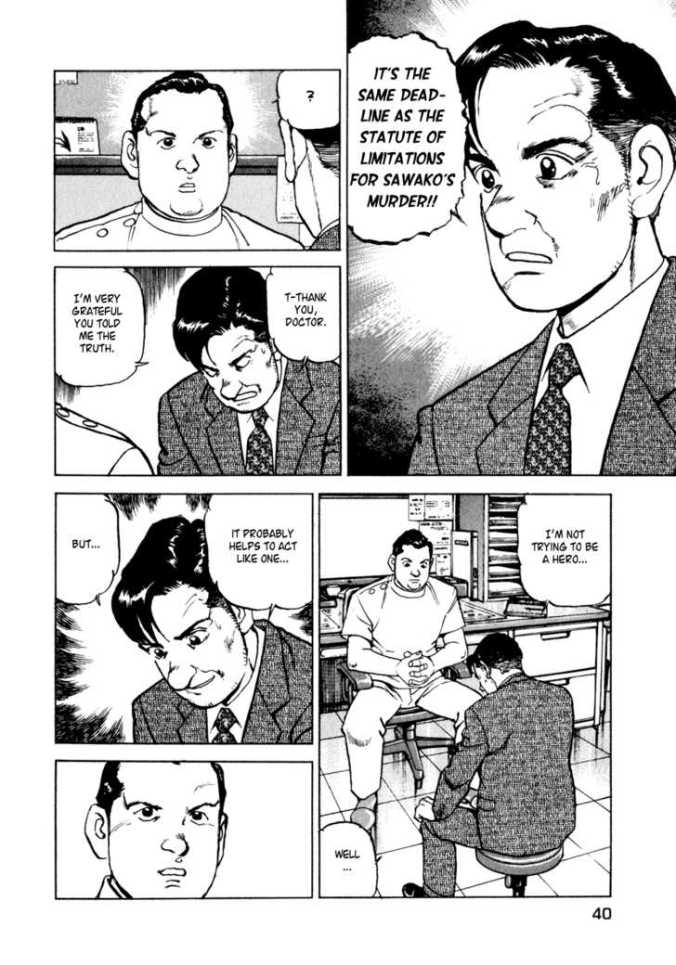
The “statute of limitations”. When 15 years pass, a case is dropped and closed, even when the true culprit has been found. Sawako has been found after 14 years and 6 months. In 6 months time, the killer will walk away unpunished.

Takeda cannot accept this. He waited so long for the confirmation of his daughter’s death and the finding of her body to give her a proper burial. He wants to take action. He will find the killer. Come what may. Yet his doctor is not ok with this.

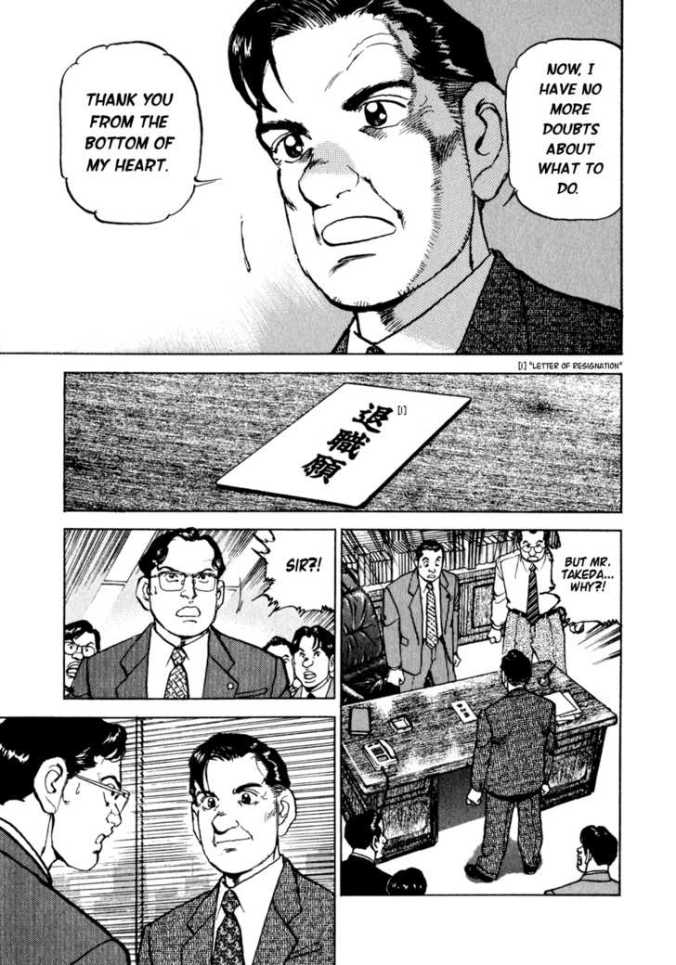
f17a7b4c41d57d671309870e1c66196e57644cda74f144a838ac1f41a25641706314630e914f5c38a5451e46ef699be0

He hands in his resignation and walks away.

6 months until his death. 6 months until the murderer is free. This cannot be a coincidence, he thinks. And so, he goes on his very last mission: Find the killer of his daughter.

life-1

He is somewhere. Out there. A free man, unpunished.

The story unfolds, and reveals single pieces of mystery and detective work, as Masao Takeda tries to walk the same path his daughter did on the fateful day she died. As he retreads his memories, Takeda sees himself as a bad father during her lifetime. He was too cold, distant, didn’t really care for her interests and hobbies, and was always at work.

But now, all he can and even must do, is to look at her life and interests.

5f210497582ad7896b38455dbcbb10c22ded9dac1720c6afa021f2ddbff3090f

And so, they reunite from beyond the grave to find the killer and their lost time – together.

A big criticism of FKMT’s body of work has always been that he doesn’t include romance or important female characters in his stories. While largely true, this does not impact the strength and importance of his work. It is not his focus, and it may also be his way of breaking with his “Shoujo Manga Artist” past. He was once an artist who wrote and drew romance, even winning awards with it, but it left him unhappy. It was not what he wanted to do. So, he left the magazine he worked for, and went to a tiny Majongg manga magazine. And this is where his career took off. But now, it is nearly impossible to find his old work before he started doing Seinen.

Instead, he has found his way. He understands and paints “relationships”, especially between male characters, more than any other: be it top-down unbalanced friendships, true friendship, naive falling for fake relationships, false admiration, extensive villainy, a mix of all of them, or in this case: Family. And as he has shown in other works – most noteably in Kaiji Part 4 – that “family” is theme he can do perfectly. It’s even a more rare case here: The bond between daughter and father – a theme way too often overlooked and underexplored in media. “LifE” shows it in a beautiful, strong light, that may bring a tear to your eyes and make your heart swell.

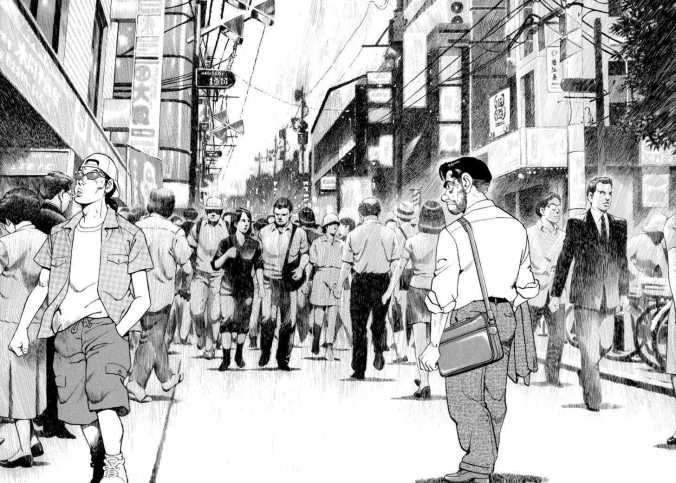
Takeda only has 6 months to solve the case, and to live on this planet. It is his last stand and final action. The clock is ticking. 15 years are a long time. Many things have changed. This is not going to be easy.

life-3

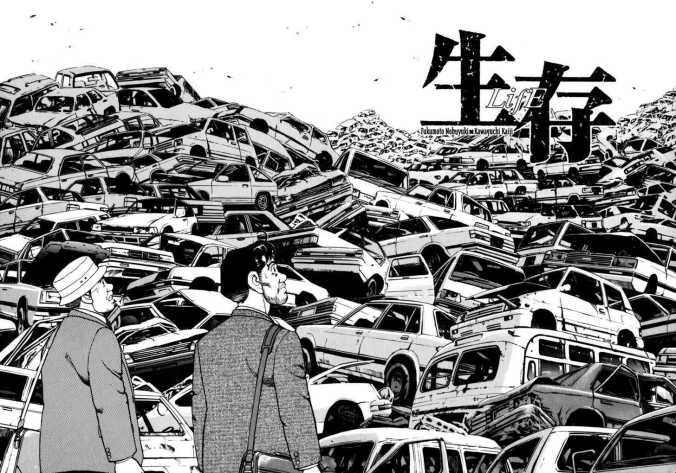
It’s like finding a needle in a haystack. Or a clue in a junkyard full of cars.

Complementing FKMT’s writing is Kawaguchi’s artwork, a very detailed, but still slightly cartoonish look, that gives it a strong sense of realism. A special focus should be put onto protagonist Takeda. His grave, sad, expressive face is what carries this manga. In addition, cancer is eating away at Takeda’s general health, meaning that he becomes more and more thin and gaunt the more time passes. The visual clock of his well-being is ticking away too.

Takeda must also walk the fine line between “handing the murderer to the police”, and “not turn into a raging vigilante”, which is also a theme in the story. When sadness and grief builds up for so long, it can cause immense damage.

6835e044630dc80e5712e1fe08129e08

“Shining Justice” certainly looks different.

While this story seems inherently sad from the outlook and may scare some readers away, I can more than recommend it for its intense detective/mystery story, but also for the heartwarming moments. “LifE” is a story of hope and sadness, reuniting of a family, the bond between father and daughter, and the race against death – for one last act of justice.

“LifE” is concluded in 3 volumes, and would make for a really good movie length-wise. FKMT’s writing and Kawaguchi’s artstyle really compliment each other and create a strong, emotional impression, with a touching story and expressive art.

57706141800f05de310aee185008a893

After this heartwarming/breaking story, let us focus on FKMT’s other short story and main strength: Intensity and Thrill.

Confession

“Confession” or “Confession: Kokuhaku” is the story of two friends, Asai and Ishikura, who go hiking in the snowy mountains, but get lost in a snowstorm.

31903dcad677faf541906944f8298dc4

Now, you may look at this cover and think, “Man, why would you write such a spoiler on your cover?” There is a point to that. It is the initial setting.

5f94a67af7da8b95876aa7a9af32177d49bdcd676c8eea469eb7ad1ff9a160a578ebf42a56d54be2bb04414b6d76a2e0

This happens in the first 15 pages.

Ishikura confesses that he killed one of their friends during a past hiking trip. He is certain that they will both die in this snowstorm together, so he wants to confess his sins, to, at least, die in peace.

Asai is understanding in this extreme situation. How can he deny his dying friend’s last wish?

But as Asai gets up, for a desperate try to look for help, suddenly:

ea6259b60fcfee2f484a3ca95179bbbc214272010ad5b46da5eb8044ac1aa436

They weren’t far from their original destination, a mountain lodge.

Saved! They are not going to die out here in the cold! So, he simply needs to carry his wounded friend up there and call for help! Everything is going to turn out ok, is it?

fce7cf159e3bdf36e8387eb9261192ce

No.

In fact, everything has become worse. Ishikura just confessed a murder. And he survives. His dying wish has turned into a massive regret. Maybe into something more.

19da7d7b98e747ae25e1e7256fbdaa95733c225803a84d2eb29d3ce7ff2b96ab

Something is not alright.

And so, the manga starts. 2 days until help arrives. 2 men in a single room. One of them is a murderer, who just confessed. But he is hurt, so he cannot move.

What to do now?

6c9057b9d60e4aaacc4e5774d235d68b

They wait.

Kawaguchi’s artstyle really shines in this story, as he also shows a stylistic preference and focus that FKMT prefers in his manga: Eyes.

eye

confession

Eyes say more than a thousand words.

This is peak FKMT writing: Psychological warfare with real physical threat between two characters. We see both sides and it has the genre of a “chamber play” – a whole story that plays out in a single room. His writing influences the artstyle as well, a lot of reaction panels, atmospheric shots and internal monologue that just flies by. His writing is so smooth, you won’t notice going through many, many pages.

268b50cef47e51940c15cd8b352bd580

I do not wish to tell you more than this setting, because this story is best experienced blind, without prior knowledge. Just let it be known that FKMT is a master of dialogue, suspense and Thriller.

“Confession” is only one volume, about 300 pages long, and yet it has you on the edge of your seat at every page turn.

Conclusion

If you ask me personally, I prefer “Confession” over “LifE”, as it had me cling to my table while reading it. This does not mean that “LifE” is bad, far from it. Both works are brilliant short pieces, but fundamentally different in tone and narrative structure, so that it comes down to personal preference. While “Confession” glued me to the pages and sucked me in with pure intensity and rough power, “LifE” made my eyes teary in empathy and understanding.

Both stories have aspects that many fans and critics love about FKMT’s writing: Heartwarming and heartbreaking moments, raw emotion, intruiging characters, difficult and interesting relationships, unique situations, psychological aspects and intense atmosphere.

If you are a fan of FKMT already, these stories are interesting additions to his canon and great observations about his writing, to see it detached from his unique, yet “something-to-get-used-to” artstyle.

If you haven’t read anything by FKMT yet, or have been put off by his artstyle, this may be your chance to check him out as an author and see the appeal that his trusty, long-living fanbase loves him so much for.

The End.

“Kaiji” – An Introduction to One of my Favourite Anime

kaiji-and-group.png

Genres: Seinen | Thriller | Psychological | Gambling

Rating: R (17+)

Studio: Madhouse

Year: 2007 (Season 1) | 2011 (Season 2)

Streaming License: Crunchyroll

What is this?

“Kaiji” is an adaptation of the manga by the same name, by author and mangaka Nobuyuki Fukumoto. “Kaiji” is his highly regarded, most popular manga. Running since 1996 and still ongoing today, it is a very influential piece and a beloved franchise. Like other long-running series, it is split up into story parts. The manga is currently in Part 5, and Part 1 and 2 were adapted into anime by Studio Madhouse, with Season 1 and 2 respectively.

Story

In the financial crisis of 90’s Japan, Kaiji, a young good-for-nothing guy, is failing at life. Accumulating small gambling debts, drinking and smoking, being jobless, living alone in his tiny apartment – he lives a sad life that he wants to change. Due to a stroke of tragic destiny, he suddenly gains a lot more debt, as he absent-mindedly signed a contract for one of his co-workers a few years ago. Now a mafia loan-shark stands in front of him, telling him that he is 3,850,000 Yen (~35,500$) in debt. And they want their money back. Now.

Thus starts the adventure of Kaiji, through a lot of manly tears, addiction, hype, tragedy, happiness, gambles, pain and twisted gameshows.

kaiji-cry

Eh.

What?

I have seen this, I don’t like the art style. It looks ugly.

Don’t worry, there are perfectly good reasons for the art style to be like that.

Firstly, this is Fukumoto’s style. His character design is sharp, angular and instantly recognisable. And Madhouse did a fantastic job of brushing up his style and giving it a fresh coat of paint. Here is a comparison between the first chapter of the manga (1996) and the first episode of the anime (2007).

00.png

This slideshow requires JavaScript.

Sharper, cleaner and more modern, while keeping the spirit.

They made the initial artwork more accessible and more timeless, the same way Studio David Productions handled the modern adaptation of Jojo’s Bizarre Adventure.

Secondly, this style fits perfectly for the stories Fukumoto is telling. Kaiji is a story of the lowlifes of this generation, the ones without hope and money, the shady business of loan sharks and the dark empire of the yakuzas. This is not a pleasant world, and the art reflects that. It is not supposed to be beautiful. The creators were in on the joke for Season 2 and straight up advertised it as “It’s the anti-moe anime.”

You will grow to you like it, once you see it in context and motion, trust me!

Characters

The main protagonist is Kaiji Itou, a man in his early twenties, our first grade procrastinator and overly emotional underdog. He may be one of the most relatable characters, without being a self-insert MC. Today’s anime landscape is saturated with overpowered light novel edgelords and insanely dense harem “comedy” protagonists, who can’t express any emotions except embarrassment when confronted with any form of sexuality.

Kaiji is emotional, he cries a lot, but he is annoyed by this fact – he doesn’t like it. He wants to change his life, he wants to do something! But life is not that easy sometimes. Some obstacles are thrown in his way, some obstacles he creates himself.

Significant to notice is: He is emotional, not whiny.

His emotional range goes both ways. From happy to sad, from destroyed to gleeful, this man has everything. He is expressive and vivid, in Season 1 and even more in Season 2.

kaiji compo v2.png

Season 1

kaiji compo 2

Season 2

Kaiji as a protagonist is an outright joy to watch, and that paired with the intense, unpredictable, serious Seinen plot, makes an emotional rollercoaster. Will he win? Will he lose? Will his plans work out for him?

When he is thrown into this unusual situation of fighting to survive, kill or be killed, he will reach his limits; but here is the important fact: He will not give up, he will fight. The harder he is pushed, the harder he will fight back. Even if that means suffering and dealing with the consequences of lost gambles.

And the yakuza do not take kindly to people screwing with them. Believe me, there is a reason “Kaiji” is rated R. Expect physical and psychological violence. This series gets intense. Manly tears shall flow.

tumblr_mkz5tcLoLO1r5kw8so3_1280.png

Life isn’t all sunshine and rainbows.

Voice Acting

What makes Kaiji also work as a protagonist is not only the story and the characterisation; it’s also the voice work of Masato Hagiwara as Kaiji. He is not a voice actor, he is a film actor – often playing roles in drama and thriller movies. He is able to pull this emotional range off, and give it a realistic, non-anime touch. The main character breathes and comes to life.

The other important character is the “Narrator”. With a big, booming voice, he will explain and announce, and sometimes even have his own monologues. Over the top and full of ham, this performance is pure fun. You may recognise this voice: It’s Fumihiko Tachiki a.k.a. “Gendou Ikari” from Neon Genesis Evangelion.

This rift between realism and overstatement creates both moments of comedy and drama. Having these two voices clash is bliss.

stare.png

The narrator knows what’s up!

Soundtrack

Absolutely fantastic. As this anime is mostly about mind-battles and has heavy use of internal monologue and dialogues between characters, you need something to accompany this mass of words. And the OST by Hideki Taniuchi is stellar. You could watch this series for its soundtrack alone.

The whole OST is an effective blend between “hype”, “melancholy” and “INTENSE” . I can only call this OST “depressingly uplifting”. It fits the tone of the show like a glove. (I do not wish to spoil the soundtrack, but here is a selection if you want to check it out beforehand.)

Hype

Fate | Wish | Don’t Give Up | High Max

Melancholy

Beginning | Regret | Elegie | Child’s Mind

INTENSE

Middle Zawa | Black Sun | Prologue | ZAWA ZAWA~

What is this “Zawa”?

As most long-running influential series, some aspects gain a form of an iconic status.

For example, in Jojo’s Bizarre Adventure, it’s the use of  ゴゴゴゴゴ, the “menacing” sound effect used by Araki. Fukumoto also has his own sound effect that he uses: ざわ‥ or “Zawa…” meaning “unnerving/muttering/whispers/uncomfortable”. Madhouse, like David Productions, incorporated these sound words into the anime, and in this case, even into the soundtrack. It has a unique effect in creating an uneasy atmosphere.

kaiji.png

ZAWA…

Any downsides?

The animation is not the most mindblowing of all – it is solid, sharp and polished, but it takes a backseat compared to the dialogue, the characters, the intrigue and the soundtrack. Sakuga moments do exist, and they are great, especially in the realm of character acting – but most are reserved for big reveals and story twists. The use of CGI is unfortunately there, a bit more so in Season 1 – but it is mostly used as a 3D camera for establishing shots and sweeping shots through rooms and across tables. But: CGI is never used on characters or crowds. They are always hand-drawn, which is a big plus.

Another thing would be the sort-of slow beginning. Season 1 does not immediately start with life-or-death scenarios and Kaiji, the old procrastinator, needs a good slap in the face before he gets going. He needs to understand his position first. But once it gets into the hype flow, you will be binging this series. His character development is beautiful to watch.

Season 1 is great, but Season 2 clearly outshines it, with better soundtrack, better animation, better characterisation of the villains and even more intense mind battles. Fukumoto gets better with every part, in his writing and his artwork, and it shows.

Also, Studio Madhouse made a season 2 for once, hurray! Therefore, Season 3 never. But you can immediately pick up the manga for Part 3 after finishing Season 2, if you so desire. The adaptation is very faithful.

(And stay away from the live action movies. They’re bloody awful adaptations. But that is a rant for another day.)

Influence and Conclusion

ka

Kaiji was highly influential for the mid-nineties, by having a humane main character, who has his own flaws and occupies the position of an underdog. He is not overpowered, he has to work, scheme and think hard in order to win. And there is no way to tell if it will work out.

The ending for Season 1 conveys this feeling quite beautifully. The slow walk with a grave, Western style song, that nearly feels tarantino-esque, is delightfully elegant. Simple, yet effective.

In contrast to other gambling manga from this time period, Kaiji’s gambles are all original games. There is no Poker, Uno, Roulette, or Black Jack – everything and anything can be a gamble. This makes it easier for the audience to understand the situations, as no previous knowledge is needed and we, the audience, can figure out a way to beat the game with Kaiji together.

And little references to “Kaiji” are still present in anime today, either in direct form or as parody. Kaiji recently even got a “Monster Hunter” DLC, complete with little word clouds of ZAWA that surround your character. (Trailer, Attention: Little visual spoilers for Kaiji!)

It is a cherished franchise, still today, after 20 years.

“Kaiji” is a unique, intense, historically important manga, winning the Kodansha Manga Award in 1998. It has been treated and remade with great care and love in anime form, and I think that you will enjoy it. Both seasons have great ratings, but they are criminally underwatched. Maybe it’s your turn to check them out!

Watch this if…

– you like Jojo’s Bizarre Adventure. As already mentioned above, it’s an old manga series that has been brought to life again with a lot of care and love for the influential, beloved source material. The mix of intense battles and manly emotions is similar – just with a lot less muscles and longer hair. Important: If you loved the D’Arby Brothers fights in “Stardust Crusaders”, this is absolutely for you.

– you like Gen Urobuchi, especially Madoka Magica. Yes, you read that correctly. Both series share a common theme of likable characters going through a lot of pain and suffering. You might like Kaiji if you enjoyed Madoka for this melancholy feel. Get ready for another form of despair: Urobuchi is more tragedy and personal destiny, while Fukumoto is more human drama and moral dilemmas. It’s different, but in the same tradition.

– you like Sports Anime: Gambling is a sport! Just with more “card-throwing” and less “ball-tossing”. Some episodes feel as if only 5 minutes had passed. The hype soundtrack and insane cliffhangers will have you on the edge of your seat, as per usual for the genre. I can’t possibly fathom how people could have watched this series while airing. Kaiji is highly binge-watchable.

– you like Mind Battles: “Death Note” or the manga “Liar Game” are some examples that fit the genre. They are cat and mouse games, where the roles can easily switch from the hunter to the hunted.

you have been feeling down lately. There is nothing more cathartic and supportive than watching a character who is in an equal, or even worse position than you are. You are not alone. Aren’t we all procrastinators? Do you also just work when somebody forces you, or gives you a deadline? Haven’t we all got hope that our lives get better? Instead of looking for escapism – go for confrontation.

TL;DR Kaiji is a long-running manga, starting from 1996 and still ongoing today. It currently has 5 parts, Part 1 and 2 both got an anime series. Kaiji has ludicrous amounts of debts that he has to pay back to the yakuza. Join him in his adventures and his life-or-death gambles to get money. It’s a depressingly uplifting tale, with an endearing, overly-emotional protagonist who is all too relatable.

UPDATE July 2023: Kaiji was mentioned as one of the main influences on the Netflix hit series “Squid Game”, and the anime has a US Bluray release! Please enjoy!

kaiji-and-group

The End.