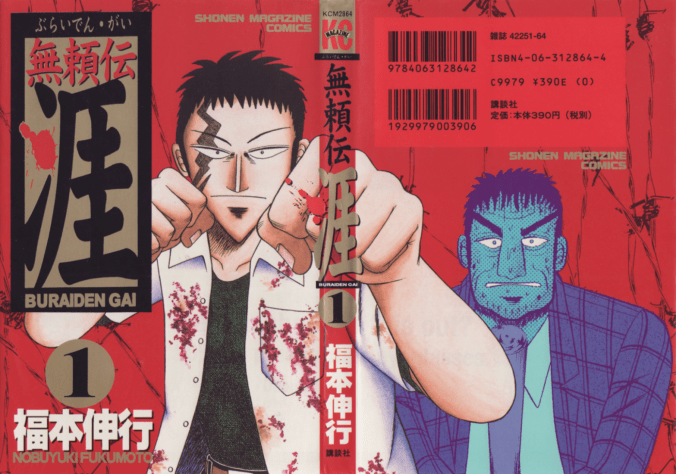
It is a good time for Nobuyuki Fukumoto’s works. Gin to Kin and Akagi both have successful TV dramas, the Kaiji manga has started a new arc, Zero is getting a steampunk TV adaptation, and the highly anticipated Tonegawa anime is on the horizon, with a release scheduled for July 2018.
In this big “Fukumotoverse” with its prequels, sequels and spinoffs, lies one smaller work that is on its own. No continuation, no adaptation, there it stands, alone and completed – fitting for its own story, themes and characters.
This is the manga Buraiden Gai, or “Legend of Outlaw Gai”. This manga was published from 2000 – 2001 in the Weekly Shonen Magazine, (not related to JUMP) which has more popular and successful series in the past and present than you might think: Devilman, Ashita no Joe, Hajime no Ippo, GTO, and recently, Koe no Katachi, Fairy Tail and AKB49.
In Buraiden Gai, the eponymous Gai, a young 13 year old schoolchild, is running. Running away from the police.

And so, he is cornered in a dead end street.
The city is in chaos, the media is all over the place and the police is unable to cope with all this confusion. Why is everybody on their feet trying to catch this young boy?
As it turns out, he murdered an older man. Not any man, however, but the patriarch of a big and influential yakuza clan. As Gai faces the overwhelming police force with nothing but his bare fists, he proclaims: “I was framed!”
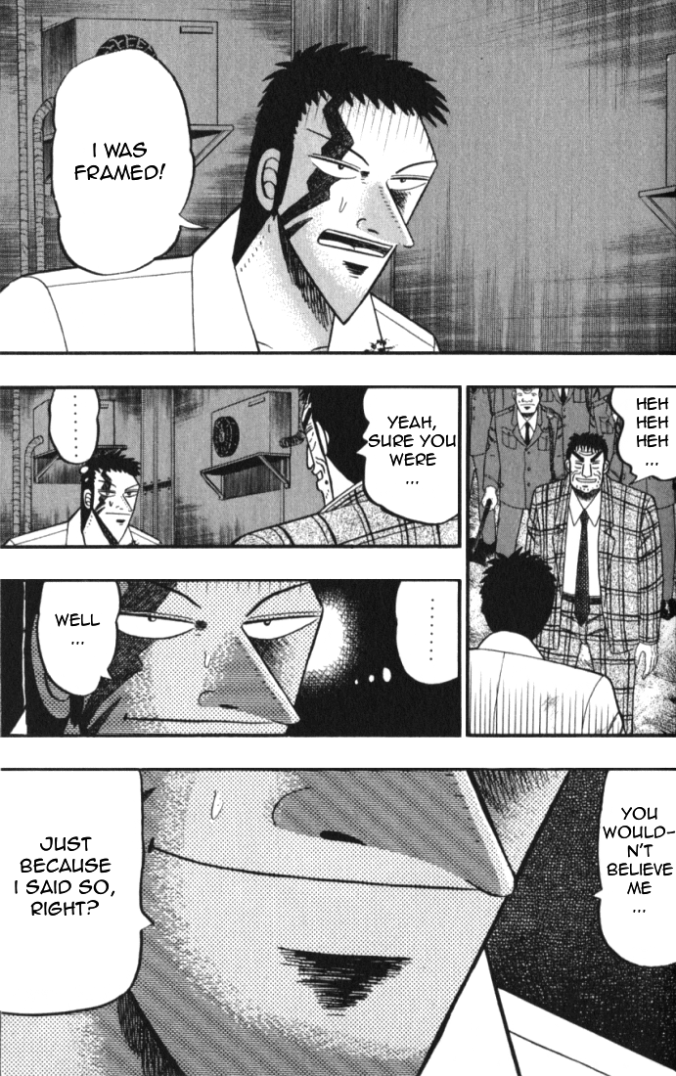
Of course, no one believes Gai.
The evidence points absolutely against Gai: his fingerprints are on the murder weapon, on the body, at the site and his escape from the crime scene is recorded on a security tape, directly after the point of murder.
After a long verbal battle and a short physical one with the police inspector, which Gai surprisingly wins despite his age and size, he is arrested. Too young to go to prison, he will be sent to a youth rehabilitation facility before his trial. However, as he arrives, he finds out that this is not better than prison, in fact, it’s worse.
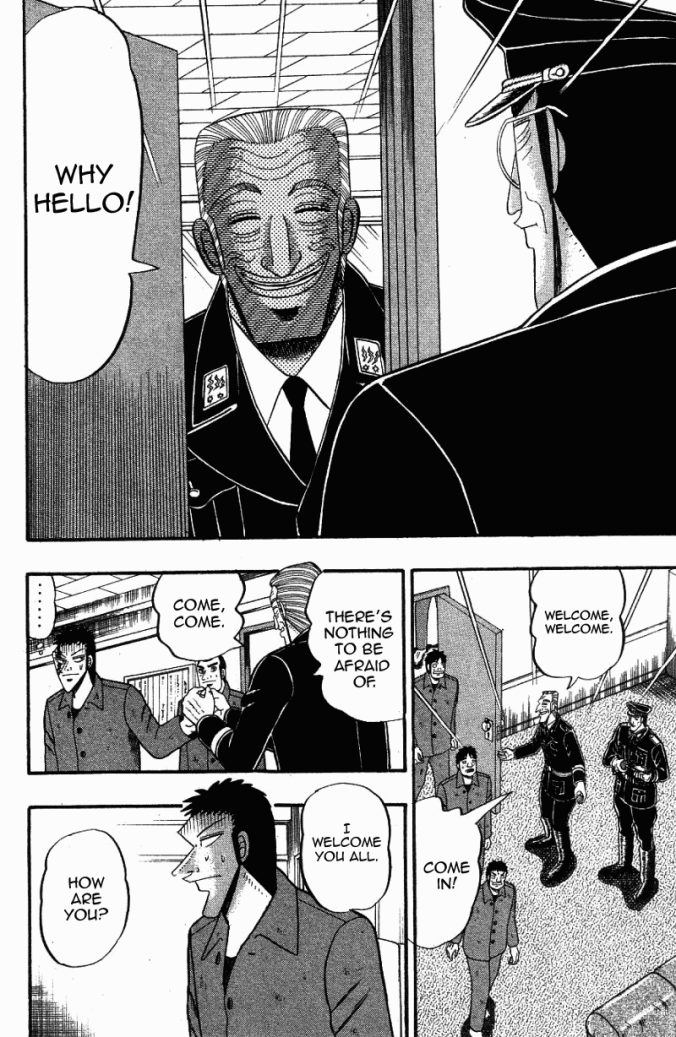
Something is fishy. Especially the visual historical weight of those uniform designs, if you look at them more closely.
This is more than prison, this an institution of cruelty with one goal only: turning young people into honourable and upright citizens, with any means necessary. It immediately becomes clear to Gai: He has to get out of here, but more importantly, he has to prove his innocence. The police officer believes him, however, there is no proof that the evidence is forged.
And so, the adventure of Outlaw Gai begins: Regain your freedom, fight for justice, crash the abusive system of the adults. “Prison Break Plot” meets “Philosophy Hour”.
Inherently, this sounds like a very Shonen plot, but the seriousness and intensity of Fukumoto’s Seinen spirit shines through, which I will not spoil here. The way the young prisoners are treated is very violent and shocking, and the themes he addresses are important to anyone, not just teenagers who are the target group of this manga. And it is definitely not for the faint of heart. There will be violence and questionable “education” methods, ranging from physical discomfort to psychological terror.
We see several themes in this manga: What is “freedom”? What is “strength”? What does it mean to “grow up”?
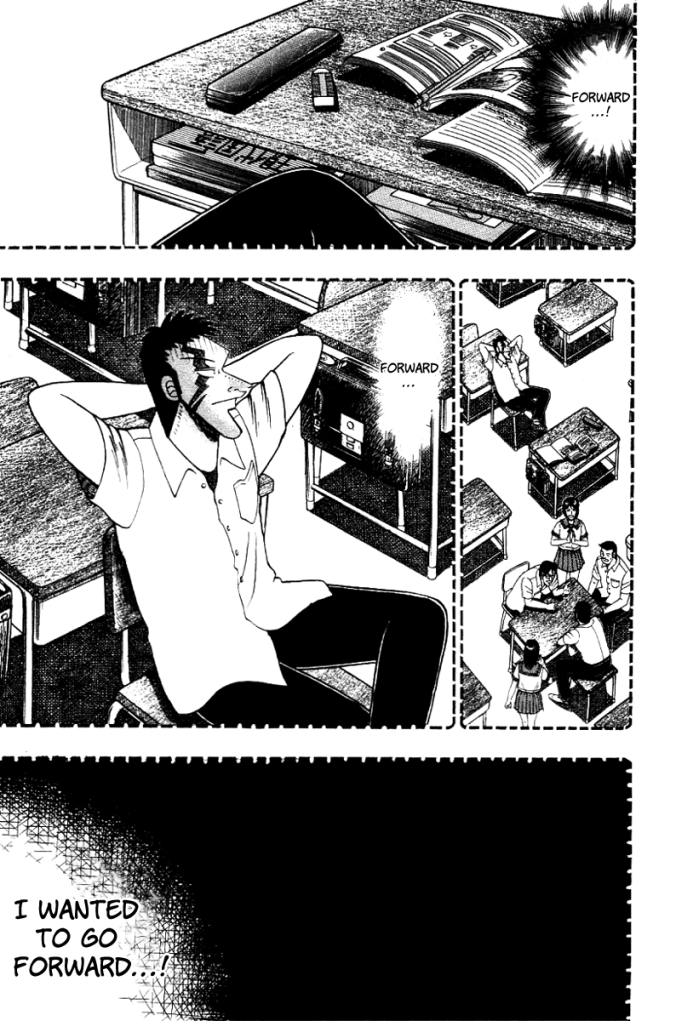
School settings are rare for Fukumoto, and thus very welcome.
Gai is a great protagonist for this story: young, with a clear, straight outlook on life, and he does what he thinks is right. He receives a proper backstory as well, which fleshes out his character even more – a rare thing for Fukumoto, who normally does not give big flashbacks to his protagonists, as they are characterised by their actions in the present, such as Kaiji, Akagi or Kurosawa. For Gai, it fits, as we see him in his middle school days, struggling with the decisions of life before he was thrown into the prison setting.
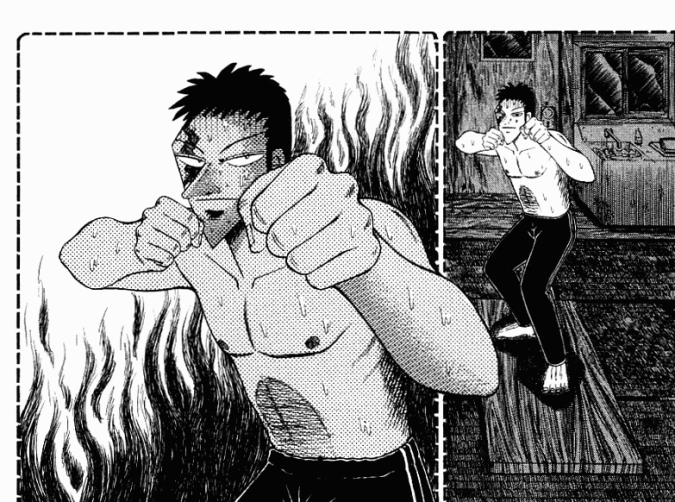
And much like Kurosawa, Gai uses predominantly his fists to solve problems. Fukumoto’s intense, visceral, sharp style lends itself perfectly to these violent outbursts that carry gravitas within the story.
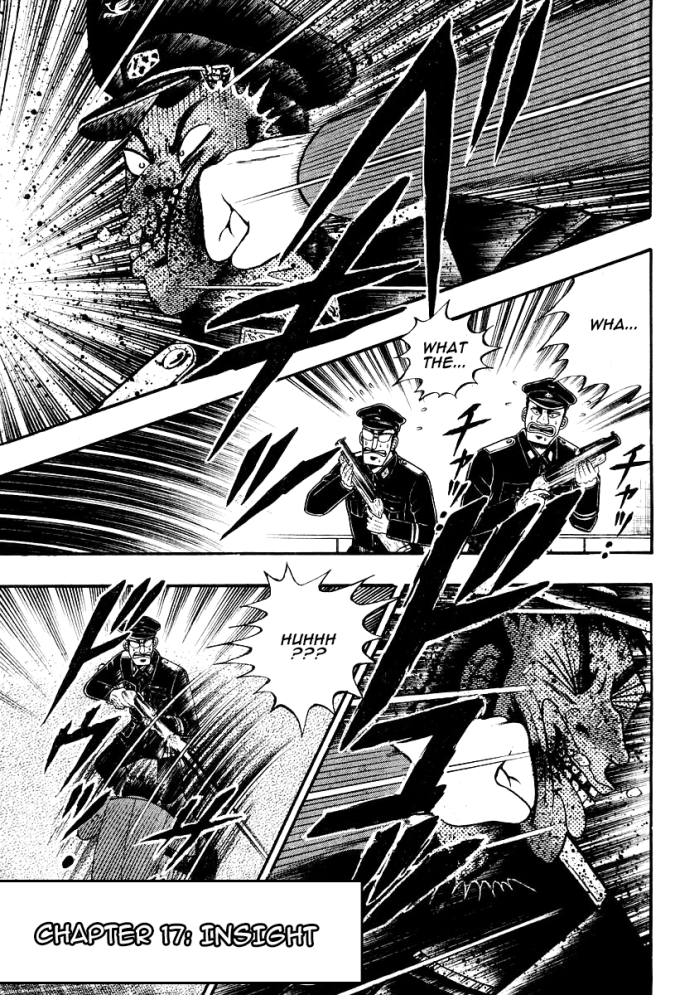
Smash the system. Right in the face.
If there is one word I can use for Buraiden Gai, it’s “condensed”. With its 5 volumes and 38 chapters in total, it is one of the shortest series Fukumoto has ever done, some of his series have been going for over 20 years – and yet, it brushes and discusses a lot of topics, through flashbacks, monologues and dialogues, all neatly woven into the story, which is equally busy: a prison break and a yakuza crime story all rolled into one.
From my research, I could only find information that the series was cancelled by the Weekly Shonen magazine, and that Fukumoto was unhappy with the ending he had to re-write, but nothing very concrete or any reasoning behind the decision to scrap it. As it stands, I like the ending, but one can feel the change in direction in the story. After about 3/4 of the chapters, the focus shifts and the narration speed slows down for a few chapters, only to pick up again – most likely to steer into the direction of the new finale.
It is a bit sad that Buraiden Gai was not allowed not fully unfold itself, as the potential is there. A young hero with a no-nonsense direction but lacking life experience and maturity, against a smooth-talking villainous prison guard who thinks his own askew methods of education are right. In addition, the Hirata Clan, the powerful yakuza family, is maybe holding more threads than they seem.
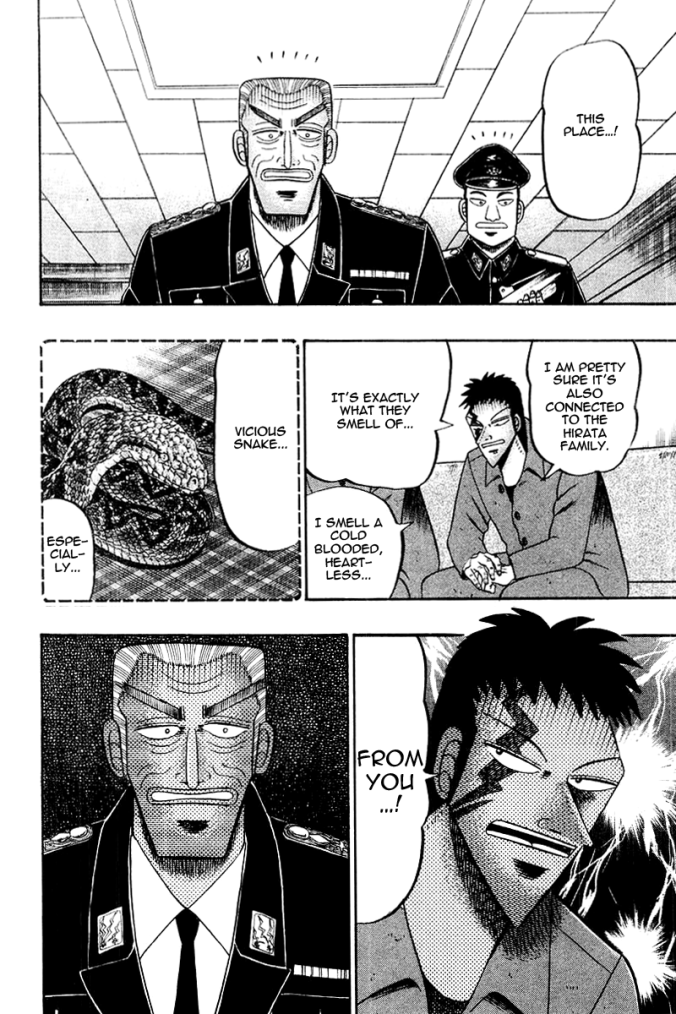
Everything is connected. Is there a way out for Gai?
Even if the story is cut short, it still delivers the themes and questions it wants to. One can only wonder what it would have looked like if Fukumoto had the time to give it the vision he intended. Buraiden Gai could have been a big epic about the struggle of growing up and wishing for independence, as well as the conflict of generations. But as it stands, it is now a short, quick Shonen that delivers its punches and disappears again into the night, to leave you with its thoughts. Other Shonen might have pushed the boundary already what goes on in the genre, from Go Nagai’s Devilman to Hajime Isayama’s Attack on Titan, both violent and intense as well, but Buraiden Gai manages to even stand out among these. If a series can make me actively queasy with its ideas without being too graphic, then we got something unique here.
You can read all of Buraiden Gai in one or two days, maybe even in one sitting, and I highly recommend doing so. Not only for its intense story and philosophy, but also for Fukumoto’s artstyle. His longer stories rarely change settings, but Buraiden Gai displays a surprising amount of setting changes, brought to great effect in great spreads.
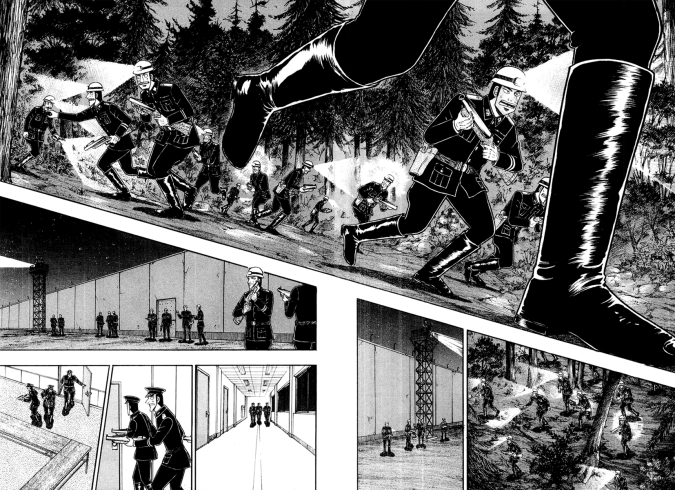
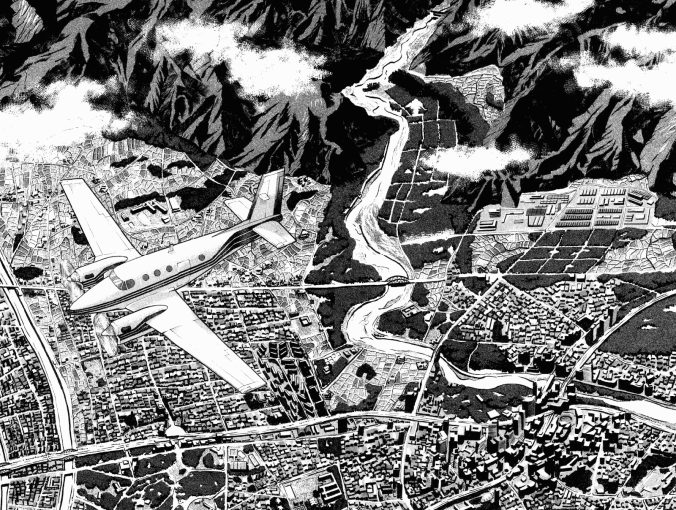
Some double-spreads are absolutely beautiful.
Buraiden Gai is the unique little Shonen outlaw in Fukumoto’s catalogue, without gambling themes or spinoffs, and I highly recommend reading it – for seeing what can be done in a Shonen Magazine, and for its philosophic content that it delivers with a sympathetic, strong and likeable protagonist.
The series had no time to show its true potential, but what it did was great, and it can nicely sit with all the other Fukumoto series in a big serious universe full of intense life stories. Will Gai break out of the youth detention prison? Will Gai defeat the yakuza? And will Gai find what he wants in life?
Give Gai a chance, he won’t take much out of your time, but I’m sure that he will stay with you for a longer while.
The End.
PS: And once you’re done, check out this fantastic mock-up of an Anime OP, in the style of the Death Note OP2.
Sources: Wikipedia entry: “Nobuyuki Fukumoto”, MyAnimeList entry: “Weekly Shounen Magazine” and “Buraiden Gai”
 Elena DS