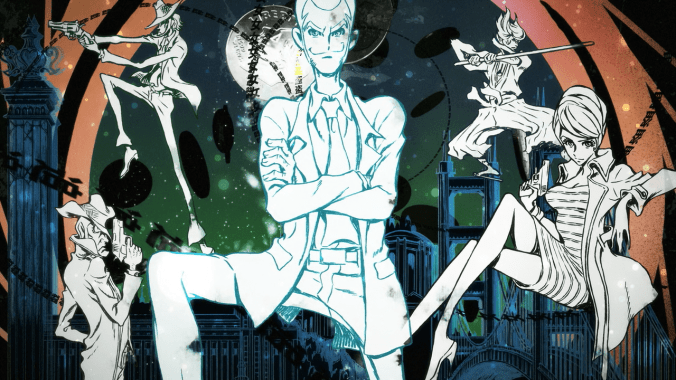
The beauty of any long-running franchise is to see the different interpretations over time. How does the zeitgeist influence an adaptation? How does the director influence the style on a narrative or visual level? What does the new look or re-design say about the characters?
Here comes Lupin III into the game. This franchise about a suave thief and his team has had many entries over the decades, from the original manga by Monkey Punch in 1967, to long-form TV series 1969 and 1977, to many OVAs and films in the 80s and 90s – some even by great and popular names in the industry like Hayao Miyazaki’s Castle of Cagliostro and Osamu Dezaki’s Harimao’s Treasure. And every creator brought their signature styles to the table.
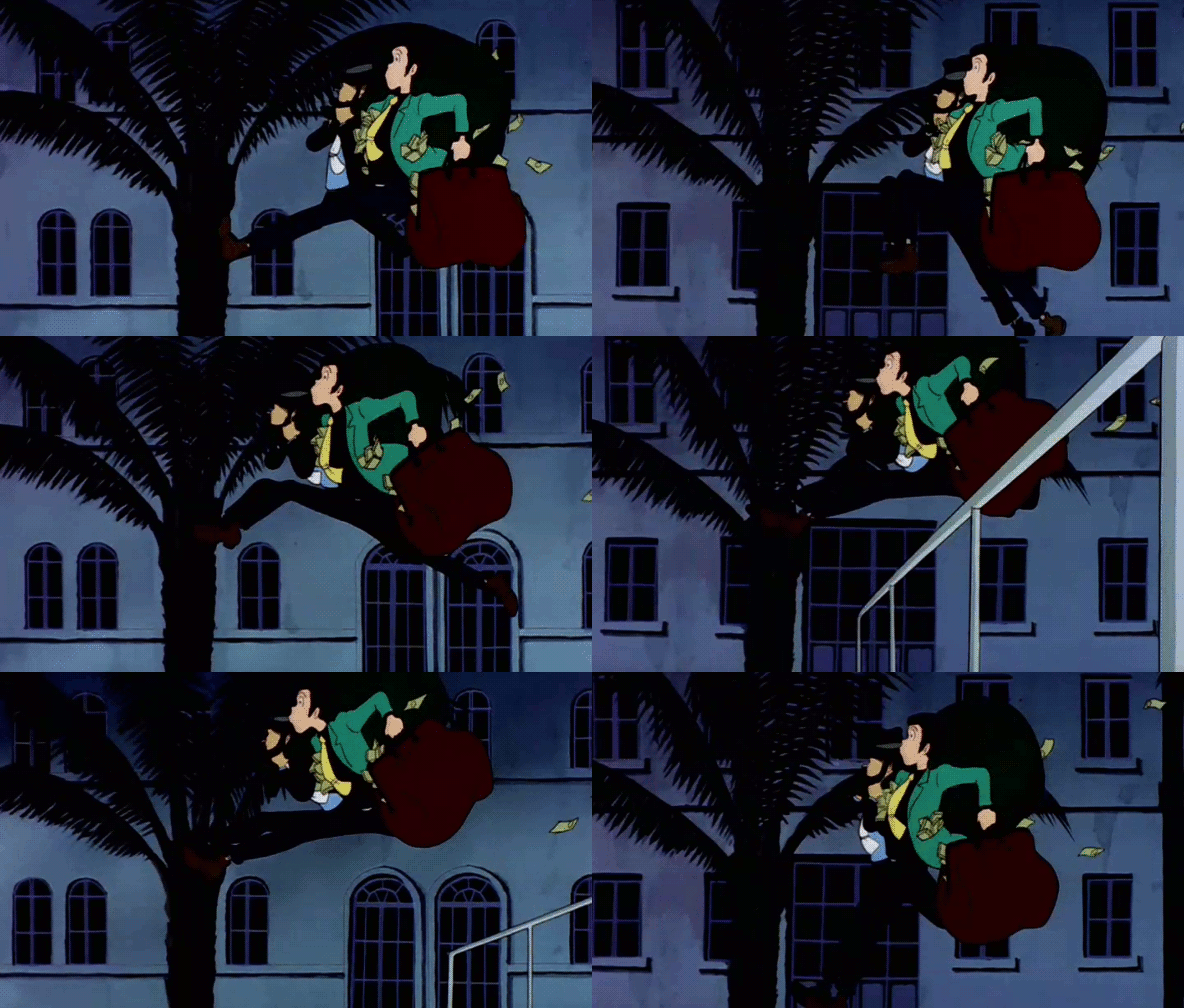
From Miyazaki’s bouncy fun and super-smooth animation…
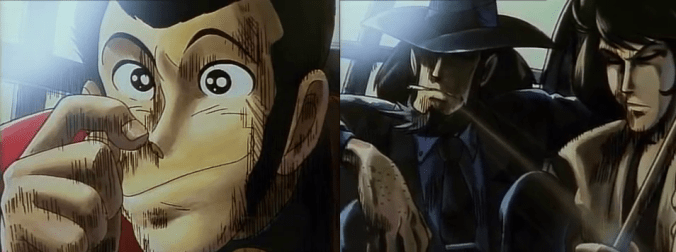
… to Dezaki’s signature style “Postcard Memories” still frames.
This, to me, is the fun of Lupin III.
It’s essentially a gigantic toybox where any creator can come along and pick up the characters to play out a story for you, and in the end, they put the toys back for the next one to pick up. Do you have a favourite creator? Look up if they did anything on any Lupin III, they most likely will have an entry somewhere! You can explore freely through many styles and time periods, and find the Lupin III adaptation that you will like the most.
You only need to know the very basics and you’re good to go: Lupin is a thief, Fujiko is a rival thief and love/lust interest, Jigen is a relaxed gunslinger, Goemon is a honourable samurai, and frantic INTERPOL Inspector Zenigata is always hunting them. And then, adventures happen – car chases, shootouts, sword fights, trickery and thievery, helping friends and defeating foes, you name it.
This toybox freedom allows for great experiments and more outlandish interpretations of the characters. Lupin III: A Woman Called Fujiko Mine (2012) by Sayo Yamamoto for example told the story from Fujiko’s side of things, with heavy themes and explorations of sexuality – heterosexual and homosexual alike – giving the franchise a very adult and interesting not-very-canon-feeling entry.
To give you a short overview of styles through the ages:
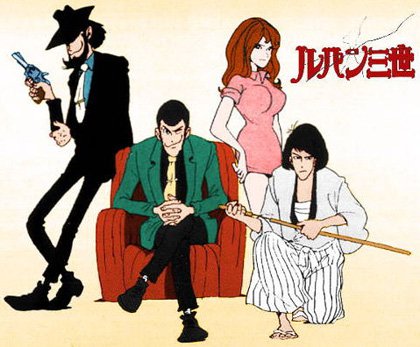
Lupin III: Part 1 (1972)
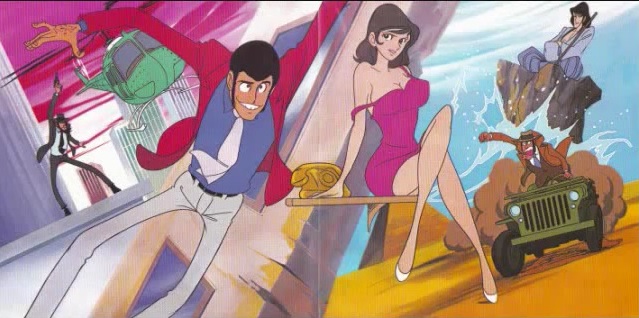
Lupin III: Part 2 (1977)
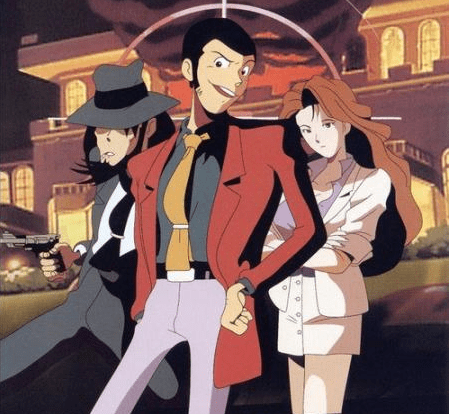
Lupin III: Voyage to Danger (Special, 1993)

Lupin III: A Woman Called Fujiko Mine (2012)

Lupin III: Part V (2018)
In 2015, the next Lupin III TV series started, called Part IV, with a light fun tone, classic thieving hijinks, and new characters to add to the roster. The opening alone will tell you the fun it has with itself, it certainly is a feel-good series where you can relax with a big smile. This year, in 2018, Lupin III Part V has started airing, with a heavier focus on the internet and the digital world, giving it its unique spin on the world too – and again, it has a fun opening, which underlines the sci-fi and digital aspect more, with Lupin’s little signature Fiat 500 flying into space to install a camera on a satellite.
So, the TV series are doing fine and are absolutely fun, what else is going on? We have the funny Lupin III airing on TV, is there a serious Lupin III at the moment too? Some other interpretation? Another creator putting their own spin on the franchise?
Enter director and animator Takeshi Koike.
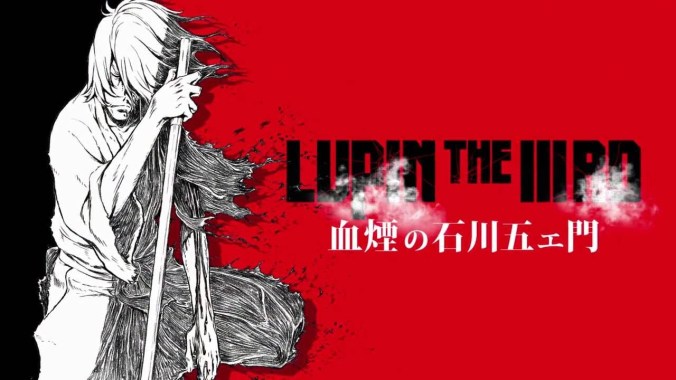
Takeshi Koike’s character design for Goemon Ichikawa.
Takeshi Koike made a name for himself with the animated film Redline, which is an absolute MUST-WATCH for any fan of animation. A story about intergalactic racers, a yakuza plot, three friends who must grow together, and the most insane race the universe has ever seen – I could speak for hours about this film, as it is one of my favourites. Koike was the director, storyboarder, character and machine designer (and probably even more, as he mostly went uncredited in his own work) for this film, and it is simply a masterpiece in the medium.
Even before his directorial debut with Redline he was a talented animator and worked on many projects: Koike is the protégée of Yoshiaki Kawajiri, the stellar director behind aesthetic and atmospheric masterpieces such as Vampire Hunter D Bloodlust, Ninja Scroll and Running Man. Koike even worked on some of these films under his mentor. And the influence is more than visible: Both use stylish sharp character design, precise and breathtaking slow motion, strong shadows with stark contrast. To this, Koike adds his own flavour: extreme and atmospheric camera angles, immense power and speed in action, and some realistic violence with impressive outlandish sword- and gunplay. (For more information and examples: Here is a sakuga compilation of his work and here a piece by The Canipa Effect.)
So, what happens if such a skilled director takes on the Lupin III franchise?
Detailed, powerful, well-directed pure fun. (Source: Jigen’s Gravestone)
Koike’s Lupin III films are intense, fun and an absolute blast.
As you can see from the scene above, Koike brings the fantastic car sequences from Redline into the mix, and as the franchise always has had outstanding chase sequences, it fits perfectly into the whole canon. Little details can be found as well, like Lupin cranking down the window and covering his ears before Jigen shoots, the outline smear on the villain when he the cars collide, or Lupin’s expressive yelling you can hear even without sound.
Takeshi Koike has so far directed and designed two Lupin III films, Jigen’s Gravestone (2014) and Goemon’s Spray of Blood (2017). They are considered “spin-off continuations” of A Woman Called Fujiko Mine (2012), however, the Fujiko series is not needed in order to watch these two, they work as a standalone duo of movies and do not reference the previous series.
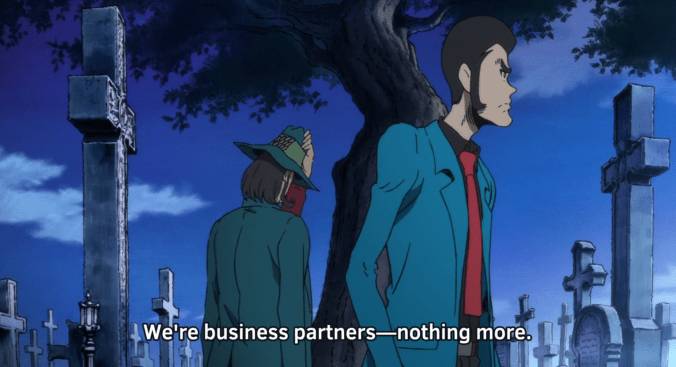
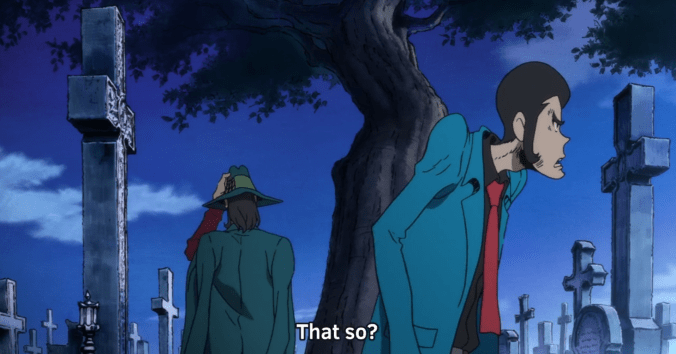
In the first film, Jigen’s Gravestone, Lupin the 3rd and Jigen Daisuke are a team of a thief and a sharpshooter – however, they are not yet the “best friends” they will grow into, they are only business partners at this point. But it soon turns out that the two are being trailed by a dangerous sniper, Okuzaki, who is set out to kill them – he already has prepared their graves for them to see: The titular gravestones. Jigen is not ok with this, as this sniper has also recently killed a client Jigen swore to protect. And so, the hunt and battle between the two begins.
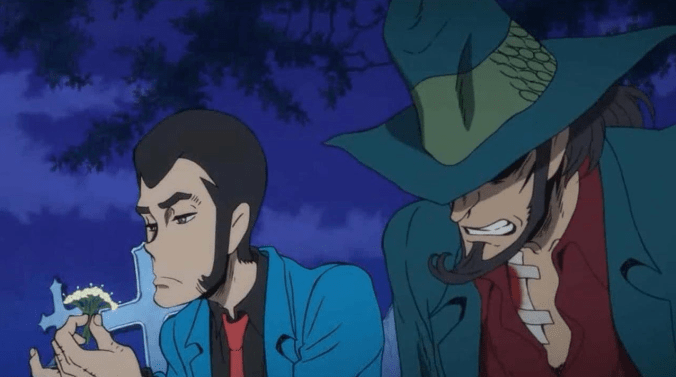
Jigen is upset, but Lupin is rather calm about getting a death threat.
In the second film, Goemon’s Spray of Blood, the two heroes Lupin and Jigen meet Goemon, a samurai they have seen a few times around. Goemon is the body guard of a yakuza boss, but as he fails to protect him, the clan turns against him. Not only that, Goemon’s spirit will be broken by the assassin of his former boss, a man called Hawk, a big, bearish unit of a lad who fights with heavy dual-wielding axes. This is the story of how Goemon joins the Lupin team and how he became what is today: one of the best samurai in the world.

Goemon vs. Hawk. This won’t go well.
As these films are quite short, about 50 minutes long each, I do not wish to talk too much about the plot of these. The are essentially introduction films, one for Jigen and his friendship to Lupin, and the other one as a character piece for Goemon, all held neatly together by the charming ensemble cast of the Lupin III franchise and charismatic villains they need to fight.
The big center pieces of the two films are the two main conflicts: Jigen vs. Okuzaki and Goemon vs. Hawk. And let me tell you that these are absolutely worth it – battles of strength, mentally and physically, but also of wit, observation and skill.
These are some of the more serious Lupin III entries, far away from the current jolly TV adaptations of Part IV and V. All of the fun aspects are still there, the car chases, the banter and the fights – however, they are all presented through a lens of hardboiled intensity. Meaning, if characters get hurt, they get hurt. It’s violent. Some of the most violent I have ever seen in the animated medium, and I like watching hyperviolent OVAs from the 80’s.

This is tame.
If you say: “But I can deal with splatter, no problem!”, then I will warn you of some of the body horror that swords, blades and guns can produce. You will definitely do your sharp air inhale of “Oooouh, that must’ve hurt.“
And it’s this hardboiled intensity that is so strong and refreshing. It’s not trying to be “edgy” or deliberately over the top, it’s a whole new adaptation that paints the Lupin III franchise in the colours it always had if one thinks about it: Theft, murder, yakuza, gunmen, samurai, and the general underworld. The darker tone fits like a glove. It wants to be that, and it is exactly that.
But more than that, Koike finds the perfect balance between the fun action segments and heavier dramatic scenes, never feeling like a tonal break or betrayal of itself or the source material. These characters suffer, fight and grow, battle their fears and rivals, and in the end, you will be immensely satisfied.
Goemon’s Spray of Blood was such an adrenaline ride for me, that I watched the whole film with a smile, alternating between laughter at outlandish action scenes and quick comedy bits, and being in awe of the violence and intensity of the fights that carry importance to the characters and the overall story.
In addition, Takeshi Koike’s signature character design and artwork with thicker outlines than usual just fits perfectly to the Lupin III franchise. It is safe to say that the cast has rarely looked so suave.
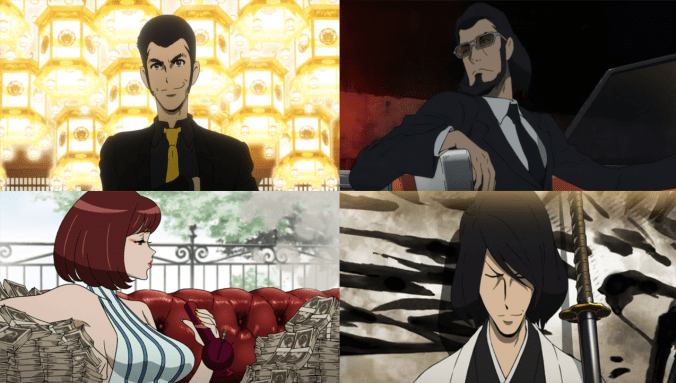
Especially in “Goemon’s Spray of Blood”, with its yakuza setting.
Every character is animated extraordinarily well, not only in the big set-pieces, but also in dialogue scenes and small movements. Let’s take the scene I showed you a still frame earlier, the first round of Goemon vs. Hawk – katana against axe, samurai against biker, on an exploding ship, while Lupin, Jigen and Fujiko get away on a boat.
This is only the beginning. (Source: Goemon’s Spray of Blood)
The gigantic flames in the background, the water animation, the debris of flying roof tiles, the heaviness of Hawk, Goemon putting his sword away, the wind flying through his hair – there is so much love and care poured into film, from the big scenes, all the way into these tiny details.
Everything comes together perfectly, Koike’s style, animation, tone, action and drama, even the soundtrack, which, for example, gives gunslinger Jigen a James Bond style opening credits theme – I’m sure you will find something that especially stands out for you in these marvelous films.
Conclusion
I highly recommend watching Takeshi Koike’s two Lupin III films, Jigen’s Gravestone and Goemon’s Spray of Blood, purely because they are such fun, intense and wonderful productions, that ooze style and power in every second they are on screen. You can go in blind, or maybe check out another Lupin III adaptation that catches your interest, many start with Castle of Cagliostro, for example, for the taste of a young and fresh pre-Ghibli Hayao Miyazaki.
In the end, you will have a marvellous duo of films by one of the best directors in the industry. Two films that belong together, which also describe how one of the most beautiful friendships in the medium came to be. Lupin and Jigen – a friendship that has now existed for over 50 years.
And that alone is absolutely beautiful.


The End.
Sources: Sakugabooru, Wikipedia entry “Lupin III: Jigen’s Gravestone“, MyAnimelist, Anime News Network
 Elena DS