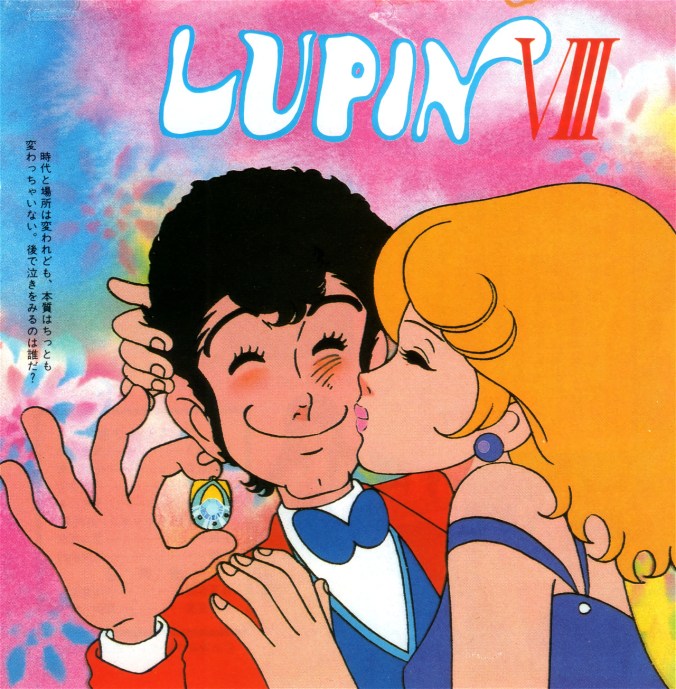
The Lupin III franchise is now celebrating its 50th anniversary, with countless entries and works over many years. While I covered a few of my favourite works already, it is interesting to look not only look at the beloved, but also at the ones that are overlooked.
Or in this specific case, the ones that never made it to the public. Not every entry can be successful in this fast world of entertainment, and some get outright cancelled before they see the light of day. Such as this little pilot episode to a new series called Lupin VIII in 1982.
Let’s take a look at this unusual pilot and what lead to its early cancellation.
Lupin VIII, “Arsène & Company” in French.
Story and Changes
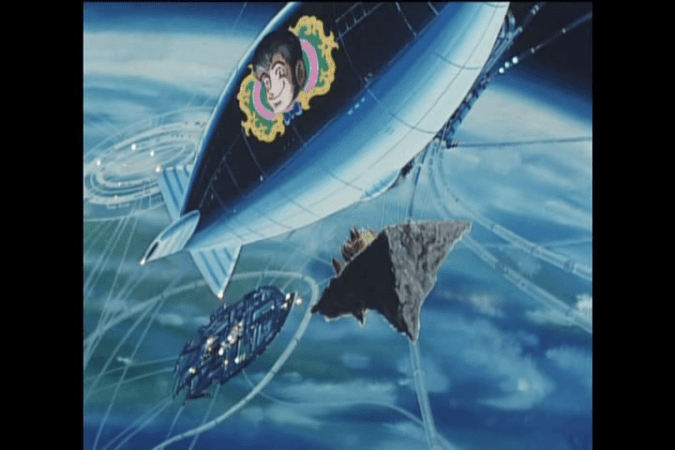
Lupin VIII takes place in the far future, space travel is a day-to-day occurrence and Earth’s orbit is full of space stations, galactic highways and private rockets, big and small.
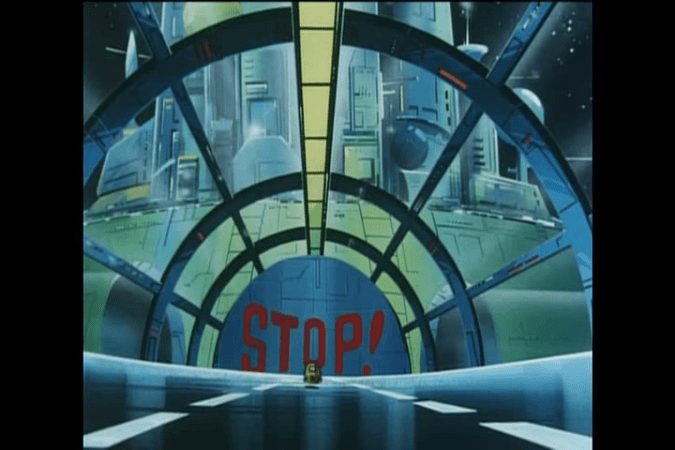
Lovingly designed backgrounds that establish the world in the intro.
Inmidst all of these flies a space ship in the shape of a zeppelin – it’s the office of freelance detective Lupin VIII. Together with his friends Jigen The Fifth and Goemon XVIII, they solve mysteries for many clients. Love interest Fujiko Mine (no extra number given) is also around, but having her own adventures that intersect with the other main characters coincidentally.
In this pilot, a little girl comes to visit the detective agency of Lupin VIII. She has a message in a music box from one of her ancestors to “wake him up” after 100 years. Those 100 years are nearly over, and she doesn’t know what to do about it. Lupin VIII and Jigen V accept the case and go on a mission, which will involve car chases on galactic highways, shootouts, a treasure hidden on the Moon and evil greedy villains to defeat.

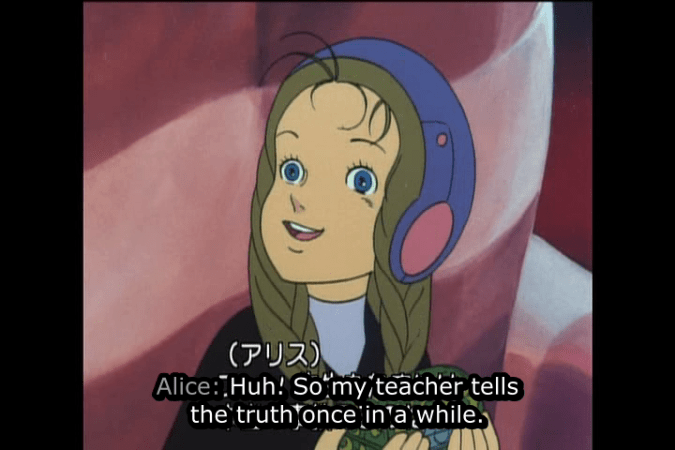
A girl giving them a mission…

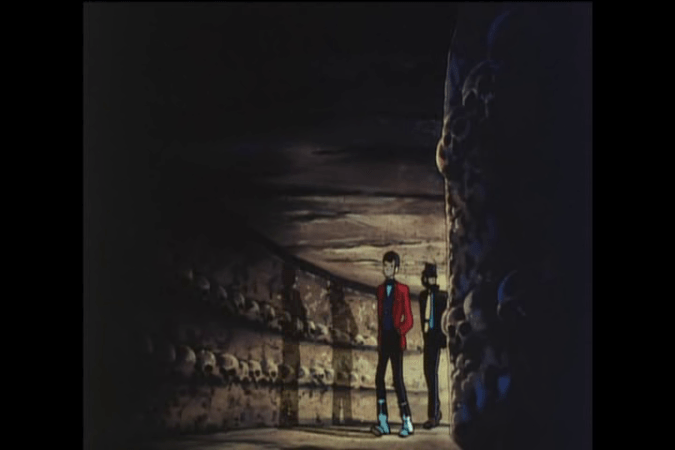
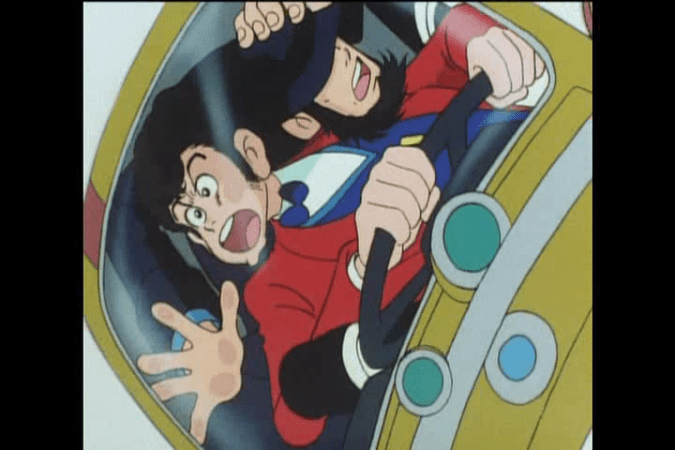

…ends in damp catacombs and with raging robot sharks.
If one reads this plot outline, it leads to the natural conclusion of “So, it’s Lupin III in Space?”, and while that is largely true, the amount of minor changes add up to quite a significant deviation from the original series’ topics and feeling.
Lupin VIII was supposed to be a kid’s show, and hence, it couldn’t have a “thief” as a main character – stealing is illegal, so a good example needs to be set – protagonist Lupin VIII is a detective now.
In addition, weapons and tobacco are also taboo. This means that both Lupin and Jigen swap their signature pistol and revolver for laser guns, and Goemon receives a lightsaber. This decision is fine, as it fits with the given sci-fi setting, but it also means that Jigen Daisuke (who is normally seen smoking) has a lollipop 24/7.
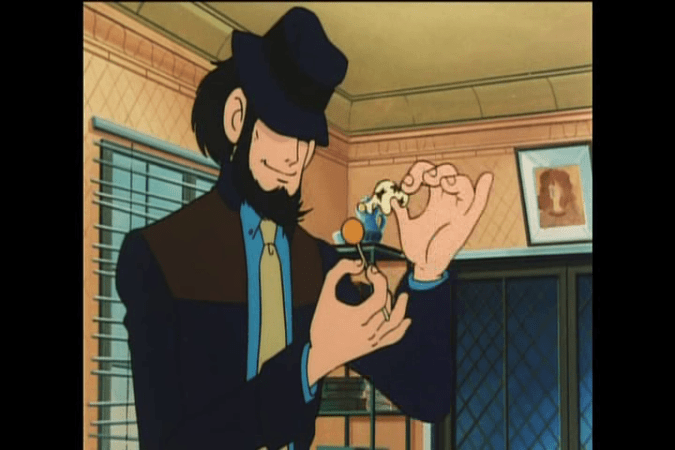
The change from “thief” to “detective” poses another problem if one thinks of the original cast: What does Zenigata, Lupin’s adversary, do now? Lupin VIII is not a criminal, he follows a normal job.
Here is the kicker: Zenigata still thinks Lupin VIII is worth suspecting, and that one day he might show his “true colours”. Convinced that he is the descendant of many criminals from several generations ago, he certainly must be up to no good.
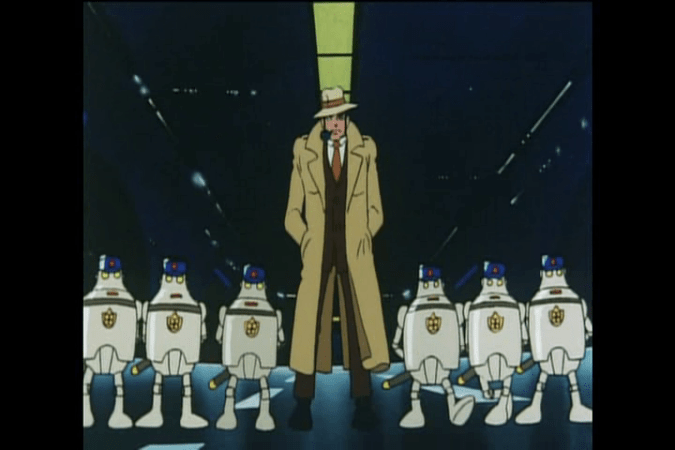
His little robo police is very adorable, though. (And the pipe is a communicator!)
This fact is played for laughs (with Lupin VIII flatly saying that this outlook is “Good for him” to have), it feels a bit out of place for Zenigata, a capable police inspector, to have someone under general suspicion purely for their ancestry.
To have the cast look exactly the same (just add five generations as a number and you’re done) feels like a concept held back by its own self. Instead of creating its own character design, it simply repeats the classic and censors them for a younger audience.
“Descendants of the Lupin III cast in a sci-fi future” could be a very interesting visual design to tackle, but some decisions feel a bit out of place – such as Goemon’s space suit being futuristic samurai armour. It makes sense as an idea, but the armour is not giving him the visual finesse and elegance he normally has and that is part of his character. But it is positively goofy and grand, and thus very fitting for a kid’s show!


Not his usual sleek self, but still as cool.
So, a few elements are changed, giving this pilot its own visual identity and feel, why was that?
An International Production
Lupin VIII was a French-Japanese production, collaborating with DiC Entertainment, who are known to many as the creators of the Inspector Gadget animated series, as well as co-productions with US studios on series such as Sonic The Hedgehog and Captain N. As a studio that mainly produced kid’s shows, it was only logical to make their Lupin VIII also one.
This international creative process may explain some of the character designs by Shingo Araki, who also did the designs for Part III (Pink Jacket Lupin) from 1984-1985. His character designs in Lupin VIII, especially his Fujiko Mine, feel more oriented towards a “80’s Western Animation” aesthetic. Fujiko especially reminded me personally of Jem and the Holograms (which is also a Japanese co-production!) or Michel Vaillant, if we compare her directly to her Part III contemporary.
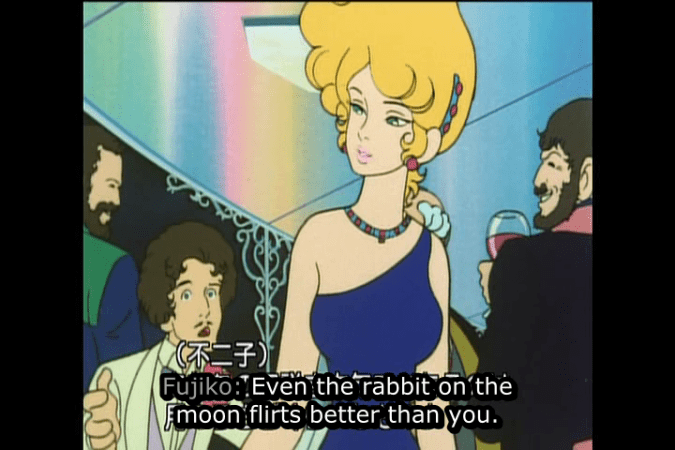
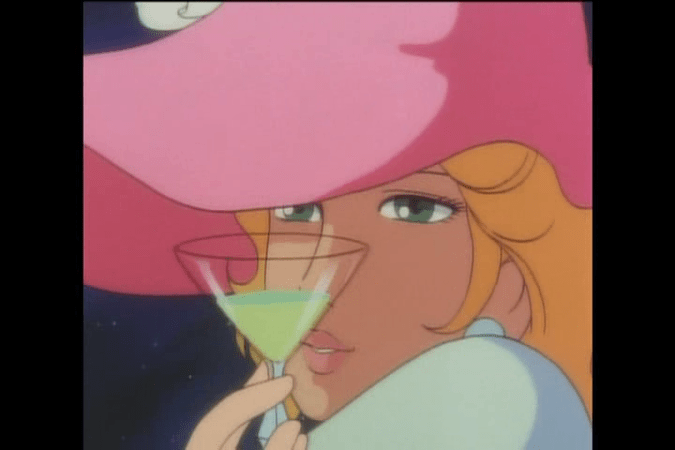
To compare: Fujiko Mine in “Lupin VIII” in 1982…
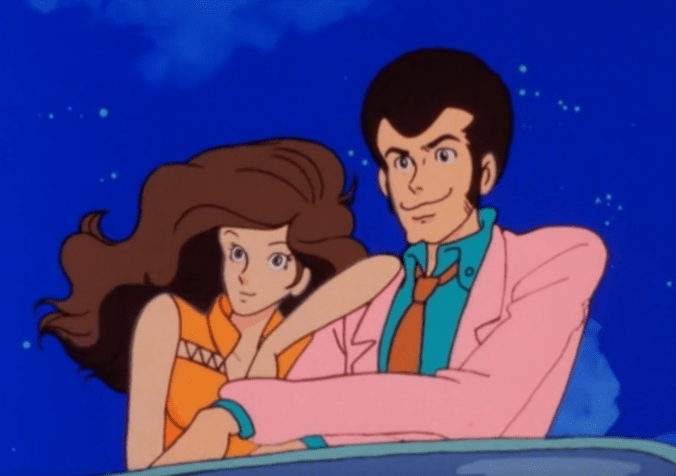
…and Fujiko Mine in “Lupin Part III” in 1984. Same character designer, different feel.
Why was it cancelled?
Lupin VIII was cancelled not due to its content, but due to the use of the name: Lupin VIII / Arsene & Company. The heir of the original author, Maurice Leblanc, who wrote the Arsène Lupin novels in 1905, did not give his permission for this anime, and thus, the project was doomed to fail – production was cancelled before the pilot could be finished.
Regarding the production and checking available sources, it seems like 6 episodes were planned, 2 were scripted, and only 1 episode made it to a near-finished stage. Some sources credit Rintaro as the director of this pilot, an acclaimed veteran who has worked on many anime such as Astro Boy, Space Pirate Captain Harlock and Metropolis, but no bullet-proof confirmation is given.
Should you by this point have checked out the pilot for yourself, you will notice a sad fact: there is no voice acting. Music and sound effects are present (and are nice!), but the dialogue only exists in subtitles. It never got to the production stage of “recording voice actors”. Unfortunately, these subtitles were hardsubbed [i.e. burned] into the visuals, so I apologise for those in the screenshots.
This pilot, in its mute and unfinished form, was released in the 2012 Lupin III Master File box set, as a relic and an inside look into a project that could have been lost in time entirely, and thankfully has survived.
Conclusion
All in all, Lupin VIII really is an interesting glance at a thing that never was – but also something that maybe wouldn’t have had the critical success as its contemporaries. To make a “Lupin for kids” is a noble goal, and could have been a hit with children – however, as a personal opinion, it would have been a better decision to do a “Lupin for everyone”, such as Hayao Miyazaki’s Castle of Cagliostro or Masayuki Ōzeki’s The Fuma Conspiracy, which can be enjoyed by the whole family as fun and action-packed adventures without the need to censor any original element. It also could have been its own thing with brand-new character design ideas, not held back by the legacy and influence of the original Lupin III.
However, one should not think too much about the “what ifs” and “should haves” of life, but rather see what is present. And so, we have Lupin VIII, a pilot for a show that never got the chance to prove itself – but that was nonetheless a brave attempt and beautifully crafted in its world design and animation, with a unique mix of French and Japanese art and aesthetic. I sincerely hope that we may get another attempt one day, as the idea of “Lupin III in Space” with rocket ships, orbital highways, robo police and lightsabers is too good to miss.
The End.
Sources: “Lupin VIII” entries on AnimeNewsNetwork, Lupin III Encyclopedia, Wikipedia. DiC Entertainment Wikipedia Article, in French and English.



 Elena DS